In the Netherlands, it is taken for granted: strawberries are propagated vegetatively, via runners. The system is familiar, proven, and deeply embedded in the practice of growers. But in many other countries, growing strawberries from seed is already perfectly normal. Outside our borders, people sometimes look with astonishment at the Dutch attachment to the traditional cuttings. And that astonishment is not unwarranted.
Seed propagation: What makes it different?
More and more Dutch breeding companies, such as ABZ Seeds and Limgroup, are focusing on the development of F1 hybrid strawberry varieties propagated by seed. A unique concept worldwide. And the advantages are considerable.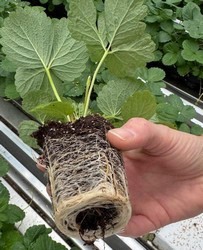 © Horti-Consult International
To begin with: plant quality. Plants grown from seed are healthier and more vigorous. They are cleaner — free from diseases or pests that can be carried over through vegetative material. This translates directly into better resilience and reduced need for chemical crop protection. For growers working towards a more sustainable business model, this is not a minor detail, but a structural advantage.
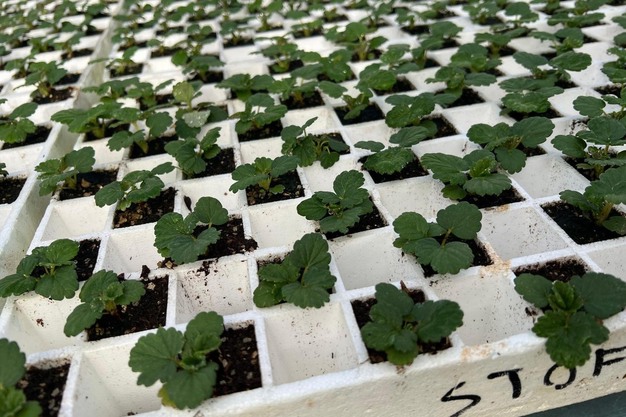
Another practical advantage that is often underestimated is the flexibility that sowing provides. With vegetative propagation via cuttings, the grower is tied to the summer — that is the only period when runners are formed and cuttings can be taken. Seed is not subject to such seasonal constraints. A grower working with seed can sow and produce throughout the year, regardless of the season. This provides considerably greater freedom in planning, spreading of labour, and alignment with market demand.
Added to this is the fact that seed propagation requires considerably less land throughout the entire chain — up to 65 to 80 times less than vegetative systems. This is no marginal improvement. It has direct consequences for the use of water, crop protection products, and the overall efficiency of the cultivation system. Less land use also means reduced pressure on scarce agricultural land, a theme that is becoming increasingly relevant in horticulture as well.
Logistics and sustainability
Cold storage of vegetatively propagated plant material requires many times more energy than seed. Furthermore, the transport of seed has a significantly lower CO₂ footprint than the transport of plants. The logistical chain becomes simpler, less labour-intensive, and more scalable.
And what about the costs?
Of course, cost price remains a relevant factor. Seed propagation involves a longer lead time, and this must be factored in. But when the growing costs at the plant nursery are well managed, seed propagation is economically competitive — and in some cases even more cost-effective. A thorough analysis is worthwhile to seriously consider whether switching to this different method of cultivation makes sense.
 © Horti-Consult International
Not a replacement, but a serious choice
This is not an argument for discarding vegetative propagation altogether. Both methods have their place and their value. But seed propagation deserves a more prominent position in the strategic considerations of the modern strawberry grower. Not as an emergency solution or experiment — but as a mature alternative that meets the demands of a more sustainable and efficient sector.
The real question, therefore, is not seed or tops. The real question is whether we are willing to critically examine a familiar habit — and determine, based on facts, which method delivers the most value. In greenhouse horticulture, we are accustomed to doing this with climate, crop balance, and growing strategy. It is time to turn that same gaze towards the foundation of cultivation: the plant with which it all begins.
For more information:
Horti-Consult International
[email protected]
www.horti-consult.nl