As demand for premium blueberries and raspberries rises in India, protected cultivation is becoming more prominent in commercial production. According to Dr Bharat Bhojane of Cal Pacific Agri Solutions Pvt. Ltd., commercial success today depends on climate precision, appropriate varietal strategy, and strong financial planning.
He reports that controlled environments support improvements in fruit size, firmness, sugar accumulation, and yield uniformity. Irrigation and fertigation systems are also used to optimise nutrient delivery and water-use efficiency.
Beyond irrigation scheduling, commercial growers are increasingly monitoring temperature, relative humidity (RH), light intensity, and Vapour Pressure Deficit (VPD), all of which influence plant physiology and fruit quality. "Greenhouse systems may integrate RH and temperature sensors, Lux and PAR monitoring, and VPD management to regulate transpiration and reduce plant stress."
"Because blueberries and raspberries are sensitive to pH levels and waterlogging, many projects now use substrate-based cultivation systems to improve drainage and root-zone control," he shares. Data-driven management of climate, irrigation, and nutrition is seen as a way to improve consistency and yield predictability.
 © Cal Pacific Agri Solutions
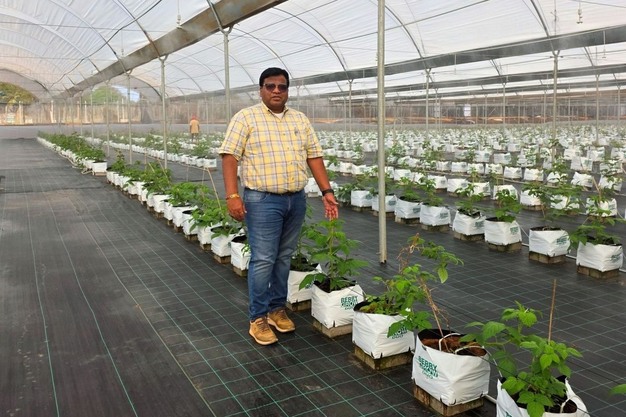
Dr. Bharat Bhojane, Director of Cal Pacific Agri Solutions, recently visited Dhanuka Farms, Hyderabad, where newly planted premium blueberry and raspberry cultivars are receiving ongoing agronomic support to ensure healthy establishment and long-term productivity
Expanding production geography
Berry cultivation in India has expanded beyond traditional temperate zones with the introduction of low-chill and zero-chill varieties.
"For subtropical and tropical regions, low- to zero-chill genetics are essential. They make commercial blueberry and raspberry cultivation viable across wider geographies," Dr Bhojane notes.
Market alignment remains critical. Varieties producing blueberries above 16 mm are preferred in fresh markets due to stronger consumer acceptance and higher price realisation.
Structured project implementation
Cal Pacific Agri Solutions Pvt. Ltd., in association with EMCO CAL, provides turnkey support for berry cultivation projects. Services include techno-commercial feasibility assessment, site selection, protected structure planning, substrate selection, irrigation and fertigation design, varietal guidance, nutrition scheduling, integrated pest and disease management (IPM), and post-harvest advisory support.
Standard operating procedures (SOPs) for greenhouse management, pruning, flowering, harvesting, and pest control are part of structured implementation. Ongoing technical monitoring is aimed at supporting crop performance throughout the production cycle.
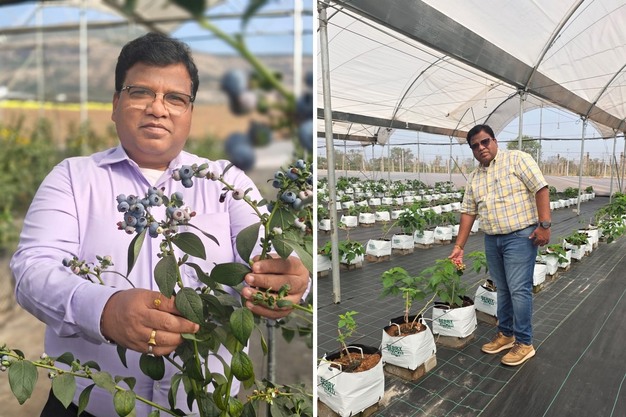
Recently, the company's director visited Dhanuka Farms in Hyderabad, where blueberry and raspberry cultivars supplied by the company have been planted under protected conditions. Following plantation completion, agronomic consultation is being provided to support crop establishment and early plant development. The project reflects a broader trend toward larger-scale, technology-driven berry initiatives.
 © Cal Pacific Agri Solutions
Investment and operational considerations
Dr Bhojane notes that large-scale berry cultivation requires careful evaluation before investment. "Water quality (pH and electrical conductivity), labour availability, regional climate stability, and access to cold-chain infrastructure are key operational factors."
Techno-commercial feasibility assessments typically include analysis of capital expenditure for protected structures, substrates, automation systems, and planting material, alongside projections of operating costs, expected yields, and market price variability.
He emphasises that agronomy and financial modelling need to be aligned from the outset for long-term viability.
Quality and post-harvest management
For premium retail markets, fruit quality is increasingly evaluated through precise physiological and biochemical parameters that influence both consumer preference and price. "Uniform berry size, optimal firmness, consistent colour development, retention of the natural bloom in blueberries, and high Brix levels are key indicators of market acceptance."
Post-harvest management focuses on minimising mechanical stress during harvest, rapid precooling to slow metabolic activity, and maintaining a stable cold chain to preserve shelf life and visual appeal. By achieving consistent grading, low residue levels, and reliable quality, growers can now compete effectively with other premium berry growers in domestic and high-end retail segments.
With organised retail expansion and consumer awareness increasing, he expects demand for consistent, high-quality berries to grow over the next five to ten years. "Protected cultivation systems equipped with climate monitoring and automation are likely to play an expanding role in India's commercial berry production landscape."
For more information:
Cal Pacific Agri Solutions
Dr Bharat Bhojane, Director
+91 98 22 098 103
[email protected]
www.calpacificagri.com