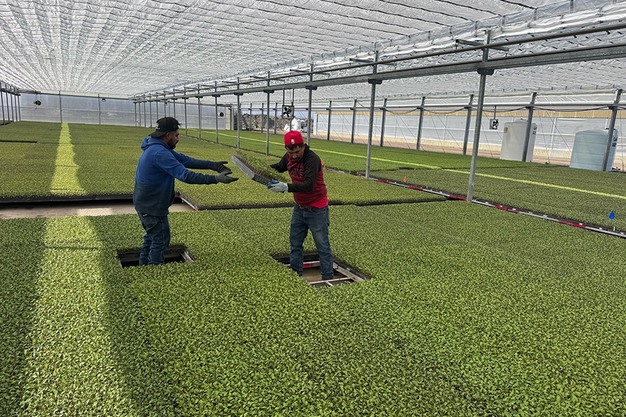
California's vegetable supply chain relies on greenhouse transplant nurseries to accelerate production, reduce field time by up to 60 days and deliver earlier, more uniform harvests. By shifting germination and early growth to controlled environments, growers benefit from improved stand establishment, lower seed waste and reduced labor inputs.
The Vegetable Transplant Nursery Association represents 18 member nurseries producing 8.7 billion plants annually across 30 million square feet of greenhouse space. The association has established minimum germination standards by crop—95% for lettuce and 90% for tomatoes and cole crops—creating clear quality benchmarks for the sector.
 © Westside Transplant
Seed quality is the primary driver of greenhouse efficiency and cost control. Advances in breeding, priming and pelleting have improved vigor, uniformity and disease resistance, with high-performing lots approaching 100% germination; conversely, lower germination rates increase production costs exponentially.
As the industry matures, VTNA is advancing best management practices, pathogen protocols and regulatory clarity for greenhouse transplant operations. Coupled with increased transplanting automation, the sector continues to strengthen its role as a high-efficiency component of modern vegetable production.
Source: www.agalert.com