Efficient water management is one of the biggest challenges in modern agriculture, especially when it comes to crops such as strawberries in hydroponic greenhouses. If you are a producer or technical manager of a greenhouse, you are probably already familiar with the importance of controlling water consumption to improve profitability and reduce operating costs.
Water savings depend not only on the type of irrigation you use, but also on the design of the growing system. In this article, we will explore how gutter and Spacer solutions can help you optimise water efficiency in your strawberry crop, significantly reducing water consumption.
 © JH Hydroponic Systems S.L.
Why water conservation is key in hydroponic strawberry cultivation
Water scarcity is one of the biggest concerns for farmers around the world, and strawberry cultivation is no different. Hydroponic systems, although more efficient than traditional ones, still depend on proper irrigation and drainage control to ensure sustainable water use.
Despite technological advances in irrigation, adjusting irrigation is not always enough to significantly reduce water consumption. While the amount of water applied is crucial, the design of the growing system plays a key role.
Systems without proper drainage control, or those that do not allow for proper root oxygenation, can lead to waterlogging and water loss, even with efficient irrigation.
Therefore, the design of the system has a direct relationship with water consumption. The correct implementation of systems such as gutters and Spacers not only allows for better drainage, but also facilitates water recirculation, minimising waste.
These types of solutions are key to maximising water efficiency in hydroponic strawberry cultivation, especially in a context where pressure on water resources is increasing.
There are several interrelated factors that directly influence the amount of water used and, ultimately, the water efficiency of the system.
Drainage, invisible losses and recirculation
One of the biggest challenges in hydroponics is proper drainage. If drainage is not managed correctly, water passing through the system can be lost without being used, increasing total consumption.
Excessive drainage can occur due to inefficient gutter system design or lack of recirculation, leading to the loss of nutrients and water that could have been reused. Implementing a controlled drainage system, such as that provided by the Spacer gutter, helps to recycle water and reduce these invisible losses.
Substrate management and drainage accumulation
Substrate management has a direct impact on the amount of water that plants can absorb. Poorly managed substrate can accumulate excess water, promoting waterlogging, which can waste water and damage roots.
A well-designed growing system allows for better control of substrate moisture, preventing unnecessary drainage accumulation and improving water retention capacity without affecting root oxygenation.
Influence of system design on water efficiency
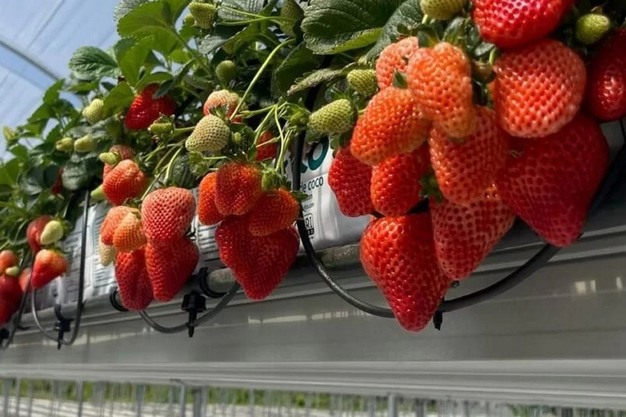
The design of the growing system has a direct influence on how water is distributed and used. An elevated gutter system with Spacer allows for better water circulation and ensures that plants have access to water and nutrients without wasting resources.
Controlled separation between the substrate and drainage also facilitates greater recirculation efficiency, reducing overall water consumption while maintaining a healthy system.
Gutter and Spacer: how system design influences water savings
When analysing water consumption in a hydroponic system, it is common to focus on irrigation. However, in practice, the physical design of the system has an equal or even greater impact on water efficiency. The combination of gutter and Spacer allows for better control of the water flow, from application to drainage, reducing losses and improving system stability.
Crop separation and drainage control
One of the key aspects of water saving is effective separation between the substrate and drainage. When the crop rests directly on the gutter without an element to raise and separate the substrate, drainage tends to accumulate and flow out in an uncontrolled manner.
The use of Spacers keeps the substrate elevated, promoting more uniform and predictable drainage. In this way, water that is not absorbed by the plant is evacuated in a controlled manner, facilitating its management and reducing unnecessary losses.
Root oxygenation and irrigation stability
Proper drainage not only influences the amount of water used, but also root oxygenation. When excess water remains in contact with the substrate, the available oxygen is reduced and the system becomes more unstable. This often results in constant irrigation adjustments to correct stress symptoms, increasing total water consumption.
Maintaining a clear separation between the substrate and the bottom of the gutter creates a more balanced root environment. The roots receive water and oxygen more consistently, allowing for more stable and precise irrigation strategies, avoiding excessive applications.
Why avoiding waterlogging reduces water consumption
Waterlogging is one of the main causes of inefficient water use in hydroponics. Although it is not always visible, it generates a chain reaction: poorer oxygenation, less active roots and irregular absorption. As a result, there is a tendency to increase the frequency or volume of irrigation to compensate, raising consumption without actually improving the condition of the crop.
A well-designed system that prevents water accumulation in the root zone allows each irrigation to be more effective. By improving absorption and reducing losses due to uncontrolled drainage, water savings are a direct result of the design, not a forced reduction in irrigation.
How to estimate the water saving potential of your strawberry crop
Estimating water savings in a hydroponic strawberry crop does not have to be a complicated process, but it does require taking several key variables into account.
Below, we explain what factors you should consider in order to make a reliable estimate of savings, comparing the differences between conventional systems and more optimised solutions such as the Spacer gutter.
To obtain an accurate estimate of water savings, it is necessary to evaluate several key factors in your growing system. These parameters will directly influence the calculation of consumption and, therefore, the potential for savings:
Type of system
The type of system you use greatly influences water consumption. Conventional drip irrigation systems or non-optimised systems often suffer from water loss through evaporation or uncontrolled drainage. In contrast, a gutter system with Spacers facilitates controlled drainage and recirculation, optimising water use by reducing losses.
Number of plants
The number of plants per square metre is crucial for calculating water consumption. The higher the plant density, the greater the irrigation demand. However, the use of an elevated system with gutters and Spacers increases water use efficiency, allowing better use of every drop, even in high-density crops.
Current drainage
Inadequate drainage can be one of the main sources of water waste. If your system is not well designed to control drainage, you are likely to lose a considerable amount of water that does not reach the roots. Gutter systems with Spacers allow for efficient drainage, minimising losses and improving water efficiency.
Crop area
The area available for cultivation also has a significant impact on water consumption. The larger the crop area, the greater the amount of water required. However, optimising the system design to make the most of every square metre can generate considerable savings.
Technical comparison: conventional systems vs. gutter with Spacer
To illustrate the difference in water consumption, it is useful to compare two typical systems: one conventional and one with gutter and Spacer. In a conventional drip irrigation system, water loss due to accumulation in the substrate and evaporation is common. Even if irrigation is adjusted to the needs of the plants, uncontrolled drainage causes a large amount of water to be wasted.
On the other hand, the gutter system with Spacer efficiently controls drainage and allows water to be recirculated, reducing the amount of water used in each cycle. Thanks to this improvement in drainage, water that is not absorbed by the plants can be recovered and reused, generating real savings in total consumption.
What kind of savings can be expected depending on the system design
Water savings depend directly on how the growing system is designed. In conventional systems, savings may be limited due to the constant need to adjust irrigation to compensate for excessive drainage and evaporation losses. When the design improves drainage control and root stability, it is possible to significantly reduce water consumption, always depending on the specific conditions of each greenhouse.
Results will vary depending on the efficiency of the recirculation system, controlled drainage capacity and plant density.
By optimising the system with gutters and Spacers, water savings are likely to increase, as these systems allow for more precise and controlled irrigation, avoiding waste and improving water efficiency throughout the entire growing cycle.
Make technical decisions based on real data
Optimising water consumption in hydroponic strawberry cultivation is a crucial step towards improving efficiency, reducing costs and contributing to sustainability. However, each greenhouse has unique characteristics, and decisions must be made based on specific data, not general assumptions.
For more information:
Hydroponic Systems
Email: [email protected]
https://hydroponicsystems.eu/