Tomra Food, through the acquisition of BBC Technologies have been in the blueberry sorting business for over 20 years. Ten years after launching the first blueberry lane grader, they have taken the next step with the 5S Blueberry – Spectrim with LUCAi.
"We've had a lot of experience in seeing how the industry has evolved," said Troy Cleaver, Senior Project Product Manager at Tomra Food. "Ten years ago, we introduced the first lane grader for blueberries, the KATO 260. This new project really built on everything we have learned from our customers in those ten years, and it is that feedback we have taken and applied to the 5S Blueberry optical grader."
As for the features of the new sorter, Troy explained that it is not one big thing but a thousand little things. "We've gone through every step of the process. When handling blueberries, you must be very delicate; it is important to retain the bloom on the fruit, which is very easily removed by bouncing, scraping, and rolling. So, everything along the line was considered."
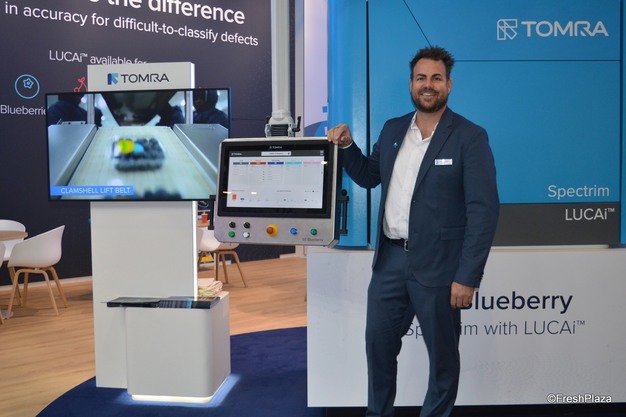 © Nichola McGregor | HortiDaily.com
Challenges in the blueberry sector
New varieties, bigger berries, and new challenges in logistics are all things Tomra had to consider when developing the new grading line.
"AI plays a huge part in our development, in 2018 we introduced LUCAi, the world's first deep learning system for fresh blueberries. Since that time, Tomra has expanded our knowledge and toolkit, utilizing deep learning. Severity tuning gives growers the control to decide the most appropriate value stream for fruit to be in; this is not just a prerequisite for a consistent food supply and food safety but also provides a consistent eating experience and marketability for consumers.
"The challenge with blueberries is they're not very spherical, so handling can be tricky. We need to rotate them in order to see all their sides so we can accurately size them, but the bigger they get, the more oblate they get. Blueberries have one of the biggest size ranges of any of the small fruits. We still see markets for 10-millimetre blueberries, but we're now seeing berries up to 40 millimetres. Capacity is also a big thing; people want to go faster, but we didn't want to go faster without making sure we were handling the berries better. Another difference in the industry is that blueberries used to be seasonal; they would run for six or eight weeks, but that's continually changed. Packing facilities now run all year round; they're importing fruit from everywhere, so the machine needs to be more robust to last all year round and run without stopping."
The 5S Blueberry optical sorter has a patented design on the transfer cushion. This stabilises the berries when they are being singulated before they go onto a roller, where their rotation can be controlled. That process can be quite unstable, and the traditional way to solve that would be to add more drops and more transitions, which are two things that are bad for the blueberries and can make the machine very large and take up additional space in the packhouse. The new design mitigates that, and it absorbs that energy without damaging the fruit.
"We work with a combination of visual and infrared inspection, looking at a number of different attributes, and then we use a combination of the traditional algorithms for values like sizing, but also deep learning for more complex defects. So, we look at many different aspects of the berry."
Future proofing
New varieties are being developed all the time, bringing with them new challenges, so Tomra has tried to create a platform that will be future-proof. The company introduced the Kato 260 ten years ago and had really great success with it. They have over 250 machines in the world, with over 3000 lanes, which means many existing customers and new ones coming along all the time. For their existing customers, they wanted to make sure the 5S Blueberry would fit into those existing packing facilities. One of the advantages is that the footprint of the machine is quite small for its capacity, and Tomra didn't want to lose that.
"The 5S Blueberry is the realization of everything we learned in ten years with the most successful lane grader in the blueberry industry. We broke a lot of new ground back in 2016, so that gave us a tremendous foundation. With machines in over 20 countries around the world, we got a comprehensive look at the challenges growers face and how that has evolved. It is our customers who have provided the feedback on which we based our innovation.
"This is not a "one off" list of demands, but a conversation that continues; we are building a platform growers can invest in that will continue to evolve as they face new and evolving challenges."
For more information:
Duncan Griffiths
Tomra
Tel: +353 87 1990016
Email: [email protected]
www.tomra.com