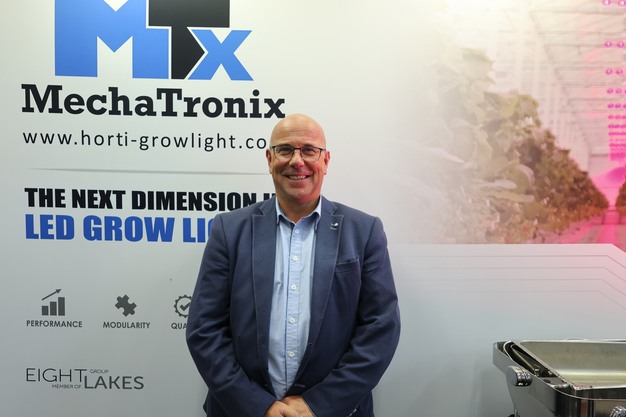
Expectations that the European greenhouse market would slow down have proven wrong. Instead, demand for lit greenhouses is accelerating, according to Koen Vangorp, CEO of MechaTronix. "We originally thought the EU market would cool down. What we see now is the opposite," he says, noting that growth is steep enough to justify major manufacturing investments.
 © MechaTronix
From hybrid to fully lit
A key driver is the ongoing transition from hybrid to fully lit greenhouses. Many vegetable growers had only partially adopted LED lighting, particularly in the Benelux region. Early projects often combined lit and unlit sections, but this model is increasingly being phased out. The shift is largely operational. Partial lighting leads to staggered production and fluctuating labor needs, forcing growers to hire extra staff in winter and reduce workforce later. "With a fully lit greenhouse, growers can retain the full workforce year round," Koen explains, making training and operational continuity easier.
Economics also plays a role. Hybrid systems add complexity while still exposing growers to energy price volatility. Fully switching to LED simplifies planning, as growers manage one consistent cultivation strategy rather than parallel systems.
 © MechaTronix
Fending off pathogens
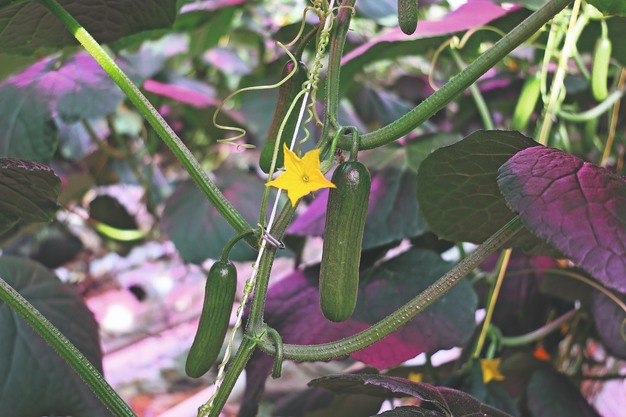
Disease pressure is another decisive factor. Viruses such as ToBRFV in tomato and cucumber production have made hygiene protocols more critical. In mixed-light facilities, cleaning cycles become fragmented. "If one part is lit and another is not, you never fully clean the facility at once," Koen says. Concentrating production in a fully lit site allows synchronized cleaning, disinfection, and crop cycles, turning lighting investments into a form of risk management.
In floriculture, motivations differ. Around 60% of MechaTronix's activity is in vegetables and 40% in flowers. Recent investments in the Dutch flower sector, particularly in chrysanthemums, are driven more by strong economic performance than by disease or labor concerns. "We see fully new greenhouse projects being built from scratch," Koen notes.
Retail trends and climate instability are also fueling investment. Large retailers increasingly prioritize local produce, consistent quality, and supply stability. Southern European production has become less predictable due to extreme weather, making controlled environment agriculture in Northern and Central Europe strategically more important. "Retailers value not just proximity, but the ability to deliver uniform quality week after week."
Energy costs are reshaping markets beyond Europe as well. In North America, previously low electricity prices encouraged less efficient lighting, but rising energy costs are pushing growers to reassess their strategies.
 © MechaTronix
The rise of dynamic spectrum
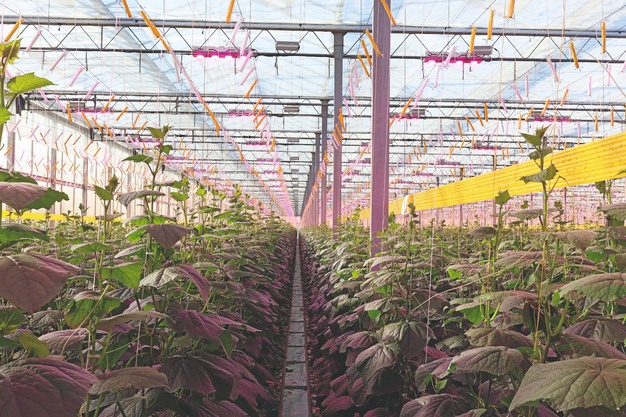
Another major trend is the rise of dynamic spectrum lighting. While often seen as expensive, Koen argues the cost difference with fixed spectrum systems is minimal. At MechaTronix, 95% of sales now involve full dynamic spectrum systems. Subsidies further influence investment decisions, with Dutch growers benefiting from large rebate programs that can cover a significant share of project costs.
Overall, supply instability, stricter retail standards, climate change, and labor challenges are accelerating greenhouse investments, with LED lighting adoption emerging as a clear indicator of the sector's structural shift.
For more information:
MechaTronix Europe NV
Minervum 7139
4817 ZN Breda
Tel: +31 (0)76 790 16 10
[email protected]
www.mechatronix-europe.com