Holdfast & Stipe, founded by Nikki Spil, helps growers make their plants and cut flowers healthier and stronger using the natural power of seaweed, reducing the need for artificial inputs.
"Seaweed was hardly known here in 2017," Nikki says. "We first wanted to make sure the quality was right." What started as an experiment using seaweed as a raw material for building products has since developed into a sustainable innovation within the ornamental horticulture sector, among others. After more than 10 years of research and developing their own production process for seaweed fertilizer, Nikki's company opened its own factory last year and introduced a new name: Holdfast and Stipe, named after the parts of seaweed. "The holdfast is the root, the stipe is the stem."
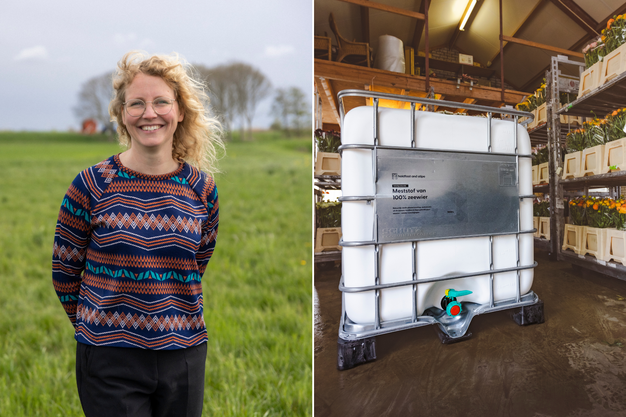 © Marco Vet / Holdfast and Stipe
Nikki Spil
Dominic Burbridge, Commercial Director, joined the company several years ago. "We are not a chemicals company. We want natural solutions to become the norm and the obvious choice for growers. Growers are under pressure to deliver beautiful, strong plants, while remaining efficient and resilient."
Stronger growth without additional chemical inputs
The idea behind Holdfast and Stipe is that seaweed can strengthen plants without requiring growers to rely on additional chemical inputs. "Growers tell us that overfertilization, if you're not careful, can attract pests and diseases. Moreover, chemical inputs are CO₂-intensive and end up in our waterways, which harms nature and the climate. Seaweed strengthens the plant itself, so you don't need to keep adding more," Nikki explains.
Seaweed is not a new product. "It has been used for a long time, for example by organic tulip growers, potato farmers, and in livestock farming for grass," Nikki says. "It may not work for everyone, but it works for most farmers and growers."
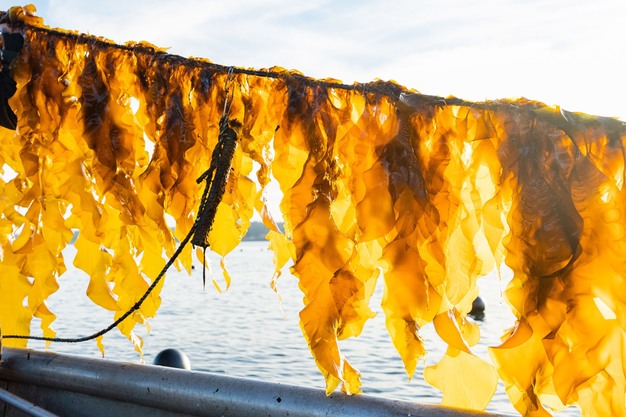
Dominic describes the fertilizer as a stimulant. "Seaweed fertilizer promotes longer root growth and improves nutrient uptake processes within the plant. It contains valuable compounds such as minerals, sugars, proteins, fatty acids and amino acids. We extract these compounds from seaweed in a natural and energy-efficient way and preserve them in a stable, highly concentrated liquid."
According to Dominic, the product works on three levels: it improves nutrient efficiency, stimulates the activity of plant-friendly microbes in the substrate, and strengthens the plant's natural defense mechanisms. "Some of the sugars in seaweed feed beneficial fungi and bacteria, which break down the substrate more efficiently, allowing the plant to access nutrients more easily," he explains.
 © Marco Vet / Holdfast and Stipe
Practical trials with growers
"We keep it practical," Nikki says. "Every company and every growing environment is different. We invest a lot of time and effort in guided testing and implementation together with growers. Data is important, but we are not a laboratory."
Dominic adds: "We see ourselves as facilitators, not as a one-stop shop. Everyone knows change is needed, but too much change at once creates uncertainty. We help growers first improve crop quality."
"Growers may not immediately see a visible difference," Nikki says. "But the results are measurable, and science supports our conviction. For example, in grass trials we saw an 18 percent increase in dry matter yield, with up to 15 percent increases in crude protein and sugar levels. We are now testing these effects, together with partners, in the ornamental sector as well—always tailored to their specific conditions, because every situation is unique."
Easy to apply
The product is liquid and is mainly applied as a foliar spray. "That works best," Dominic says. "But it can also be applied to the soil or used as a bulb dip for bulb growers. It adheres well and stimulates early growth."
The company identifies three types of growers: innovation partners who actively test the product, a group that simply tries it out, and a group that follows developments before adopting it. "All of them help move the conversation forward," Dominic says.
Holdfast and Stipe continues to test the fertilizer extensively in practice with farmers and growers. "We want to understand the real challenges growers face," Nikki concludes. "Whether it is resilience, pest pressure or external requirements. If we can be a small catalyst for change, that is already a success."
Engaging with the sector
Holdfast and Stipe considers ongoing dialogue with the sector essential. The company welcomes personal conversations with growers to discuss trial results and how they can work together on implementation and further sustainability. On April 16, they will organize a small-scale event to discuss these topics. Registration is available via the Holdfast and Stipe website.
For more information:
Holdfast and Stipe 
[email protected]
www.holdfastandstipe.com