Growers are paying closer attention to how structural design choices affect long-term performance. Ceres Greenhouse Solutions will address this in its March 5 Greenhouse Q&A webinar at 12 p.m. MST, where experts Marc Plinke and Josh Holleb will examine how glazing influences light transmission and operational outcomes.
"Glazing is often treated as a construction detail, but it directly affects light transmission, crop productivity, and ultimately financial performance," says Miriam Schaffer of Ceres Greenhouse Solutions. "Operators and investors evaluating new builds or retrofits need to understand how material selection impacts energy use, yield consistency, and operating predictability."
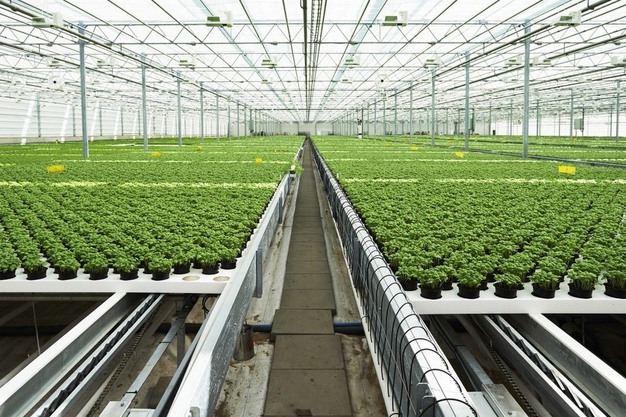
Because greenhouses rely primarily on sunlight, glazing efficiency is central to reducing supplemental lighting demand and stabilizing operating costs.
 © Ceres Greenhouse Solutions
Vertical farming lessons: Technology vs. economics
The renewed focus on greenhouse fundamentals comes as many fully automated indoor farms continue to face financial challenges. While the technology behind vertical farming remains advanced, several operations have struggled under high capital and operating costs.
"Many indoor farms were funded and structured like software startups, but they were producing agricultural commodities," she notes. "Agriculture is constrained by biology, crop cycles, and commodity pricing. It doesn't scale like code."
Heavy investment in robotics and proprietary automation often exceeded what commodity crops could support.
"The value of the crop must justify the complexity of the system used to grow it. If the price ceiling of the product is fixed, no amount of automation changes that reality."
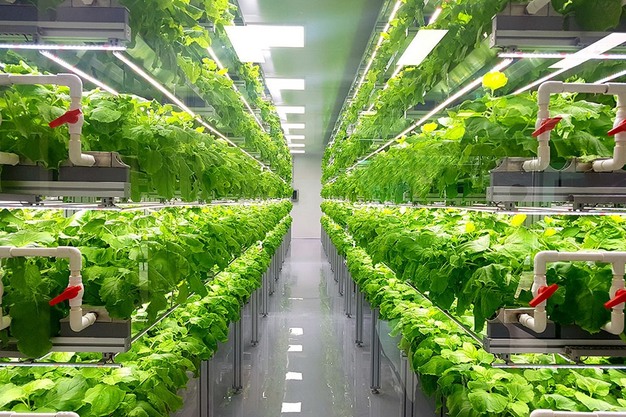
Energy has been a defining pressure point. Fully enclosed facilities must replace sunlight with artificial lighting and depend entirely on mechanical climate systems.
"Energy is one of the defining economic differences between vertical farms and greenhouses. Greenhouses use natural sunlight as the primary energy source. That significantly reduces baseline operating costs and improves long-term predictability."
 © Ceres Greenhouse Solutions
Crop selection and market alignment
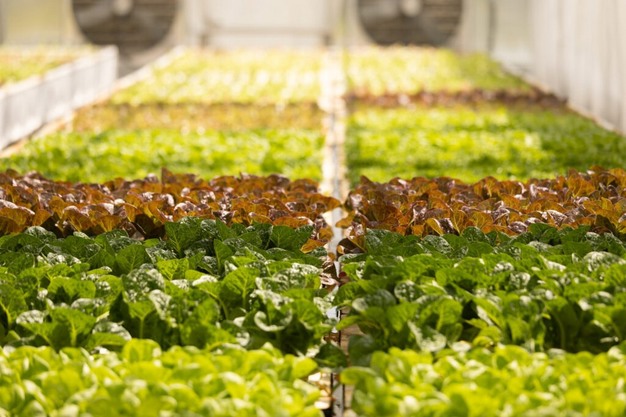
According to her, crop economics remain central to investment viability. Many indoor farms concentrate on leafy greens and herbs (categories with strong demand but limited pricing flexibility), leading to oversupply in some markets.
"Technology cannot override market dynamics," she states. "If too many growers target the same narrow crop category, pricing pressure follows."
Greenhouse operators are increasingly evaluating crops with stronger revenue potential and seasonal advantages.
 © Ceres Greenhouse Solutions
Strawberries as an opportunity
Strawberries are gaining momentum within greenhouse systems due to their higher retail value and off-season pricing strength.
"Strawberries can support more sophisticated systems when those systems make economic sense. The key is pairing proven greenhouse infrastructure with targeted automation, not overengineering the facility."
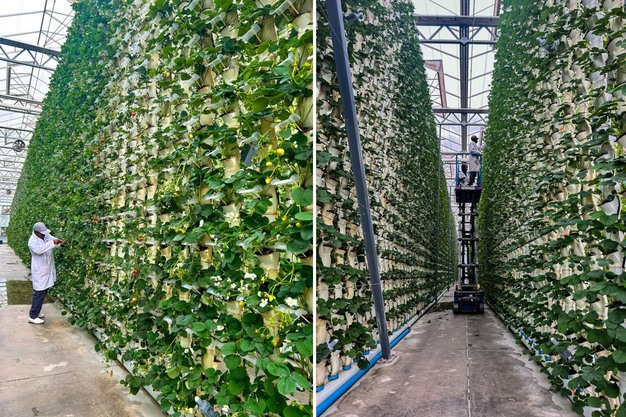
Modern greenhouse strawberry production builds on established vertical gutter systems, controlled fertigation, and refined climate management strategies. New cultivars developed for protected environments have demonstrated higher yields compared to comparable outdoor varieties, alongside improved flavor potential.
"Genetics, irrigation strategies, and environmental controls for greenhouse strawberries are advancing quickly. But unlike some indoor farm models, these systems are grounded in decades of global greenhouse experience."
Once established, strawberry plants can produce fruit for nine to twelve months, allowing greenhouse operators to supply markets during fall through spring, when outdoor production declines and pricing typically strengthens.
 © Vgreens
Capital efficiency and hybrid models
Compared to fully automated indoor farms, greenhouses generally require lower capital investment per square foot due to reliance on sunlight and less intensive mechanical infrastructure.
"High upfront capital has been a barrier for some indoor operations. Greenhouses typically involve simpler environmental control systems and more modular components, which can reduce both cost and operational risk."
Automation remains relevant but is increasingly deployed selectively. "We're seeing a shift toward hybrid models which include sunlight-based production combined with selective automation," Miriam says. "That balance helps manage labor while keeping capital and energy costs aligned with crop value."
As climate variability increases and demand for local produce continues to grow, disciplined greenhouse design, beginning with glazing, remains central to performance.
"The real question in 2026 isn't whether commercial greenhouses can be profitable. It's under what conditions they make sense. With the right crop, the right scale, and disciplined design decisions, greenhouses remain one of the more resilient and economically sound investments in controlled environment agriculture."
Register for the webinar here.
For more information:
Ceres Greenhouse Solutions
[email protected]
www.ceresgs.com