For the past three years, AG Group Europe has incorporated, through its Innovation department, a division created specifically to differentiate conventional agricultural machinery from more advanced solutions based on robotics, automation and artificial intelligence applied to intensive horticultural production.
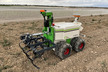
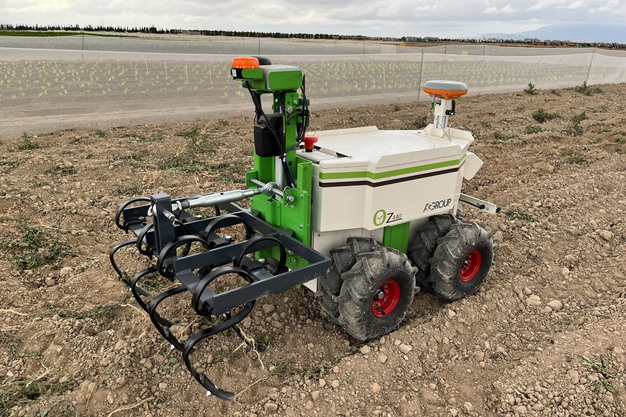
"Within this strategy, AG Group works with the robotic platforms developed by Naïo Technologies, specifically designed for intensive horticulture, both in open field and greenhouse production. The range includes two main models, Orio, a larger platform, and Oz, a compact version especially conceived for reduced spaces and protected crops," explains Josep Dalmases.
 © AG Group
"These are not robots with a single function. They are autonomous platforms, equivalent to an electric tractor, which depending on the implement attached, can sow, weed, cultivate or spray," he details.
These robots are designed to carry out high precision mechanical tasks, especially inter row weeding, one of the applications with the greatest direct impact on herbicide reduction in intensive horticulture. Their ability to work repeatedly and with great accuracy allows crops to be kept clean without systematic chemical treatments.
Full autonomy and operational safety
One of the most distinctive features of these platforms is their ability to operate fully autonomously within the legal framework. In the case of Orio, the robot can reach speeds of up to 5 km per hour and is equipped with LiDAR sensors that detect people or obstacles at less than 1.5 metres, automatically stopping the machine.
"It is the only platform on the market that can work on its own without the need for constant supervision, thanks to its safety systems," Josep points out. "In the case of Oz, being a lighter and slower robot, with a maximum speed of 1.8 km per hour, safety requirements are lower, which makes autonomous use easier in greenhouses and organic farms."
"From an energy perspective, Orio offers up to 10 hours of autonomy, while Oz provides around 6 hours of continuous work, with fast charging completed in approximately 4 hours. This balance between autonomy and charging time allows the robots to be integrated into full horticultural working days."
Navigation for both robots is based on RTK satellite technology, with a precision of around 2 centimetres.
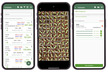
"Before starting work, it is necessary to carry out prior mapping of the plot or greenhouse. We mark key points at the beginning and end of each crop line, generating straight and parallel lines that the robot then follows with complete accuracy," Josep explains. "This precision allows the work to be adapted to each crop stage, on the line during sowing or between rows for mechanical weeding."
Sector interest, but gradual adoption
According to AG Group, the horticultural sector is not starting from scratch in terms of awareness of this technology. "We thought we would be explaining something completely new, but many clients had already seen these robots at international trade fairs, especially in France, Germany or the Netherlands."
However, the definitive step towards purchase remains limited. "Acceptance is good, but implementation is progressing more slowly than expected. That is why our current focus is on field demonstrations, training and technical support, a process that at AG Group we consider essential to reduce producers' initial uncertainty."
"In this regard, the move towards automation and robotics can become an opportunity to attract new profiles to the agricultural sector," Josep highlights. Agricultural, electronic and mechanical engineers are increasingly finding their place in horticultural operations that now function as highly technified businesses, where planning, data analysis and cost optimisation play an ever greater role.
"Robotics does not replace the farmer, it complements them. And in fact, it can be key to making the sector more attractive to younger generations and to reducing the generational renewal problem."
 For more information:
AG Group
[email protected]
https://ag-group.es