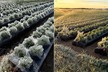
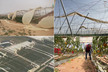
On Thursday, February 5, strong winds have continued to blow across Huelva, where gusts of more than 70 km/h are expected along the coastal areas. The province has been heavily affected by successive storms which, while pushing reservoir reserves above 992 hm³, compared to 575.36 hm³ recorded on the same date last year, have also caused significant damage to one of the main drivers of Huelva's economy, the berry sector.
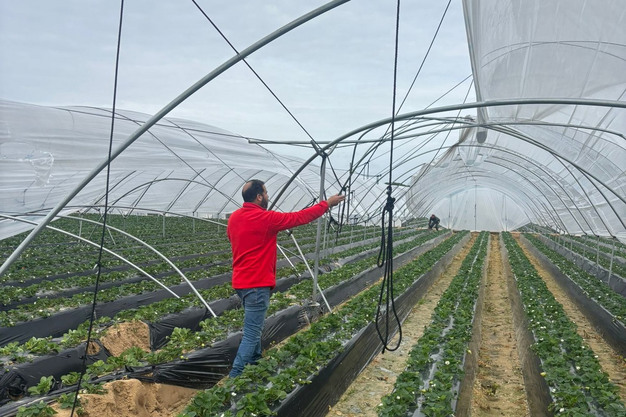
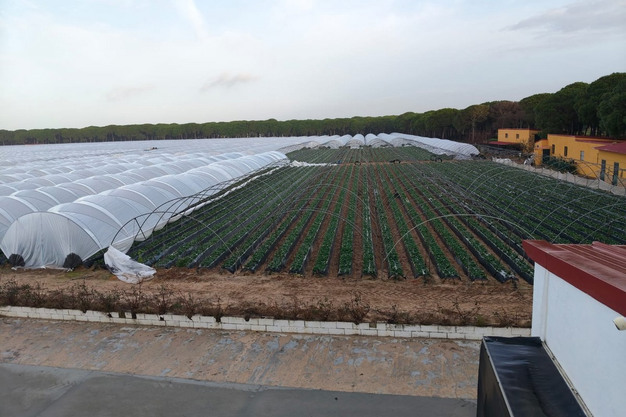
"The wind has caused many greenhouse plastics to fly off, or to loosen and fall to the ground, which makes them tear much more easily," explain representatives from a farm in the Mazagón area. "As for the fruit inside the affected greenhouses, when it gets wet it rots, so we are experiencing small episodes of poor quality."
The cold temperatures recorded so far, together with reduced light levels due to the high frequency of cloudy days, are limiting flowering and fruit set and delaying fruit development and ripening. This situation was already highlighted in the latest weekly phytosanitary bulletin from the RAIF corresponding to the last week of January, when accumulated rainfall reached 88 l/m². At the beginning of February, the situation has continued, "keeping production very restrained".
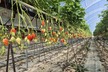
"Strawberries need hours of light to ripen," the company continues, "and the lack of sunny days is making it difficult for the fruit to mature fully. In fact, we are seeing a high percentage of fruit with green tips, without fully developing their characteristic red colour".
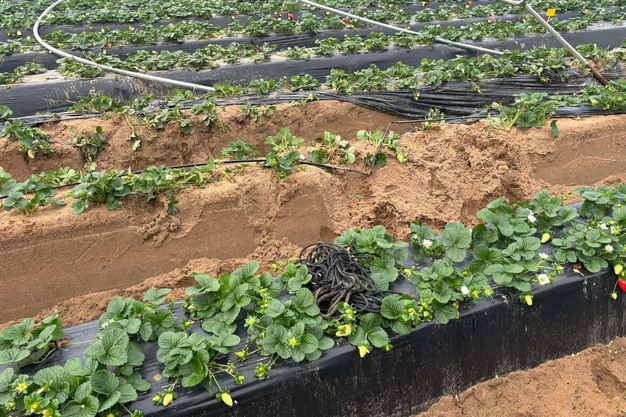
Strawberry harvesting is continuing, although at lower volumes than last year. In week 5 of 2026, it is estimated that around 50% less strawberry volume was marketed compared to the same week in 2025, and in external markets such as Munich, strawberries of Greek origin are currently predominant. This shortage situation has pushed both farm gate prices and international market prices well above those recorded in the same week of the previous campaign, according to the Andalusian Regional Government's Observatory of Prices and Markets.
High humidity levels raise disease pressure
During the last week of January, average humidity remained at 85%. According to the RAIF report, by the end of January around 10.7% of plants showed the presence of powdery mildew (Podosphaera aphanis), while the percentage of affected plots in the province remained at 87%. As for grey mould (Botrytis cinerea), the level of infection is currently low, although the percentage of plots showing symptoms increased to 77%. Until now, the low temperatures recorded have slowed the development of diseases in crops, but pressure could increase as temperatures begin to rise.
"At the moment, and in order to prevent that situation, we are focused on repairing storm damage. In our case, only around 5% of our greenhouses have been affected, but we know farmers in the Moguer area who have had to replace up to 80% of the plastics on their farms."
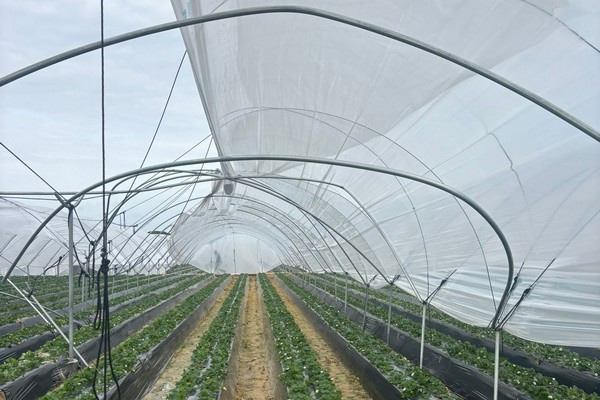
"There are also cases where the strength of the wind has been such that it has bent the greenhouse arches themselves, meaning that repair investments, which must be carried out quickly to avoid losing production, will be much higher," the berry producer adds.
"We will activate the necessary mechanisms"
The Andalusian Ministry of Agriculture, Fisheries, Water and Rural Development has already announced that the regional government will roll out support measures for Andalusian farmers who have suffered losses caused by Storm Leonardo.
During an appearance by the Regional Minister of Agriculture, Ramón Fernández-Pacheco, on Canal Sur's programme Despierta Andalucía, he stressed that "all the necessary instruments will be activated" to protect one of the region's main economic engines and the livelihood "of thousands of Andalusian families". In this regard, he emphasised that the agricultural sector "will not be left unattended".
Fernández-Pacheco also confirmed that he "has already been in contact with the Ministry of Agriculture to address this situation", although he acknowledged that it is still too early to quantify the full extent of the damage.
"Now is the time to stand by" the Andalusian agricultural sector and "to rise to the occasion". "The images are devastating", he la