High-throughput phenotyping (HTP) is emerging as a key technology to support breeding, research, and production decisions. Founded 11 years ago, French-based Hiphen develops digital phenotyping tools and services that put plant observations into quantitative, repeatable data. The company focuses on measuring plant traits at scale using imaging technologies, advanced sensors, and artificial intelligence.
"Our role is to make plant measurements faster, more accurate, and comparable across trials and environments," says Alexis Comar, co-founder and CEO of Hiphen. "Phenotyping only creates value when it produces data that can directly support decisions."
International reach and target markets
Although headquartered in France, the company operates globally. In 2025, the company carried out projects in 18 countries, with its largest markets including the United States, the Netherlands, France, Brazil, and Australia. Local partnerships, on-site project execution, and centralized data processing and analytics support this international activity.
Hiphen's core markets include plant breeding, academic research, and post-harvest quality assessment. More recently, the company has expanded into areas such as biostimulant and biocontrol product evaluation, as well as On-Farm Experimentation (OFE). In these contexts, digital phenotyping provides objective performance data under real production conditions.
"There is increasing pressure across the value chain to justify decisions with data," he explains. "Phenotyping helps connect experimental trials with operational realities."
 © Thijmen Tiersma | HortiDaily.com
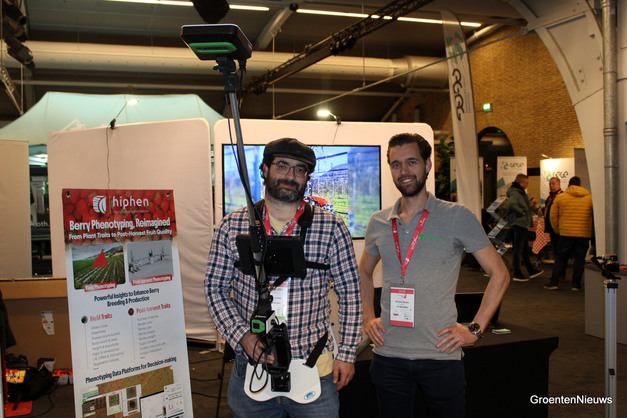
Alexis Comar, Co-Founder and CEO, demonstrated their phenotyping system this year at the International Soft Fruit Day. Hiphen works with Michael Meijler, who attended the Strawberry Day on behalf of WPS.
Technologies for greenhouse and field phenotyping
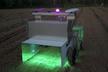
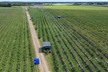
Hiphen has developed a portfolio of complementary phenotyping platforms designed for different environments and scales. These include Phenoscale, a drone-based phenotyping service for large field trials; Literal, a handheld device for rapid in-field measurements; Phenomobile, a tractor-embedded sensor platform; and Phenostation, a dedicated greenhouse phenotyping system.
For greenhouse applications, Phenostation enables consistent, repeatable measurements under controlled conditions. Using imaging-based approaches, it captures traits related to growth, biomass, architecture, color, and development over time. These datasets allow for robust comparisons between varieties, treatments, or environmental strategies.
"Greenhouses offer excellent conditions for phenotyping, but scalability and standardization remain challenges," Alexis explains. "Our focus has been on making controlled-environment phenotyping more accessible without sacrificing data quality."
Preparing for implementation
Hiphen's solutions integrate hardware, software, and AI-based analytics. Sensors and cameras generate raw data, which are processed into standardized traits suitable for statistical analysis and decision-making.
Successful implementation depends largely on preparation. Clear definition of objectives, appropriate experimental design, and alignment with existing workflows are essential. "The technology delivers the most value when the biological or agronomic questions are clearly defined upfront."
The company typically supports users during this phase to ensure phenotyping systems integrate smoothly into greenhouse operations without adding unnecessary complexity.
Demonstrated applications and recognition
Hiphen technologies are already used in commercial and regulatory contexts. In Champagne vineyards, imaging systems support post-harvest quality assessment by quantifying grape characteristics linked to processing performance, with major producers such as Moët & Chandon among the users.
In another example, their Literal device for wheat head counting has been officially approved by the Bundessortenamt for cultivar registration trials in Germany. This represents a significant step toward regulatory acceptance of digital phenotyping methods.
"Regulatory recognition shows that digital measurements can meet established standards of reliability."
Strategic outlook and industry challenges
In early 2025, Hiphen acquired the drone phenotyping division of Aurea Imaging in the Netherlands, strengthening its capabilities in large-scale field phenotyping. Looking ahead, the company aims to further rebalance its portfolio between field and greenhouse applications, with new developments focused on scalable controlled-environment measurements.
Despite technological maturity, broader adoption of digital phenotyping remains a challenge. Data ownership, standardization, and economic value creation are still evolving across the industry.
"For growers and breeders, the challenge is moving from visual assessments to data-driven measurements without increasing workload," Alexis concludes. "Our objective is to ensure phenotyping tools genuinely support decision-making."
For more information:
Hiphen
Alexis Comar, Co-Founder & CEO
[email protected]
www.hiphen-plant.com