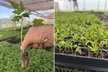
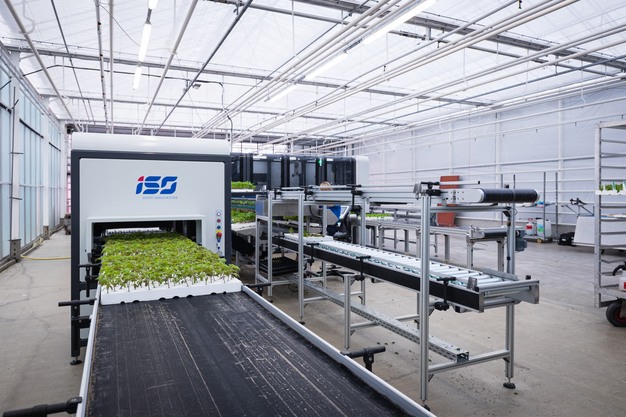
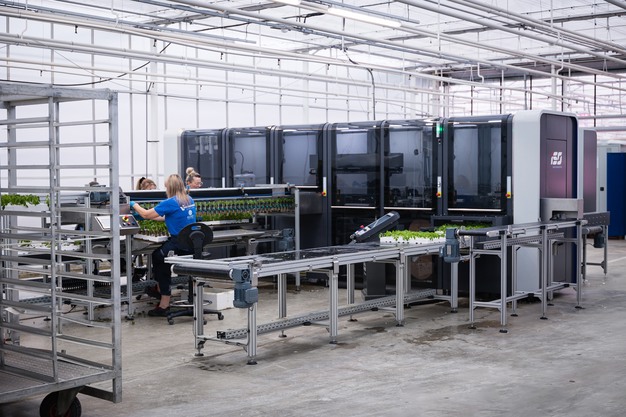
In the Netherlands, propagator Vreugdenhil Young Plants has started using a grafting machine to support the grafting of tomato plants. The company, based in De Lier, is the first to work with the High-Speed Grafter AC (Above Cotyledons) developed by TTA-ISO. The machine is notable for its ability to assist with grafting tomato plants above the cotyledons, a method commonly used in high-tech propagation systems in Dutch greenhouse production. A previous version of the High-Speed Grafter for grafting below the cotyledons had already been introduced to the market.
 © Vreugdenhil Young Plants
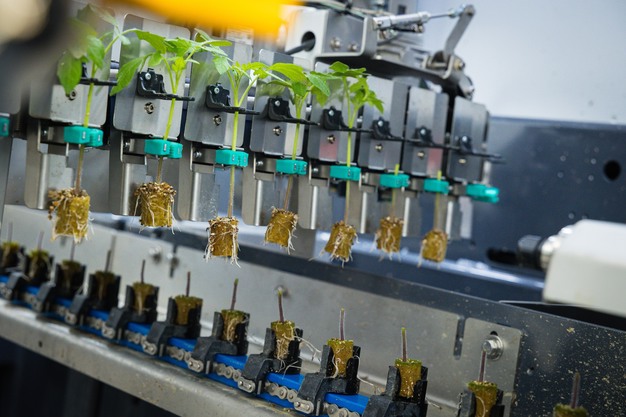
"With the High-Speed Grafter AC, you can be sure that the cutting angle of both the rootstock and the scion is always exactly the same," says Cock Groenendaal, General Operations Manager at Vreugdenhil Young Plants. This high level of precision is expected to result in improved grafting success rates, a process that is still largely carried out manually. "Our confidence in the machine increases every day."
A step forward
Vreugdenhil Young Plants began working with the High-Speed Grafter AC after its introduction. It is not the first innovation from TTA-ISO that the propagator has implemented. Previous investments include a clipping robot, the High-Speed Clipper, and sorting machines such as the MaxSorter, aimed at improving the plant selection process during propagation. "We are constantly looking for new technologies to reduce labour intensity," Groenendaal explains.
 © TTA-ISO
Grafting is typically a very labour-intensive activity. Groenendaal estimates that the process accounts for around 20,000 working hours per year. For that reason, the company had already explored mechanical grafting solutions in the past. "At that time, we worked with a three-head grafting machine from ISO that used clips. However, the fusion between rootstock and scion was not reliable enough."
After several years of further development, a new version of the grafting machine became available. The propagator from De Lier showed immediate interest. "We visited to see it in operation and said to each other: this represents such a significant step forward that we want to start working with it again."
 © TTA-ISO
Fine-tuning and scaling up
Tomato grafting at Vreugdenhil Young Plants shows two peak periods during the year. The first occurs in the run-up to the illuminated growing season, roughly between weeks 30 and 36, when tomato plants are propagated during summer. A second, larger peak is linked to propagation for unlit cultivation. This peak typically runs from around week 40 until weeks 2 or 3, when orders from growers with unlit crops are processed.
Initially, the High-Speed Grafter AC was not immediately scheduled for full commercial production. According to Groenendaal, the company first wanted to thoroughly test the machine, gain experience and fine-tune the settings where necessary. "We then started by running 10 to 25% of the batches with the grafting robot. As we saw that things were going well and that the grafting success rate was good, we gradually increased that percentage. You can assess the success rate after about three to four days."
 © TTA-ISO
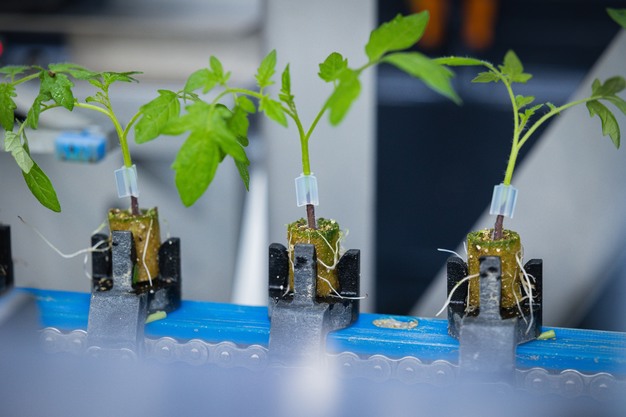
The lead machine operator at Vreugdenhil Young Plants is Dhierin Bhagolie, who was the first to work with the High-Speed Grafter AC. During the initial phase, he was supported by specialists from TTA-ISO. Since then, several operators have been trained to work with the machine.
"We have multiple operators within our company, and thanks to increasing automation we can now deploy them across several machines. Our operators clearly enjoy working with this kind of new technology. Looking ahead, I expect that we will further expand our team of operators."
 © TTA-ISO
Grafting success rate
Shortly after the peak period for propagation for unlit tomato cultivation, Groenendaal notes with satisfaction that the grafting success rate achieved with the High-Speed Grafter AC matches that of traditional manual grafting. "We are already very pleased with that. In the future, we want to do even better, and that is what we are aiming for."
A key factor in further improvement is gaining more insight into how plant material can be propagated in the most optimal way so that it is fully compatible with the grafting robot. Differences between varieties also play a role. "Finer varieties seem to be easier to handle than heavier types, such as beef tomatoes. Not every scion is the same."
Vreugdenhil Young Plants is well acquainted with optimising processes around automated equipment, partly due to experience with other forms of automation. "With the cutting robot, for example, we also have to train people at our farms in Africa to harvest cuttings that are suitable for robotic processing."
 © TTA-ISO
Cutting point
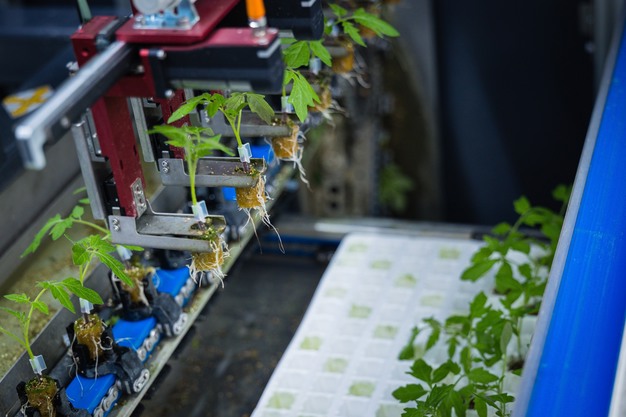
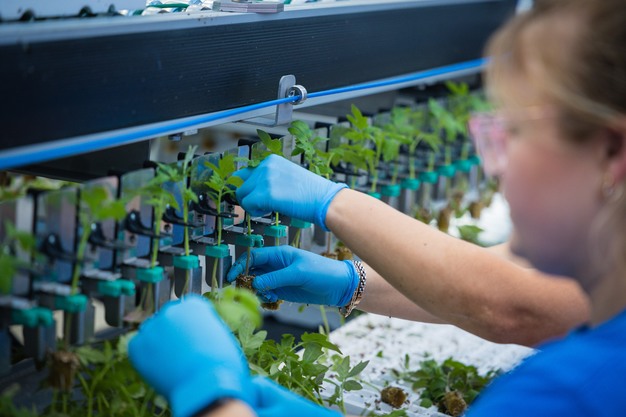
In addition to the machine operator, Vreugdenhil Young Plants deploys three employees to supply the High-Speed Grafter AC with scions. They place the scions into the carousel system that feeds them into the robot.
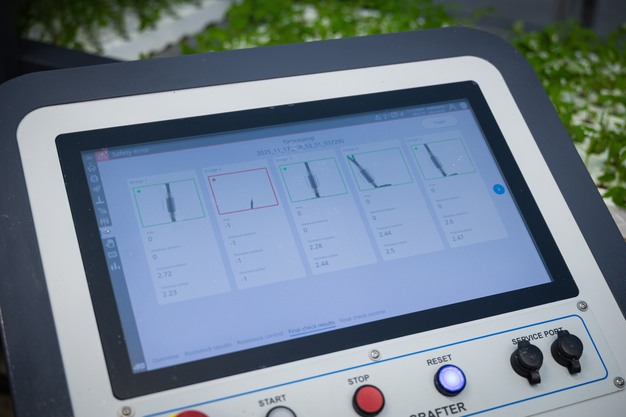
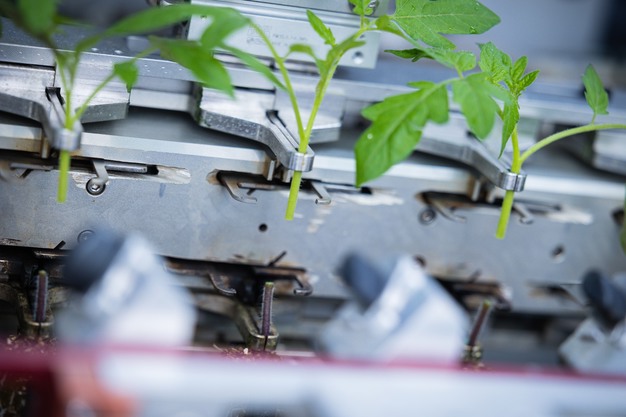
Automating grafting above the cotyledons presents a specific challenge, as the cotyledon leaves are never positioned at exactly the same height. "To make the cut, the robot has to detect the cotyledon leaves and determine the correct height," explained Ben Pieterse of TTA-ISO. "When grafting below the cotyledons, the height can be measured from the plug, which is much easier. With above-cotyledon grafting, that reference point is not available."
 © TTA-ISO
During the development of the High-Speed Grafter AC for grafting above the cotyledons, a deliberate decision was made not to make the robot fully automatic. Feeding the scions into the machine remains a manual task.
The High-Speed Grafter AC is equipped with an innovative positioning aid that helps determine the correct cutting height. "In this way, you ensure that cutting and grafting are carried out accurately every time, without the need for additional expensive equipment to determine the correct height," Ben says.
 © TTA-ISO
Nomination
TTA-ISO has been nominated by the organisers of Fruit Logistica for a Fruit Logistica Innovation Award in the technology category for its High-Speed Grafter AC, designed for grafting above the cotyledons. The innovation is attracting considerable interest beyond the trade fair in Berlin, according to Groenendaal.
"I think I have already discussed it with almost all fellow propagators," he says. "They ask how it works and how it is performing." His response has been positive.
Groenendaal is already looking ahead to the next illuminated growing season, when the machine will be back in operation. "Then we will work towards grafting 100% of our batches with the grafting robot. That is what we purchased it for."
 © TTA-ISO
TTA-ISO will be present at Fruit Logistica and can be found in hall 3.1, booth A-61.
For more information:
TTA-ISO
[email protected]
www.tta-iso.com