Inspiration often sprouts in unexpected places. For electrical engineering students Kermina David '27 and Santiago Garcia '27, the taste of a tropical fruit swiftly ripened into an interest in greenhouses. It then branched into a quest to help farmers manage greenhouse crops more efficiently.
David and Garcia, both Albert Dorman Honors College scholars, are co-founders of Verdura Automations, a system using artificial intelligence as a "brain" for greenhouse climate control. With guidance from NJIT mentor Oksana Manzhura, a senior university lecturer in electrical and computer engineering, they designed and built a prototype that uses wireless sensors in soil to gather environmental data, measuring light, humidity and temperature. The sensors connect to a central AI-powered hub, allowing users to monitor and adjust greenhouse conditions in real time through an app — on-site or remotely — for facilities measuring up to 2,500 square feet.
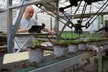
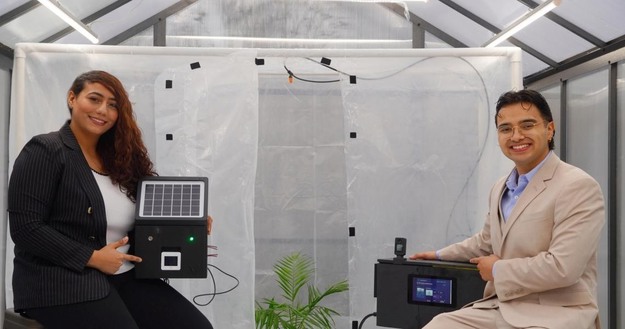 © Jason GomezKermina David '27 and Santiago Garcia '27, co-creators of the Verdura Automations system for climate control in greenhouses, with one of their prototypes
"It's modular, so that means that you don't have to buy everything all at once," Garcia explained. "You can buy as you grow, and Verdura grows with you."
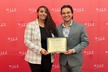
In October 2025, their prototype and poster for Verdura won first place at the Institute of Electrical and Electronics Engineers (IEEE) AP-S Poster Competition, held at NJIT. Panels, talks and presentations at the event addressed the use of AI and electromagnetic technologies to tackle societal issues on a global scale.
Following their win at IEEE, David and Garcia (Verdura's CTO and CEO, respectively) pitched Verdura at an NJIT event for Angeles Investors, an organization that supports Latinx-driven startups. Next came an invitation to a mentoring event in December with The Indus Entrepreneurs (TiE) New Jersey, where the Verdura team were TIE's first student presenters. In January 2026, they participated in the VentureWell E-Team Program at the University of Miami. VentureWell supports student entrepreneurs and awards grants for innovative solutions to environmental, health and social challenges.
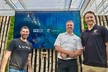
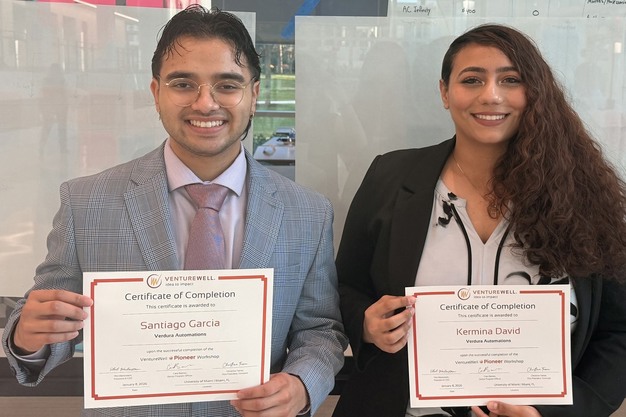 © Kermina DavidAt VentureWell, Garcia and David met with mentors and other inventors using technology to tackle environmental challenges
"They really emphasized thinking about your market and making sure that you're trying to solve something," said David, a Grand Challenges Scholar at the Newark College of Engineering. While at VentureWell, they met other inventors who had also tackled issues that ate into greenhouse farmers' time and profits. This told them that Verdura was on the right track.
"It proved to us that it is definitely a problem," she said. As their fellow inventors had yet to find a solution, "we knew we needed to find a different way to attack it."
A taste of success
Granadilla is a cousin of passionfruit, with orange skin and juicy, seed-filled pulp. After Garcia sampled a granadilla from Colombia, he tried to find the fruit in New Jersey. But imported granadillas were prohibitively expensive, and they are hard to grow in cold climates.
At first, Garcia's curiosity about automated climate control for greenhouses was personal, spurred by his own interest in growing granadillas in his backyard. But after Manzhura saw one of his greenhouse sketches, she encouraged him to develop his idea for a broader audience.
Through the National Science Foundation's Innovation Corps (I-Corps), an entrepreneurial program providing training and funds for student projects, Garcia conducted two rounds of interviews with dozens of farmers. He learned that greenhouse crops in general were high-maintenance. Growers on average spent up to 70% of their time on manual tasks like climate management, leaving them little time to market their produce or find new customers. Other farmers reported losing a significant percentage of their crops to pests. Equipment failure and delays in replacing broken parts eroded farmers' confidence in high-tech systems, some of which cost upward of $100,000 — a hefty price tag for small-scale growers.
"Through those real-life conversations, I started seeing a lot of pain points," Garcia said.
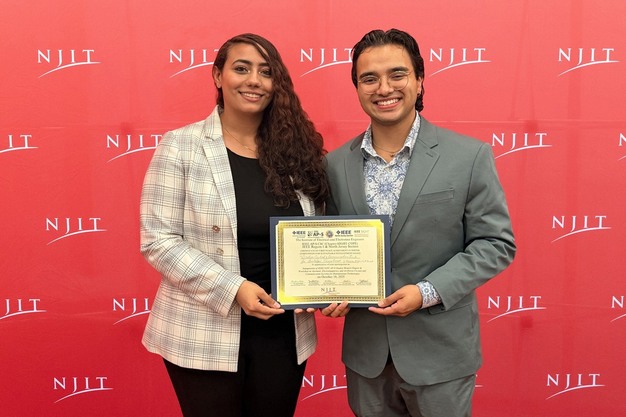 © New Jersey Institute of TechnologyVerdura Automations won first place at the IEEE AP-S Poster Competition, held at NJIT in October 2025.
From those interviews, Garcia imagined an affordable solution that could ease farmers' workloads and optimize greenhouse conditions for crops, reducing the need for harmful pesticides. He partnered with David to develop an automated plug-and-play climate control system, with an estimated cost of about $4,000 for equipment and a monthly subscription fee for the app. Garcia focused on the sensors and hardware and David managed software, drawing from her experience in programming and robotics to coordinate sensor functions with an AI controller.
"We were trying to not only make something that would help grow the granadilla, but would actually benefit the farmers, even the backyard growers," David said.
Room for growth
Their goal, David explained, is to reduce the amount of time that farmers need to spend manually checking in on their crops, and to nip climate problems in the bud to keep plants healthy and thriving. The system also needed to be simple to install and manage, with components that could quickly and easily be swapped or replaced. But designing, building and testing Verdura was just the start; they also had to learn how to pitch to investors. Support came from research professor Kathleen Naasz, executive director of NJIT's Center for Student Entrepreneurship (CSE), a resource for student entrepreneurs across all six colleges.
"The heart of a pitch is that the problem is relatable and that you clearly articulate the solution," she said. According to Naasz, successful pitches address three questions: Is the product something people want, does it offer something unique, and does it have a sustainable business model. Naasz offered Verdura's team tips for pitch preparation and practice, encouraging them to emphasize that they had identified an important need in the greenhouse growers' market.
"Combining that need with tailored AI software and then the hardware — it's like bespoke greenhouse support," Naasz said. "It's tailoring environments to whatever plant, fruit or vegetable they want to grow."
David and Garcia further honed their pitching skills at VentureWell, where mentors "really emphasized thinking about your market, and making sure that you're trying to solve something," David said. "Being able to communicate with other startups — with people our age — was amazing. Their input was very important to us."
Eventually, the addition of robotics could expand Verdura's capabilities to manage crops in larger commercial greenhouses, David added. For now, the team is applying for grants to help them improve their hardware and prototypes, build more units and distribute them at pilot sites with small greenhouses, Garcia said.
"After that, we'd get all the information, go back and make Verdura the best possible, and get up in front of venture capitalists and show them that Verdura is a rocket ship that just needs more fuel."