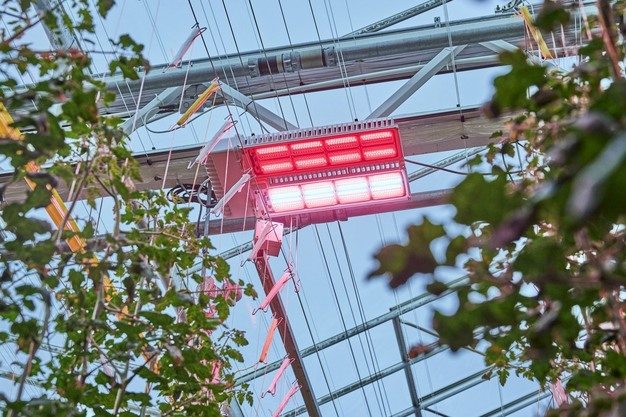
When transitioning from HPS lights to LEDs, the screen and heating strategies can rarely be directly copied from a previous HPS setup. Switching to LED lighting significantly alters the greenhouse microclimate and therefore requires a different cultivation strategy.
The general understanding is that the yellowing of upper leaves and browning of leaf edges is mainly due to a lack of calcium or a disruption in its transport to the outer cells of the leaves. Calcium is transported passively with water, so its availability depends on transpiration and the rate of sap flow within the plant.
Results from a trial in Lepaa, Finland, carried out by Signify, Häme University of Applied Sciences, and Aranet, showed that calcium did not effectively reach the head of the plant, resulting in tip burn, even though water was being absorbed and consumed. The crop was grown under a PPFD of 460 µmol/m²/s using a lighting mix of approximately 75 percent LEDs and 25 percent HPS. At these light levels, moving from an HPS system to a hybrid or fully LED-based installation can significantly change the plant's transpiration dynamics.
 © Signify Netherlands B.V.
Tips to prevent tip burn
By installing sensors that allowed real-time monitoring of microclimate conditions affecting sap flow, several practical conclusions could be drawn to help minimize or prevent tip burn. Screen use and heating pipe strategies should be optimized so that leaves maintain sufficient water tension at night and can transpire efficiently during the day. During daytime, it is important to create an active climate in which the entire plant transpires effectively. This can be achieved by using grow pipes to maintain adequate temperature, ensuring good air movement around the leaves, and preventing relative humidity from becoming too high. Additional focus should be placed on heating the plant head, for example by using energy screens or heating pipes installed higher in the canopy, and by promoting vertical air movement with fans.
Plant water uptake during the season
Over a two-year monitoring period in several greenhouses, tip burn was observed to start developing around mid-November and to be most severe by late January. Although it is often assumed that evaporation and water uptake decrease during winter, measurements from Lepaa showed that plants continued to take up water steadily throughout the winter season. This suggests that while water uptake remains sufficient, calcium does not effectively reach the plant head.
To better understand this process, sensors were installed to track water movement within the plant. Sap flow sensors were attached to leaf petioles to provide detailed insight into transpiration and water uptake in different parts of the plant. At the same time, the microclimate around the leaves was monitored using sensors that measured air temperature, humidity, and leaf temperature.
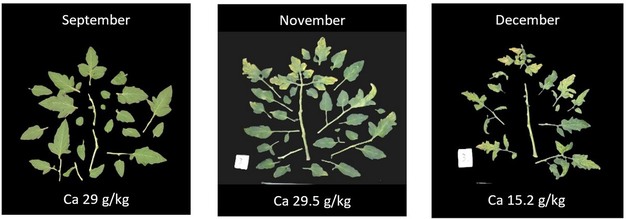 © SignifyTomato leaves in September, November and December. Each leaf is the 8th leaf counted from the top of the plant. Despite steady water uptake, the calcium fails to reach the plant head.
The effect of the microclimate
The sensors made it possible to observe in real time how variations in the microclimate influenced sap flow. At the end of September, relative humidity was higher in the upper canopy than in the lower parts of the crop, and this situation did not reverse until early December. High humidity slows evaporation by reducing the moisture gradient between the inside of the stomata and the surrounding air. As a result, the air becomes less effective at drawing water from the stomata, slowing sap flow and calcium transport and increasing the risk of tip burn.
Effect of lighting on transpiration
When switching from HPS to LED lighting, it is often assumed that transpiration slows and water uptake decreases. In greenhouses where this transition has already taken place, tip burn symptoms have either remained unchanged or, in some cases, become more pronounced. The light itself is not the direct cause; rather, the difference lies in how the luminaires emit light and heat and how this affects the canopy microclimate.
HPS lamps emit substantial radiant heat, which warms the top leaves and promotes air circulation, supporting transpiration and sap flow. In contrast, LED-lit greenhouses often have cooler plant tops and slower air movement, which can reduce sap flow in the upper leaves. In the monitored greenhouse, a hybrid lighting system was used, combining HPS at 140 µmol/m²/s with Philips LED toplighting at 240 µmol/m²/s and Philips LED interlighting at 80 µmol/m²/s in the middle of the canopy.
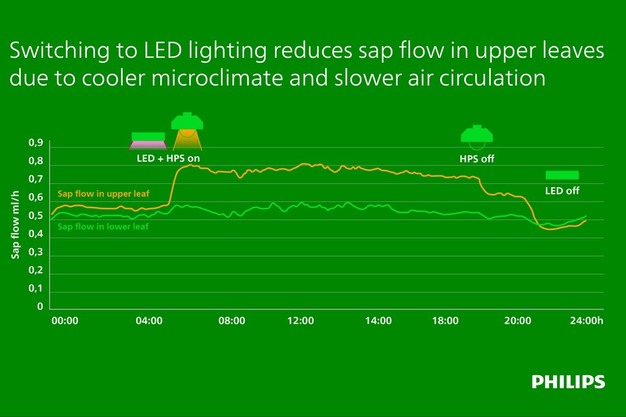 © SignifySap flow rate on the 12th of November measured from a leaf in the upper canopy (orange) and lower canopy (green). Lights were switched on at 5:20. HPS 140 µmol/m2/s was switched off 19:20, and LED toplighting 240 µmol/m2/2 were switched off at 20:40.
Nighttime transpiration can prevent water from reaching the head
Early in the season, plants showed strong daytime transpiration and minimal activity at night. This pattern changed in October. By late November, transpiration in the upper leaves had decreased significantly, while the lower leaves continued to transpire almost continuously, with little difference between day and night.
This constant 24-hour transpiration in the lower leaves was linked to nighttime heating from rail pipes. The pipes maintained greenhouse temperature and stimulated transpiration in the lower canopy. In addition, dehumidification relied on heat from these pipes, further increasing transpiration at lower leaf levels.
When stomata in the lower leaves remain open throughout the night, sap flow and water uptake stay high, even though nighttime transpiration provides little benefit to the plant and may even be counterproductive. Allowing stomata to close fully during dark hours can be more beneficial. This can be encouraged by lowering rail-pipe temperatures at night, permitting slightly higher relative humidity while still avoiding conditions that promote fungal diseases, or by removing excess moisture through dehumidification rather than increasing pipe temperature. Reducing excessive nighttime transpiration in the lower leaves allows root pressure to move water and calcium more effectively toward the upper canopy, helping to alleviate calcium deficiency and reduce the risk of tip burn.
For more information:
Signify Daniele Damoiseaux, Global Marcom Manager Horticulture [email protected]
www.philips.com/horti