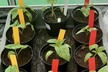
Winter is a common time to start seeds indoors in preparation for the upcoming growing season. While germinating seedlings bring welcome, verdant growth during the winter months, their establishment can be threatened by damping-off disease. Damping-off is the rotting of seeds in the soil and the collapse of newly emerged seedlings. Damping-off causes root necrosis (browning), rotting, and sloughing– a condition where the outer root tissue separates from the inner tissue.
It is categorized into two types: pre- and post-emergence damping-off. Pre-emergence damping-off destroys the radicle and hypocotyl before the seedling emerges from the soil surface. Post-emergence damping-off occurs after emergence and is characterized by stem rot at or just below the soil line.
Affected seedlings may discolor, wilt, collapse, and die. Damping-off is caused by several different fungi and water molds (Oomycetes), including Rhizoctonia spp., Fusarium spp., Pythium spp., and Phytophthora spp. These pathogens may act independently or co-occur to cause damping-off.
Whether you are starting seeds indoors or growing crops in the field, damping-off can occur in both environments. Damping-off is most severe under conditions of excessive soil moisture and high humidity. The disease often begins in localized areas with poorly drained soils and overcrowded seed beds, then spreads over time. Under moist conditions, diagnostic signs may be visible on the affected tissue.
Read more at Franklin County Free Press