Researchers at NC State University are developing robotic systems to automate labor-intensive tasks in vegetable production, including staking, monitoring, and harvesting crops such as tomatoes and peppers.
Much of fresh vegetable production in the U.S. still relies on manual labor, particularly for crops that require plant support systems. Tomatoes and peppers often need stakes and twine to prevent plants from collapsing as they grow, a process that involves driving large numbers of stakes into the soil and repeatedly adding twine layers during the season. According to horticultural sciences professor Emmanuel Torres, this work represents a substantial cost and is increasingly difficult to staff.
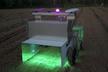
To address this, Torres and Andrea Monteza, Makerspace Director at the N.C. The Plant Sciences Initiative is developing autonomous robotic tools. One prototype, called "Thor," is designed to hammer stakes into the ground at consistent spacing while avoiding crop damage. The robot operates on a self-driving platform equipped with stereo cameras and LiDAR sensors to map fields and navigate uneven terrain.
"It's like how a Roomba uses cameras and sensors to create a floor plan of your house," Torres said.
To support machine learning for these systems, the team created a separate imaging tool known as "Hawkeye." Mounted on a tractor, the platform uses high-resolution cameras to collect top-down and side-view images of crops. During field trials last summer, the system captured around 50,000 images of tomato plants, which will be used to train algorithms to distinguish crops from weeds and other field objects.
With funding support from the N.C. General Assembly-funded Ag Analytics Platform and the U.S. Department of Agriculture, the researchers say the same imaging approach could later be applied to crop scouting. Potential uses include identifying pest pressure, disease symptoms, or nutrient deficiencies without manual field walks.
"We're trying to make tools that are flexible enough for multiple potential uses," Monteza said.
In parallel, engineering students at NC State are working on a robotic arm designed to harvest tomatoes. The system uses AI guidance, depth-sensing cameras, and a soft silicone gripper to identify ripe fruit and remove it without causing damage. While current harvesting speed still lags behind human pickers, the researchers view the project as an incremental step toward automated harvest solutions.
"The beauty about machines is that they don't need to stop, right? They can pick all day and into the night," Torres said.
Additional projects include a prototype device to collect insects from crop canopies to support pest identification and integrated pest management decisions. The first version of this system is expected to be ready by March.
Source: CALS News