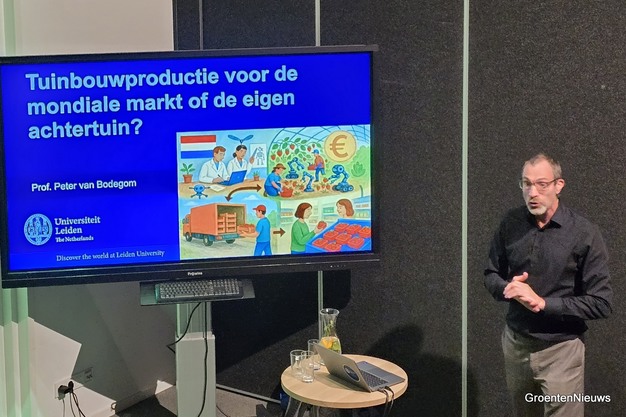
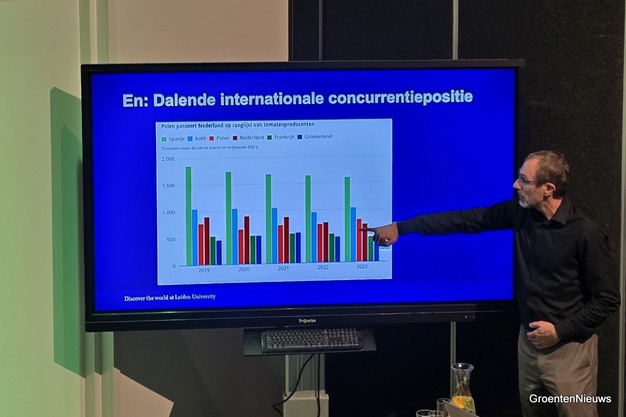
Within the greenhouse sector, the Netherlands is often described as a global frontrunner. According to Professor Peter Bodegom, that reputation is justified when it comes to high-tech solutions and productivity. However, when looking purely at production volumes, he believes the picture should be nuanced. In bulk production, the Netherlands is not a global leader, as other major horticultural countries are equally capable. With limited space available, the question is how Dutch horticulture can remain economically and socially viable.
 © Thijmen Tiersma | HortiDaily.com
No oracle
Peter Bodegom is Professor of Internationale Circulaire Tuinbouwsystemen (International Circular Horticultural Systems) at Leiden University. He addressed these issues during two public lectures at the World Horti Center, organised at the invitation of the municipality of Westland. One lecture focused on the international positioning of Dutch horticulture, while the other addressed water quality, another topic on which the sector is under increasing public scrutiny.
Various scenario studies on the future of horticulture have been conducted in recent years. Bodegom refers to research by Accez (2022), scenarios developed by the Netherlands Environmental Assessment Agency (PBL), and analyses by Rabobank. He emphasises that he does not claim to have a definitive answer. "I am not an oracle," he says. "My aim is to start the discussion."
 © Thijmen Tiersma | HortiDaily.com
Licence to produce
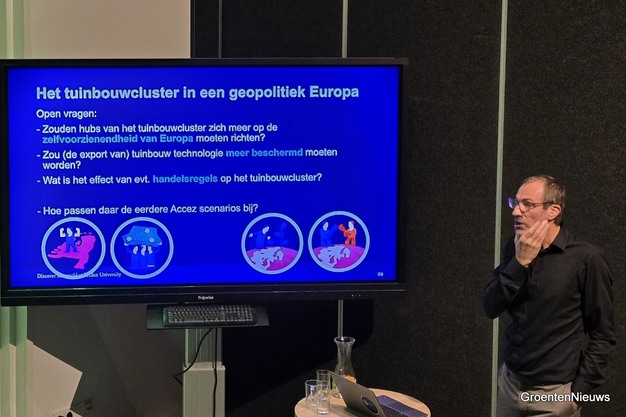
Bodegom personally favours the scenario that emphasises internationally responsible business practices, as outlined in the Accez study. "That scenario provides a licence to produce," he explains. "It is a way for horticulture to gain acceptance from society." In this approach, the Netherlands can demonstrate its technological leadership in horticulture and apply that knowledge internationally.
Another scenario discussed during the lecture focuses on global competitiveness. Bodegom noted that the current climate of trade tensions does not make this pathway particularly favourable.
 © Thijmen Tiersma | HortiDaily.com
Innovation
Midway through the lecture, which also included a brief digression on recent research into CO₂, Bodegom presented an interim conclusion. In his view, a viable future for Dutch horticulture requires a clear vision on the role of data science, healthy products and resilient cultivation systems, enabling sustainable business both locally and internationally.
 © Thijmen Tiersma | HortiDaily.com
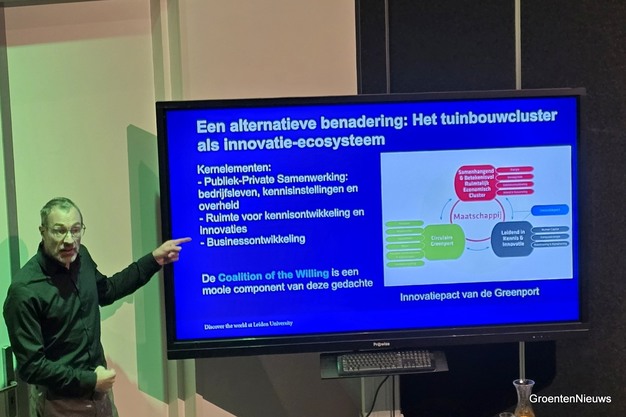
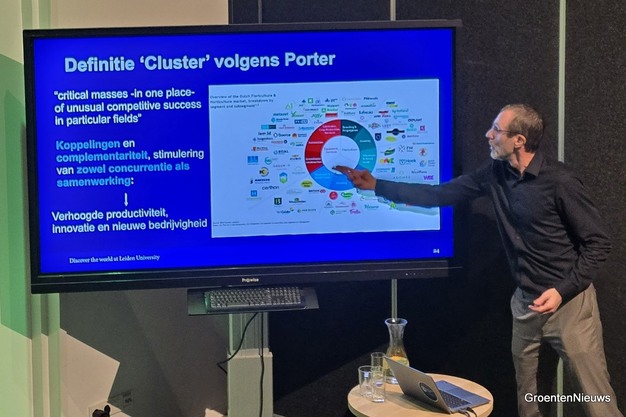
He then argued for viewing the horticultural cluster as an innovation ecosystem. "Continuous innovation is crucial," Bodegom said. "Without it, you will be overtaken." Innovation, he stressed, requires the involvement of all parties in the value chain, as well as a sufficient critical mass of greenhouses to sustain the ecosystem. He compared this with the livestock sector, which is also under pressure and, in his view, faces a greater risk of losing critical mass and therefore innovative capacity.
 © Thijmen Tiersma | HortiDaily.com
Westland is one of the key horticultural clusters in the Netherlands, but Bodegom pointed out that similar clusters exist elsewhere. Looking ahead, he envisions a network of interconnected clusters. He cited examples of Dutch horticultural suppliers such as Royal Brinkman and Koppert establishing operations within clusters in Spain. Westland has also actively sought closer ties with the Almería region, a development to which Bodegom's lecture clearly connected.