Installing photovoltaic (PV) systems on existing greenhouse structures could supply around 23% of Europe's required solar capacity, while reducing land use, carbon emissions and investment costs compared with ground-mounted systems, according to findings from the EU-funded REGACE project.
The results come as the European Union accelerates its renewable energy targets toward 2030, with solar energy expected to play a leading role. However, large-scale deployment of ground-mounted PV has raised concerns about competition for agricultural land.
"What REGACE shows very clearly is that greenhouses are not a marginal contributor to the energy transition," said Dan Gerstenfeld of Interteam, a partner in the REGACE project. "When you look at the total greenhouse footprint across Europe, the available surface area is large enough to make a meaningful contribution to national and regional solar targets."
 © REGACE
Using existing infrastructure
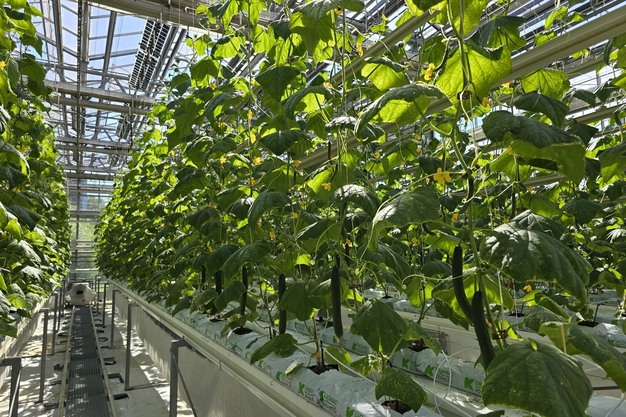
REGACE modelling indicates that in several countries, including Israel, Romania and Croatia, greenhouse-based agrivoltaic systems could deliver more than 40% of the solar capacity required by 2030. Across Europe, the average contribution reaches 23%, assuming sufficient investment and supportive policy frameworks.
According to Dan, the key distinction lies in infrastructure reuse. "Unlike open-field agrivoltaics, greenhouse systems are built on structures that already exist," he explained. "That immediately reduces land pressure and avoids the need to convert productive farmland solely for energy generation."
Studies referenced by REGACE show that meeting 2030 renewable targets using mainly ground-mounted PV could require one to two percent of total farmland in some European countries. Greenhouse-based systems, by contrast, generate electricity with almost no additional land take.
Carbon and material efficiency
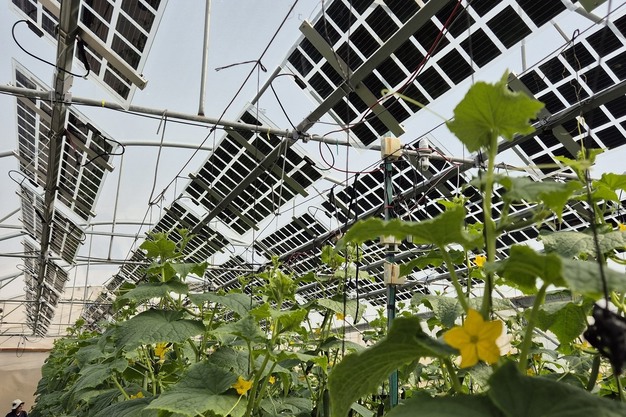
The environmental benefits extend beyond land use. Traditional open-field agrivoltaic systems rely on heavy steel structures and concrete foundations, which carry a substantial carbon footprint.
"Our analysis shows that greenhouse agrivoltaics use less than half the iron per installed kilowatt compared to open-field systems," said Gerstenfeld. "That reduction in material intensity translates directly into lower embedded carbon emissions."
REGACE data indicate that iron use falls from around 103 kg per kilowatt in open-field agrivoltaics to approximately 48 kg per kilowatt in greenhouse-based systems. As a result, the carbon footprint associated with mounting structures drops from 196 kg CO₂ per kilowatt to 84 kg CO₂ per kilowatt.
"When you scale these numbers across thousands of hectares of greenhouses, the emissions savings become significant."
 © REGACE
Investment and deployment considerations
From an economic perspective, REGACE found that greenhouse agrivoltaic systems can reduce upfront investment costs by around 24% compared with open-field installations. Savings are mainly realised through simpler mounting systems and lower installation labour requirements.
"For growers, cost is often the deciding factor. What the project demonstrates is that integrating PV into greenhouse structures can improve project economics without compromising agricultural use."
REGACE also examined practical aspects such as installation labour, maintenance and operational impacts. Because panels are installed within the protected greenhouse environment, systems experience lower exposure to wind and weather, reducing structural requirements and long-term maintenance risks.
Sharing results with the industry
These findings will be presented and discussed during the REGACE final conference, with a dedicated online webinar on January 29, 2026, from 10:00 to 13:00 CET, titled "Agrivoltaics in Greenhouses: Turning Sunlight into Energy and Crops."
"The webinar is intended to move the discussion from concept to implementation," Dan shares. "We want growers, policymakers and investors to understand where greenhouse agrivoltaics makes sense, what the trade-offs are, and how it can be deployed at scale."
The event will bring together stakeholders from agriculture, energy, research and public authorities, focusing on practical pathways to align renewable energy expansion with sustainable food production.
To register to the webinar, click here.
For more information: REGACE
regaceproject.com