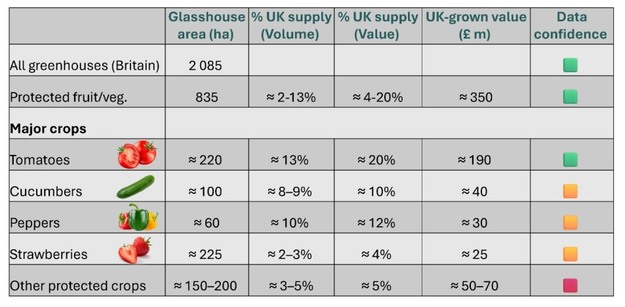
The UK greenhouse grower sector occupies a critical position at the intersection of food security, energy systems, labour markets, and regional development. Yet despite being a sector with significant productive capacity and strategic relevance, it's one that remains structurally exposed and increasingly vulnerable to external shocks. The market outlook in a newly published independent market intelligence report is therefore finely balanced between stagnation and transformation.
The report, developed by The Greenhouse Innovation Consortium (GIC), UK-wide network of growers, industry partners, researchers and public-sector stakeholders, examines the structure, financial dynamics and resilience of the UK greenhouse grower sector. Drawing on company accounts, third-party datasets and sector evidence, the report provides one of the most detailed assessments to date of how UK greenhouse production is performing under current economic conditions. "The UK greenhouse sector is highly productive and strategically important, but it is operating with very little headroom," said Sven Batke, lead author of the report. "Many businesses have grown in scale, but not in resilience. High energy exposure, labour constraints and long-term debt mean that even well-established growers remain vulnerable to shocks."
 © Freshplaza
Risks of continued inaction
Stated in the report, continued inaction carries clear and escalating risks. "Without intervention, the sector is likely to experience further consolidation, delayed capital renewal, and heightened exposure to energy and labour volatility. Ageing infrastructure will become progressively less efficient, while workforce shortages and skills gaps will constrain output even where demand exists. Over time, this will erode domestic production capacity and increase reliance on imports, amplifying exposure to geopolitical, climatic, and supply-chain disruptions", the researchers conclude.
In this scenario, losses would not be evenly distributed. "Mid-sized and legacy operators are most at risk, accelerating a two-speed sector in which capacity becomes increasingly concentrated among a small number of large businesses. Such concentration may preserve headline output in the short term, but it reduces systemic resilience and increases vulnerability to site-level failures."
Conditions under which the sector becomes investable
The researchers conclude the sector becomes investable when risk is reduced to a level commensurate with long-lived infrastructure investment. "This requires a shift from short-term, fragmented interventions toward coordinated frameworks that provide certainty over demand, energy transition pathways, labour availability, and planning outcomes. Long-term offtake signals, particularly through public procurement and anchor institutions, can stabilise revenues. Clear energy policy and infrastructure alignment can de-risk decarbonisation investments. Workforce development and migration pathways aligned to year-round production can stabilise labour supply. Importantly, investability does not depend on subsidy alone. It depends on predictability, coherence, and risk-sharing, enabling private capital to engage with confidence."
Time sensitivity of decisions
Timing is critical, the researchers conclude. "Decisions taken in the next few years will lock in infrastructure, energy systems, and workforce models for decades. Delayed action increases the likelihood that necessary investment will be postponed or diverted elsewhere, while policy uncertainty raises the cost of capital and discourages innovation deployment. Conversely, early coordination can capture existing momentum, prevent further erosion of capacity, and position the sector to respond to future shocks. The sector's small physical footprint and concentrated company base mean that timely intervention can have rapid and material effects. Delay, by contrast, risks crossing thresholds beyond which recovery becomes significantly more difficult and costly. "
Final market intelligence judgement
From a market-intelligence perspective, the UK greenhouse grower sector is neither failing nor secure. "It is operationally successful but structurally fragile, delivering high output under conditions that are increasingly misaligned with its risk profile", Sven explains. While the sector exhibits high economic and infrastructural intensity, it lacks the revenue stability required to support long-term, private investment, resulting in structural imbalance.
The central judgement of the report is that the sector's future will be determined not by technology or demand, but by coordination. "With aligned policy, investment and procurement, greenhouse growing can evolve into a resilient component of national food and infrastructure systems. Without such alignment, it will remain a case of scale without security: productive, but perpetually exposed."
The report is intended as market intelligence for growers, industry stakeholders, investors and policymakers, and aims to inform discussion on how UK greenhouse production can remain competitive, resilient and viable in the years ahead.
Click here for the full report.
For more information:
Sven Batke (e-mail)
The Greenhouse Innovation Consortium
www.edgehill.ac.uk/industry/access-our-expertise/gic/