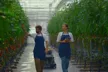
More than 30 graduates from agricultural colleges found their way to the smart greenhouse in Suining. The biggest challenge came before any seeds were planted – the soil itself.
"The soil in Suining is short on organic matter," said Bao Wen, the group's leader and an agricultural digital technician. "You can't grow high-quality vegetables here without changing what's underground."
The team turned to biological technologies for solutions. He Sijun, a microbial fertilizer specialist, led months of experiments to identify the most effective strains. "We selected five types of bacteria and ran more than 20 trials over three months," He said. "In the end, two stood out – bacillus subtilis and lactic acid bacteria – for fermentation efficiency, soil improvement and pest control."
Rather than adding nutrients directly, the microbes rebuild the soil's nutrient cycling, which in turn improves productivity even in nutrient-poor soil. The trial phase was physically demanding. Improving 50 mu (about 3.3 hectares) of land required spreading more than 150 tonnes of organic fertilizer. Each bucket filled with fertilizer weighed over 10 kilograms, and workers had to carry dozens of loads a day.
Read more at CGTN