As indoor and vertical farming operations continue to mature, much of the technical conversation has focused on lighting efficiency, automation, and crop genetics. Increasingly, however, growers and suppliers are paying closer attention to a more foundational component of controlled-environment agriculture: the grow room itself.
Modular grow room designs, in particular, are being used in some indoor farming operations to support tighter environmental control while allowing systems to be configured around specific crop or production requirements. By standardizing the physical environment, growers can focus on fine-tuning inputs rather than compensating for structural limitations.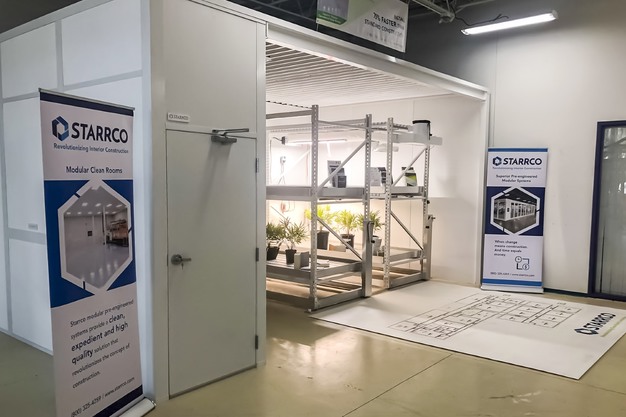 © Starrco
Environmental control beyond individual components
Temperature, humidity, airflow, lighting, and irrigation are often discussed as discrete systems, but in practice, their performance is closely linked to the physical environment in which they operate. Enclosed grow rooms enable the management of these parameters collectively, reducing variability and improving consistency across crop cycles. They play a central role in how environmental variables are managed, integrated, and scaled across indoor farming systems.
Rather than functioning as passive containers for technology, they are increasingly viewed as active infrastructure that influences climate stability, biosecurity, and operational flexibility. Investing in a modular grow room system allows for more precise control of these variables. The space can be tailored to the needs of the crops instead of conforming operations to the limitations of the space.
Scalability and operational continuity
One of the recurring challenges in indoor farming is expansion without disrupting production. Retrofitting or extending permanent structures often introduces downtime, which can affect harvest schedules and supply commitments.
"With other types of construction, it's difficult to remain in production while expanding," says Bryan Carey, President of Starrco. Starrco is a U.S.-based supplier of modular grow rooms (and other structures) across multiple industries. "Downtime can translate directly into lost harvests and revenue."
Prefabricated or modular grow rooms can be used to address this issue, allowing facilities to add capacity incrementally without halting existing operations. This approach offers a degree of flexibility that traditional construction does not. Starrco's modular grow rooms are pre-engineered for indoor cultivation, including electricity and climate control features, and they can be easily customized for application-specific needs.
Biosecurity and resource management
Enclosed grow rooms also contribute to pest and disease management by acting as a physical barrier between crops and external environmental pressures. This is one reason controlled-environment systems are often associated with reduced chemical inputs, particularly in comparison to open-field production.
Beyond biosecurity, resource efficiency remains a key consideration. Water reuse, airflow optimization, and targeted climate control are easier to manage in contained environments, where losses can be more effectively monitored and minimized.
Deployment timelines and financial considerations
Time to deployment is another factor influencing how growers evaluate infrastructure decisions. Traditional greenhouse or facility construction can take months or longer before production begins. Modular systems, by contrast, may be installed more quickly, depending on permitting and site conditions.
From a financial perspective, some modular structures may be treated differently from permanent buildings for depreciation or tax purposes, depending on the jurisdiction. These considerations vary widely and are subject to local regulations, but they can influence how growers assess capital expenditure and return timelines.
An evolving role for grow room infrastructure
As indoor farming continues to scale and diversify, the grow room is increasingly seen as more than a backdrop for technology. Its design can influence how effectively systems integrate, how easily operations expand, and how resilient production remains over time.
While lighting, automation, and data remain central to controlled-environment agriculture, the physical environment that houses these systems is becoming a more prominent part of the conversation among growers, suppliers, and investors alike.
For more information:
Starrco
Bryan Carey, President
[email protected]
www.starrco.com
Why grow room design is becoming a central consideration in indoor farming