As the horticulture industry shifts toward high-tech precision agriculture and mega-projects, the pressure on growers is intensifying. Tal Netzer, CEO of DryGair, discusses the company's roadmap for 2026, designed to solve the real-world problems that keep operation managers awake at night. "Over the last decade, we proved that controlling humidity is the key to unlocking energy savings and maximizing yield," says Netzer. "However, with the rise of large-scale projects, the question is no longer just how to grow, but how to maintain control, cut costs, and ensure uniformity in an environment of increasing scale."
 © DryGair
Gaining control from the office
One of the primary challenges in facilities spanning 10 or 20 hectares is the inability to manually monitor every sector. "A delayed reaction to a climate spike in a distant sector can compromise the harvest," Netzer explains.
To bridge this gap, DryGair is introducing its New Smart Controller and Remote Controller Display (RCD). "This technology transforms the unit into a transparent partner visible from the office via Modbus connection," says Netzer. He also points to the near future: "We are actively developing full mobile accessibility. Soon, growers will be able to monitor and control their climate from anywhere, giving them peace of mind even when they are away from the site."
Eliminating microclimates in massive spaces
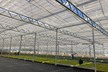
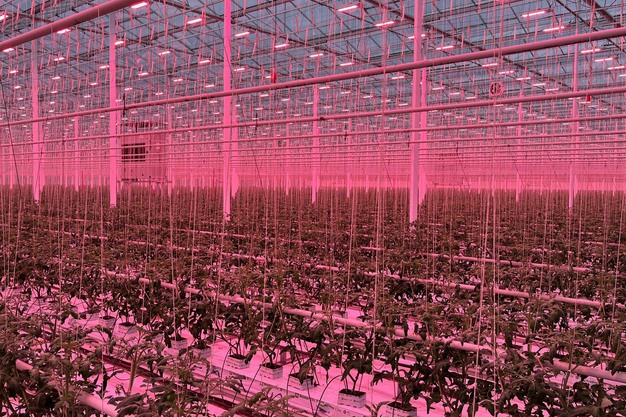
For large-scale vegetable producers, stagnant air and microclimates are significant threats. "If humidity and temperature aren't uniform, neither is the yield," states Netzer.
In response, the company has redesigned its flagship unit, the DG-12, to tackle the physics of massive greenhouses. "The new model features a slimmer profile and improved efficiency ratings. It is engineered to ensure absolute climate uniformity across vast areas, effectively eliminating the 'dead zones' where diseases thrive," Netzer notes.
Continuous operation in any climate
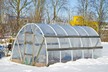
Addressing the needs of growers in colder regions, Netzer highlights a common dilemma: shutting down dehumidification to prevent freezing versus risking equipment damage.
"To solve this, we introduced the Defrost Coil," explains Netzer. "This feature enables operation in environments as cold as 6ºC, allowing for continuous humidity control without freezing. It ensures the climate remains optimal 365 days a year, regardless of the weather outside."
 © DryGair
Efficiency in any space
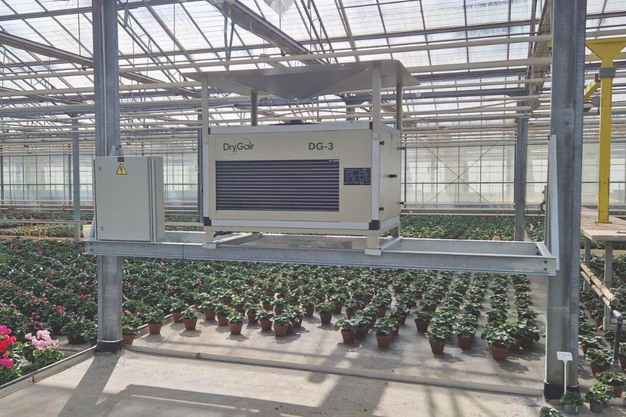
Acknowledging that greenhouse infrastructures vary significantly, Netzer discusses solutions for facilities with spatial constraints. "Low ceilings, narrow aisles, or strict regulations often limit the use of standard units. To address this, we developed the new DG-3."
According to Netzer, the DG-3 is designed to fit where others can't. "It offers the highest efficiency dehumidification on the market with lower operational costs, making it the ideal choice for facilities with specific zoning demands-without sacrificing performance or our unique airflow."
 © DryGair
A verified protocol for success
"Technology is only as good as the knowledge behind it," Netzer emphasizes. "We don't just sell machines; we share expertise. Backed by our expanded Agronomy and Engineering Support Teams, we guide growers from initial energy calculations to real-time field optimization."
Ready for 2026
"We are executing this vision with market leaders and top-tier vegetable producers who use DryGair as a strategic tool for profitability," Netzer concludes.
"We are ready for the year ahead. I invite growers to share their specific pain points with us. We will analyze the data to provide a recommendation engineered specifically for their operation-focusing on the solution that delivers the best possible Return on Investment (ROI)."
For more information:
DryGair
www.drygair.com