According to Kola Olatunji, Lead Agronomist at Starcrest Integrated Farms, Abuja, many of the production failures observed in Nigerian greenhouses are not the result of isolated pest outbreaks, but of systemic stress that accumulates within the production cycle.
His work focuses on greenhouse-grown tomatoes, peppers, cucumbers, cantaloupes, and other high-value vegetables increasingly produced around Abuja and other emerging horticultural hubs in Nigeria. In these systems, insect pests such as thrips, whiteflies, aphids, and spider mites are consistently present. However, their role as primary yield-limiting factors is often overstated.
"In most Nigerian greenhouse systems, insect pests become a serious problem only when plants are already compromised," Kola explains. "When root health and environmental conditions are stable, insect pressure is usually manageable without excessive chemical intervention."
 © StarCrest
Root-zone challenges under local conditions
Across Nigerian greenhouse operations, he identifies soil- and root-zone–related problems as the most persistent constraint to productivity. Fusarium wilt, bacterial wilt caused by Ralstonia spp., Pythium and Phytophthora root rots, root-knot nematodes, and tomato stem rot are commonly encountered. These issues are frequently exacerbated by high temperatures, inconsistent water quality, over-irrigation, and poor drainage; conditions that are widespread in many local production systems.
"Most disease problems we see are stress-driven," he notes. "They develop when plants are exposed to prolonged root-zone stress rather than from sudden pathogen introduction."
In practice, many crop losses attributed to disease outbreaks are linked to cumulative factors such as salinity buildup from excessive fertilizer use, oxygen deprivation in saturated root media, and unstable root-zone temperatures. These conditions weaken plant defenses and allow opportunistic pathogens to dominate.
 © StarCrest
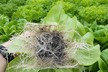
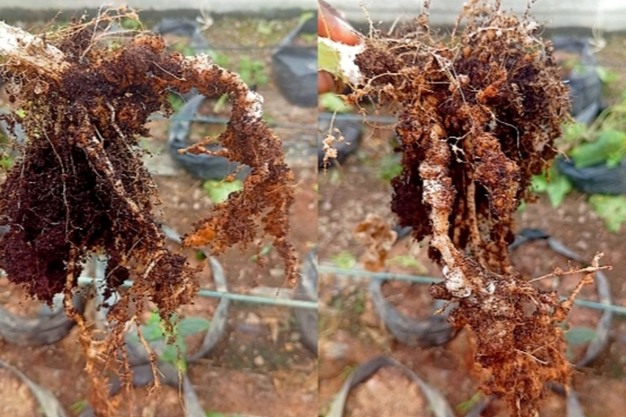
Root-knot nematode infestation diagnosed on sweet pepper roots, showing characteristic galling that often leads to reduced nutrient uptake, plant stress, and yield decline in intensive vegetable production
 © StarCrest
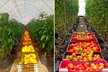
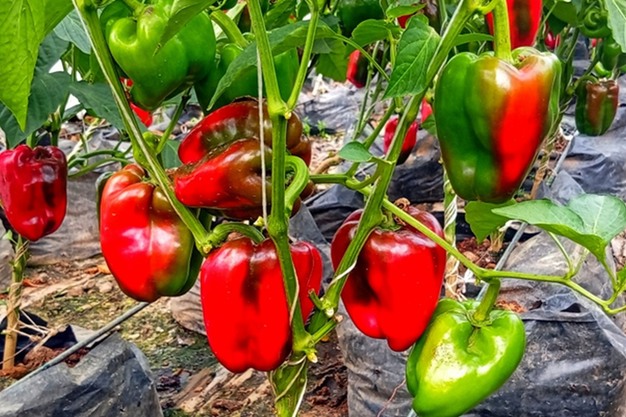
Sweet pepper crop established in the same greenhouse production area after crop termination and improved root-zone management, showing healthy vegetative growth and uniform development
Commercial impact on Nigerian greenhouse operations
Kola observes that many commercial greenhouses struggle not due to market limitations, but because pest and disease challenges undermine production stability.
A key limitation is the declining effectiveness of chemical-only control strategies. "Repeated use of the same insecticides and fungicides has led to resistance, particularly in thrips and mites," he says. "In addition, product performance under Nigerian greenhouse conditions often falls short of expectations due to application challenges and environmental variability."
Soil fumigation and heavy fungicide use have also produced mixed results. Beyond cost implications, these practices can degrade soil structure, reduce beneficial microbial populations, and increase safety risks. "In the long term, they weaken the biological foundation of the production system."
 © StarCrest
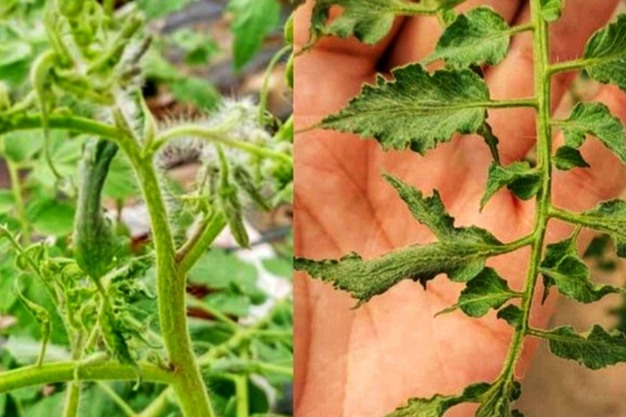
Cherry tomato plants exhibiting growth distortion and chlorosis caused by physiological stress, a condition frequently misdiagnosed by growers as herbicide injury under greenhouse conditions
 © StarCrest
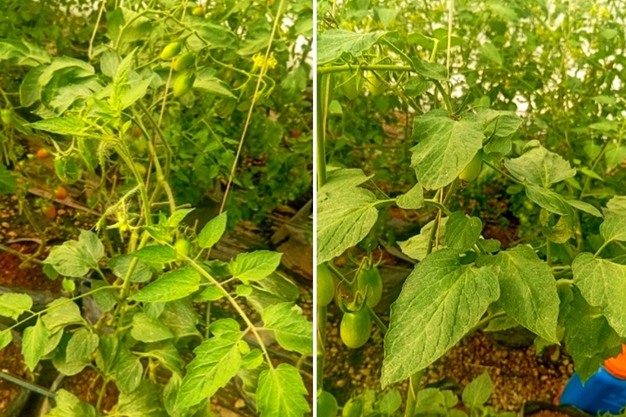
Improved tomato growth and canopy recovery following corrective root-zone and nutrient management after initial physiological stress diagnosis
 © StarCrest
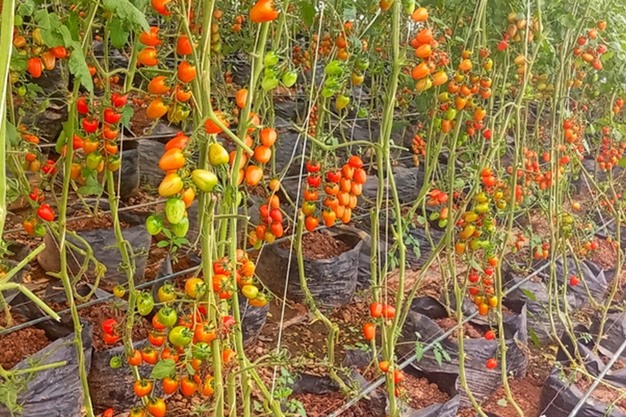
Healthy cherry tomato crop showing uniform growth, good canopy structure, and stable fruit development
Integrated management in a Nigerian context
His management philosophy is built on the recognition that pest and disease pressure is closely tied to root-zone health, irrigation management, nutrition, and environmental control. This is particularly relevant in Nigeria, where temperature fluctuations, humidity spikes during the rainy season, and inconsistent greenhouse airflow are common.
"Correct diagnosis is critical," he emphasizes. "Physiological stress is frequently misdiagnosed as pest damage or chemical injury, leading to interventions that intensify rather than resolve the problem."
To address recurring root-zone stress, he developed a silica-based formulation, NatoshiBio, designed to support plant resilience within an integrated management framework. On-farm split-plot trials conducted under Nigerian greenhouse conditions showed improved root health, reduced disease pressure, and faster recovery from stress in treated crops.
"The aim is to stabilise the system," he explains. "Reducing dependence on chemicals while strengthening the plant's ability to cope with local stress conditions leads to more consistent outcomes."
Growers adopting this approach have reported lower spray frequency, reduced input costs, improved crop uniformity, and more predictable harvests across successive production cycles.
Prevention and root health as strategic priorities
In Nigeria's high-risk production environment, prevention remains the most cost-effective strategy. Kola stresses the importance of maintaining a biologically active root zone and managing crops as integrated ecosystems rather than as isolated inputs.
"Healthy roots are the first line of defence against pests and diseases," he says. "They also determine how efficiently plants use nutrients, which is critical where fertilizer costs are high."
Key practices include avoiding over-irrigation, ensuring adequate drainage, and regularly monitoring EC, pH, moisture content, and root-zone temperature. In soilless systems commonly used in Nigerian greenhouses, maintaining adequate oxygen availability is particularly important.
Kola is currently involved in projects aimed at rehabilitating underperforming and abandoned greenhouses across Nigeria. These initiatives focus on restoring root-zone performance, correcting salinity issues linked to fertilizer misuse, and integrating biological inputs into conventional fertigation programs to improve nutrient availability and efficiency.
He is also working on the development of disease-suppressive growing media suitable for Nigerian soil-based and substrate-based systems, with the goal of improving resilience under local production conditions.
One of the most significant challenges remains guiding growers through the transition from chemical-dependent models to more balanced, biologically supported systems. "The transition has to be gradual. Through on-farm trials, data tracking, and stepwise integration, growers can maintain productivity while building more resilient and sustainable greenhouse operations suited to Nigeria's realities."
For more information:
StarCrest Integrated Farms
Kola Olatunji, Lead Agronomist
[email protected]
www.linkedin/kolaolatunji
www.starcrest.ng