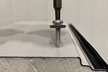
Making construction panels from eggplant residuals may sound unusual, but Reduco has made it a reality, according to Greenport West-Holland. The panels are not only fully circular, they are also moisture resistant and fire safe. In the coming years, founder Wilfried Martens hopes the market will embrace the product so that production can be scaled up.
Wilfried Martens originally worked as a dairy farmer, but at a certain point he chose a different path. He wanted to leave agriculture behind. By chance, he came into contact with the eggplant nursery Greenbrothers in Zevenbergen. Together, they began exploring whether residual streams from eggplant production could be transformed into building panels. This idea led to the founding of Nova Lignum thirteen years ago, although that company eventually went bankrupt.
Reduco is the successor, or more precisely, part of the successor to Nova Lignum. Reduco operates as the production company of the cooperative Beyond Wood. This cooperative focuses on adding value to residual streams for the construction sector, initially using willow residuals. Once it proved possible to produce building panels from willow, the next idea was revived as well, using residual streams from eggplants to create a new, circular building material.
 © Greenport West-Holland
Wilfried, why is there a cooperative and a company?
"It is important to create a high-quality building material to compete in construction, because you are dealing with competition from current products. By working together in a chain, you can create value together and strengthen each other. That is why the entire chain is represented in the cooperative Beyond Wood. It is a way to work together towards social goals and find better solutions than each on their own."
How did the collaboration with Greenbrothers go?
"They are innovative entrepreneurs; they were early adopters of geothermal energy and were open to new steps. The relationship and trust are the basis of our collaboration. And Reduco is also located in the company hall of Greenbrothers, so when the panels with willows succeeded, we thought: now we must also start working with eggplants."
How did the processing of the eggplant stems go?
"From a technical point of view, it can be done, but the preparation is complex. There can be no strings, leaves, or hooks mixed in, we truly need nothing but the stem itself. That means a great deal of additional manual work during the preparation stage. Still, it has been achieved.
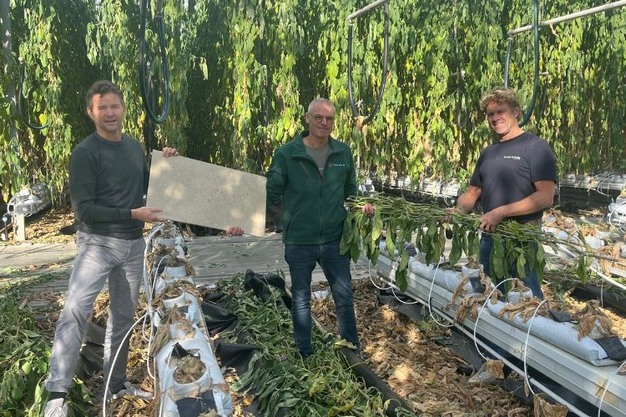
"The first panels are now ready. There are only a few of them, but they are enough to demonstrate to the construction sector that this approach works, and that the panels are moisture-resistant and fire-safe."
So it's a matter of waiting for the market?
"Circularity is becoming increasingly important in the construction industry. At the same time, introducing new materials requires a careful and well-considered approach, the building sector is, by nature, a cautious one. Further investment is only possible once the market shows real confidence in these innovations. To get there, additional funding will be needed.
"Until that moment, the processing of eggplant stems is temporarily on hold. As soon as the market starts to move, we can pick up these eggplant residual streams again and, from there, expand to processing other plant-based residual streams as well."
Bioboost platform
The eggplant stems are also included in Bioboost. This platform bundles biobased initiatives within horticulture.
Source: Greenport West-Holland