Dutch technology is set to play a bigger role in India's push to grow high-value crops in greenhouses under the HortiRoad2India public-private partnership, with strawberries emerging as one of the first focus crops. "Three new strawberry greenhouse projects are being developed in India, representing a first test of how Dutch systems and Indian horticulture can work together under increasingly challenging climate conditions." That is the message from Desh Ramnath, Head of PIB HortiRoad2India and Director India for Dutch Greenhouse Delta, and Tiffany Meijer, project manager trade Horticulture & Food at InnovationQuarter and Rotterdam Partners, who are closely involved in these projects.
Dutch Greenhouse Delta represents a cluster of greenhouse builders, technology suppliers and knowledge partners that promote complete horticultural solutions abroad, while InnovationQuarter and Rotterdam Partners are regional economic development agencies for the Rotterdam-The Hague area that support companies with their international expansion. In India, the three organisations, together with the Dutch government, have been working under the HortiRoad2India programme to bring Dutch companies into contact with Indian investors, growers and government bodies. Meijer explains that their role is to "connect the dots" between market, technology, finance and local partners, rather than push any single supplier.
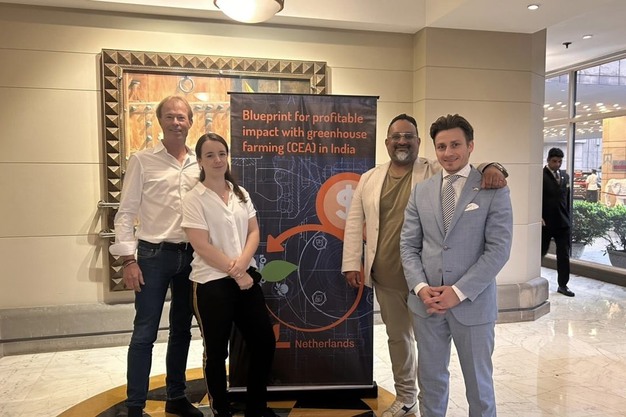 © HortiRoad2India
The three strawberry projects will span several hectares in different climate zones in Punjab, Karnataka and Tamil Nadu. Ramnath highlights, "There are no high‑tech glass greenhouses in India yet, but Dutch companies have decades of experience building and operating such systems in deserts with plus 50‑degree summers, Nordic climates with minus 20‑degree winters and rainforest areas with extreme humidity." Meijer adds that India already has several closed‑environment greenhouses, but using them for strawberries will give the segment a fresh twist: "Strawberries were chosen as a first crop because they combine strong consumer demand with clear climate challenges to grow year‑round. They are unforgiving; if the climate and fertigation are not right, the fruit shows it very quickly, and so does the business model."
Ramnath further explains the gap between current yields in many Indian protected strawberry set‑ups and what is common in Dutch systems. "In basic or mid‑tech structures, Indian growers might be reaching half a kg or even lesser per sq. meter with more fluctuation over the season. By moving to a fully integrated climate approach with advanced screening, ventilation, irrigation and fertigation guided by climate computers, the aim is to move Indian projects closer to 17 kg per sq. meter with Dutch technology, while also producing more kilos per litre of water."
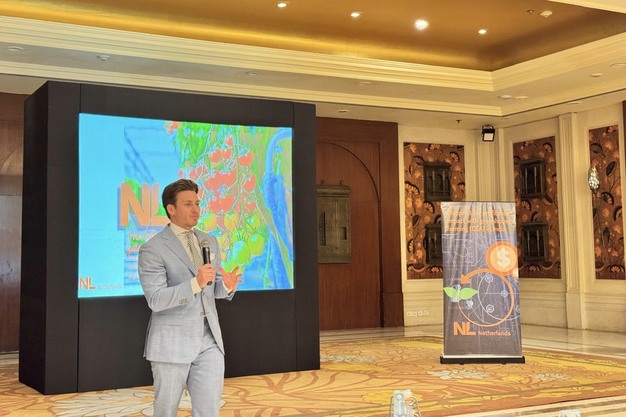 © HortiRoad2India
Both Meijer and Ramnath emphasise that knowledge transfer will be critical once the projects are operational. Growers and technical staff are expected to receive training on site and through ongoing remote support, with the aim of building local expertise that can later be applied to other greenhouse crops. "It is no longer just about whether one can build a greenhouse," Meijer explains. "It is more about training manpower, making realistic yield projections and connecting those volumes to retail or HoReCa programmes." For Dutch suppliers, she says, the challenge is to work with Indian realities relating to energy, water, labour and financing, rather than copy a European blueprint. Over the past three years, work under the HortiRoad2India umbrella has also looked at education, including the development of a training programme that can be used by Indian educational institutes.
Once up and running, the strawberry sites are expected to act as reference locations where growers, retailers and officials can see real productivity figures over multiple seasons rather than just in trial plots. Ramnath and Meijer see them as stepping stones toward a broader Indo‑Dutch partnership in high‑tech horticulture, with scope to expand into crops such as blueberries, tomatoes, peppers and leafy greens once the strawberry model has proven itself. "If these projects can demonstrate a clear yield and quality advantage that still fits Indian cost structures, it will become much easier for both, Indian partners and Dutch companies, to commit to larger, long‑term investments in climate‑resilient greenhouse production," Ramnath concludes.
For more information:
Tiffany Meijer
InnovationQuarter and Rotterdam Partners
Tel: +31 6 34 14 80 04
Email: [email protected]
www.innovationquarter.nl
www.rotterdampartners.nl
Desh Ramnath
Dutch Greenhouse Delta
Tel: +31 6 53 39 98 68
Email: [email protected]
www.dutchgreenhousedelta.com