Hydrogen peroxide has been in the spotlight recently because the Netherlands Food and Consumer Product Safety Authority is monitoring its use in greenhouse horticulture more closely.
"Many growers are wondering what this means for their water management," the Van der Ende Group team explains, "And their concern is understandable. Hydrogen peroxide is a familiar product to many, but the attention of inspection services shows that it is wise to look for future-proof alternatives."
Why hydrogen peroxide is used
The product is used because it reacts powerfully to organic contamination. It can break down biofilm, keep pipes cleaner, and help reduce microbiological pressure. However, its effectiveness depends heavily on water quality and correct dosage.
"Too little has insufficient effect and too much can damage materials or harm crops. As a result, hydrogen peroxide requires a lot of attention in practice and remains a product that combats symptoms rather than eliminating the source of contamination."
Limitations of chemical dependence
The sector also notes that dependence on chemical agents makes it vulnerable. Regulations are changing, registrations are becoming stricter, and there is an increasing need for solutions that perform consistently without additional supervision. It is logical that growers are looking for techniques that keep the water system structurally cleaner.
Ultrafiltration as a future-proof alternative
"Ultrafiltration fulfills that role. This technique filters water through membranes with extremely small pores so that viruses, bacteria, fungi, and suspended solids are blocked and removed while water, ions, and nutrients pass through," Van der Ende Group explains.
This is an important difference from disinfection techniques such as ozone or UV, which kill microorganisms but leave the pollution behind. These residues can rebuild themselves into biofilm and thus burden the system.
 © Van der Ende Groep
Structurally cleaner water system
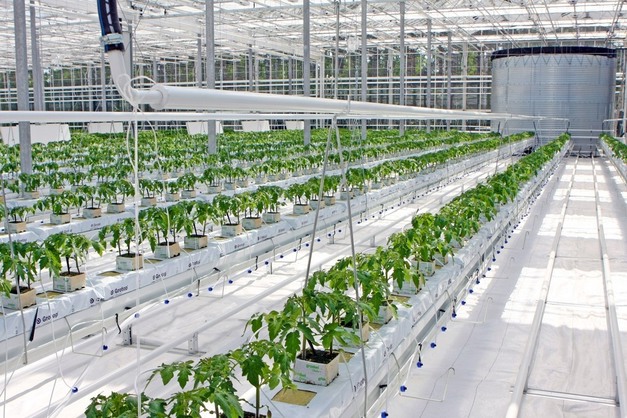
By physically filtering, ultrafiltration tackles the cause of contamination. It produces clear water with a more stable quality. Pipes and drip hoses remain cleaner and the risk of blockages is significantly reduced.
"What this means is that chemical agents are needed less often. Many companies that switch see a sharp decline in their use of hydrogen peroxide, simply because there is less contamination to combat."
Proven horticultural technology
Ultrafiltration is also a proven technology that is used worldwide in water purification. For greenhouse horticulture, this method has been further optimized to suit everyday practical conditions in which reliability, reuse of nutrients, and continuous availability are important. The result is a predictable water system that is less sensitive to fluctuations in water quality.
Practical step forward
The focus on hydrogen peroxide shows how important it is to work with a water system that does not depend on chemical corrections.
"Ultrafiltration offers that certainty because it provides structurally clean and predictable water. For growers who want to know what this can mean in their own situation, a system such as Kathari is a logical step. The water treatment specialists at Van der Ende Group are happy to help you find a suitable approach."
For more information:
Van der Ende Group
Email: [email protected]
vanderendegroup.com/