Tomatoes are under pressure, while cucumbers are seeing a remarkable price spike. That is the current situation for greenhouse crops at BelOrta. "In the winter period, we work exclusively with tomatoes and cucumbers, but while we are seeing pressure on tomatoes, there are still good opportunities for cucumbers," says Maarten Verhaegen of the Belgian cooperative.
"For tomatoes, we remain heavily dependent on pricing in southern Europe and North Africa," he explains. "Given the huge areas there, and we are talking about tens of thousands of hectares, we are experiencing pressure for obvious reasons. We also notice that Belgian retailers are betting less and less on local production. That is, of course, a great shame, because our product is of better quality and fresher, there is no doubt about that. It is often in shops the very day after harvest."
 © Sander Bruins Slot | HortiDaily.com
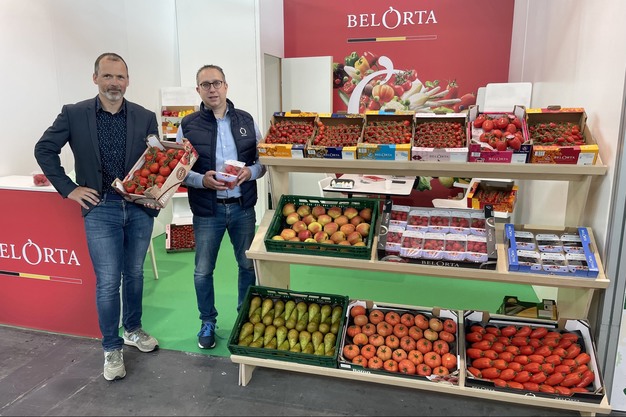
Maarten Verhaegen and Davy Smets of BelOrta at the past Macfrut
"But we see that the focus at retail is increasingly on returns. Origin is communicated less and less to consumers, which makes it harder for the local story to carry weight. Fortunately, there are still retailers who consciously opt for quality and local products, and things are going well. However, choosing a non-local product has a negative impact on our young and greenhouse crops that are currently in progress or starting up. These are factors we unfortunately have little control over ourselves."
Maarten sees this pressure starting earlier and earlier in the season. "We feel it especially when the Spanish season really gets going, but these days that is already around week 42. Our traditional crops then continue for a few weeks, so it does not always align well. Spanish, but also Moroccan and Turkish production, then tries to gain market share, leading to difficult pricing. This year was no different."
Economic considerations
So is he worried that this situation will deter growers from choosing supplemental lighting for tomato production? "Growers with specialty crops, such as cherry tomatoes and flavour tomatoes, remain committed to year-round production. This also applies to greenhouse crops. With more classic vine tomatoes, we do see that growers with exposure may start considering entering production only in January. The advantage at BelOrta is that we have a good acreage of autumn crops without lighting, and these were of excellent quality this year. This allows us to continue producing year-round in most segments."
"The decision not to continue certain crops in winter is then mainly a purely economic one. For example, growing cherry tomatoes in our region in winter is hardly profitable due to strong competition and the price difference with southern Europe. Moreover, retail wants to communicate origin less and less in winter, which removes our USP. In that case, growers sometimes choose to disinfect the greenhouse and only re-enter production around week 10."
Market recovers
Still, Maarten explains, the tomato market has recovered somewhat in the meantime. "The first large productions from southern Europe are largely over, the old crops are almost gone, and the newer ones, including autumn crops, are now coming in at a more normal price level. Not exceptionally good, but prices are appropriate for this period. Towards the holidays, we also see higher consumption, which works in our favour. The same applies to specialities. After a difficult period from about week 44 until last week, we are now seeing demand pick up again, also for exports. These are mainly focused on the UK, France, and Germany, in addition to Belgium and the Netherlands. These are nearby markets where we can play our freshness advantage better than in summer."

Will the cucumber price spike continue?
"For cucumbers, we see a completely different story," he continues. "The price with us is currently as high per unit as the kilogram price in Spain. That picture is somewhat distorted, however, because our acreage is relatively small at the moment, about three hectares, although this will soon be expanded. So where did this sudden price increase come from? It is due to several factors. In German retail, there were many promotions at the start of the Spanish season, which led to extremely low prices. Of course, that is also not bad for our growers, but it remains to be seen whether this is just a snapshot in time."
"We will only be able to say at the end of January whether it has actually been a good season or whether it has collapsed. It is expected that more cucumbers will be marketed in Spain in January due to problems in pepper cultivation there. It seems that some large and medium-sized companies have pulled out peppers and planted cucumbers instead. If these volumes enter the market, we could see a very different situation by the end of January."
Support for greenhouse cucumber cultivation
Nevertheless, he strongly believes in the future of late and greenhouse cucumber crops. "Growers can produce competitively and are not necessarily more expensive than Spanish product, especially when logistics costs are taken into account. I do not expect traditional tomato growers to switch en masse to winter cucumbers. However, growers who originally grew cucumbers and are now planting autumn tomatoes may well switch to late or lighted cucumber crops. I believe there is support for that."
In addition, the fact that local origin no longer always dominates retail does not mean that freshness is not preferred, he explains. "Retailers increasingly prefer very fresh product, not necessarily local, but product that is harvested today and in shops tomorrow. A cucumber from Spain is often three to four days in transit, sometimes longer. In that respect, there are real opportunities. Retailers who have now chosen Belgian or Dutch cucumbers are already indicating that they want to do so again next year. We currently supply two Belgian retailers, but there are more showing interest in purchasing this product in winter. There is clearly potential there."
For more information:
Maarten Verhaegen
BelOrta
Mechelsesteenweg 120
B-2860 Sint-Katelijne-Waver, Belgium
Tel: +32 (0)15 55 11 11
[email protected]
www.belorta.be