A recently published open letter in Plants, People, Planet, signed by growers, manufacturers, researchers and supply-chain organisations, calls for six coordinated actions to establish a national plan for protected horticulture in the UK. The paper argues that strategic greenhouse expansion is essential for food security, decarbonisation and economic resilience, and that this can only be achieved through aligned planning, energy and investment policy.
For Dr Sven Batke, Chair of the Greenhouse Innovation Consortium and lead author, the letter is less about proposing new ideas and more about addressing a structural gap that has held the sector back for years.
"The single biggest barrier is the lack of a joined-up national strategy for protected horticulture," he says. "Greenhouse food production is still not recognised as critical national infrastructure, which means planning, energy policy and investment decisions remain fragmented."
From fragmented policy to shared responsibility
One of the central proposals in the paper is shared responsibility for capital and operational expenditure. Dr Batke stresses that this is not about transferring costs to government, but about creating practical, equitable frameworks that enable investment across the sector.
"Fair cost-sharing will require a tiered framework that draws on models already working elsewhere in Europe, but tailored to the UK," he explains. "The priority is equitable access for all growers, from micro-growers to large cooperatives, while keeping administrative burdens low."
Rather than a single funding mechanism, he envisages multiple schemes linked to specific outcomes such as decarbonisation, automation, circular economy integration and regional economic benefits. "The details need to be co-designed with growers to ensure they are practical and effective," he adds.
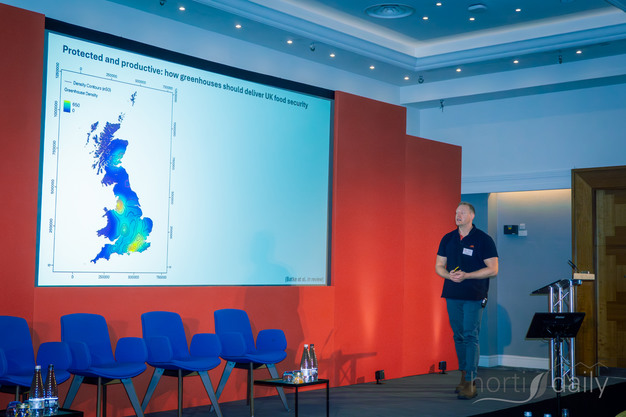 © Arlette Sijmonsma | HortiDaily.com
Dr Sven Batke this year at the British Tomato Conference 2025
Energy co-location needs strategic planning
Energy remains one of the most significant constraints on greenhouse expansion, and the letter highlights co-location with renewables, district heating and waste-heat recovery as a major opportunity. However, Dr Batke cautions that the UK currently lacks the tools to deliver this at scale.
"We do not yet have a comprehensive UK-wide picture of where co-location is most viable," he says. "We are about to submit a large research bid to develop a spatial decision-support tool that can help government and investors plan future greenhouse development."
Such a tool would need to account for energy infrastructure, land suitability and regional priorities across more than 300 planning authorities. "It's complex but essential if co-location is to be delivered strategically rather than opportunistically."
Reframing greenhouses in the planning system
For growers, planning remains a critical challenge. Dr Batke argues that progress depends on better alignment between greenhouse operators and local councils.
"Planners need access to robust mapping tools that identify optimal locations for greenhouse development, including circular economy opportunities," he says. "At the same time, growers and councils need to work together to demonstrate that protected horticulture is low-carbon critical infrastructure."
Linking greenhouse projects to local objectives such as net zero targets, job creation and regional resilience can help shift the narrative away from planning conflict towards shared benefit.
Retailers and long-term production resilience
He is clear that supply-chain stability is as important as infrastructure. "While there are positive examples, last-minute contract cancellations still occur and can lead to food waste and serious financial losses," he says. "Small and family-run businesses do not have the resilience to absorb these shocks."
He argues that fairer contracts, shared risk and longer-term commitments are essential, alongside potential expansion of public procurement through hospitals and schools.
If the sector takes only one step forward, he believes it should be collective alignment. "Growers, retailers, energy providers and planners need to engage government with one clear voice," he says. "Protected horticulture must be recognised and treated as national infrastructure. Without that shared mandate, coordinated planning will remain out of reach."
For more information:
Dr. Sven Batke, Chair of the Greenhouse Innovation Consortium
[email protected]
edgehill.ac.uk/person/sven-batke/staff/