Move over scouters, for the newly developed Fotenix India glasshouse scouting trolley system. The system is currently being trialed in commercial pepper and tomato operations across the UK, and will be available commercially next year. Abbey View and Thanet Earth will next year take part in early-access deployments.
Although – move over scouters? Fotenix CEO Charles Veys is quick to nuance this idea. "The trolley isn't intended to replace manual scouting. Instead, it complements existing workflows," he explains."It's a solution that can be embedded seamlessly into a commercial operation, speeding up adoption."
 © Fotenix India
Bringing imaging technology directly into the crop rows
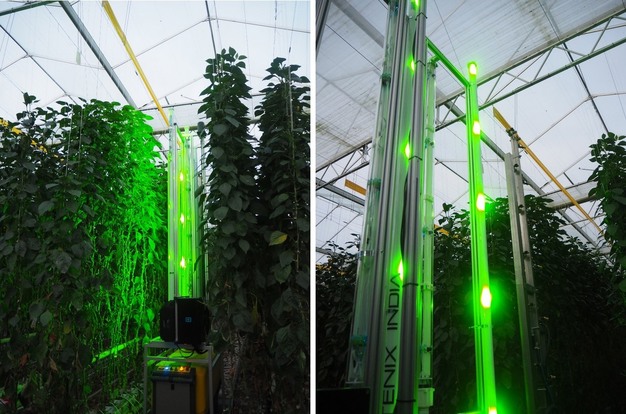
Building on the company's earlier imaging system, the new robotic trolley moves autonomously through crop rows to capture 3D multispectral images. "This way, it gives growers a consistent view of plant health across their environment," Charles says. "The robotic trolley effectively digitises crop management in glasshouses, enabling growers to spot stress early and helping them get ahead of issues that would otherwise take days to detect."
Fotenix uses 3D spectral imaging to assess the health of individual plants. Cameras and lights installed inside the growing environment scan crops at different wavelengths every evening. These scans create a highly detailed 'digital twin' of the canopy, highlighting subtle stress indicators long before they are visible to the human eye and enabling precise, targeted interventions.
All data collected by the cameras feed into Fotenix's ALPHA platform—or any compatible glasshouse management system—where growers can view heatmaps of stress, track changes over time, and see updated yield forecasts.
From fixed rigs to flexible mobile scouting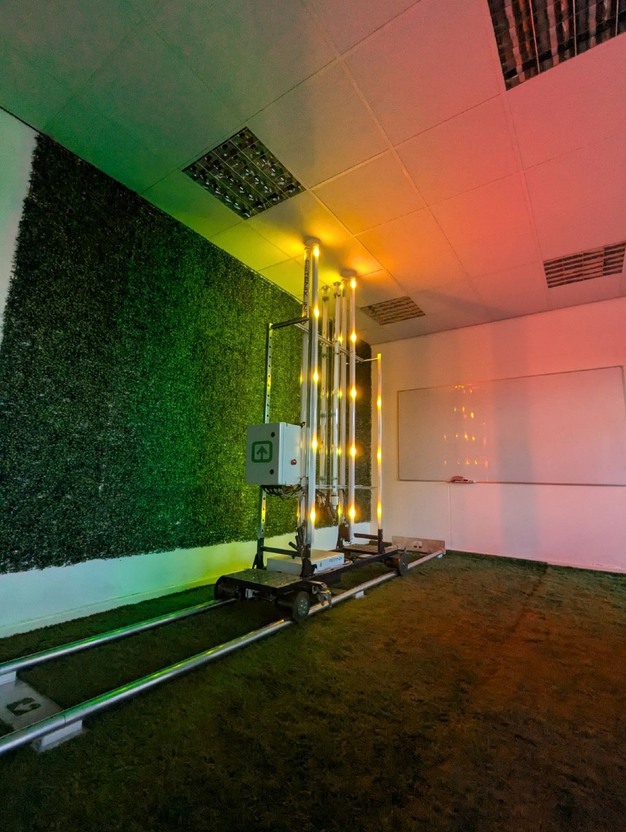 © Fotenix India
Until now, the Fotenix system has been deployed on permanently mounted rigs above trays and is already relied on by growers such as GrowUp and Angus Soft Fruits. "This is the first time it has been mounted on a robotic platform, making the technology more accessible to growers who need flexible, mobile scouting without installing fixed infrastructure," Charles notes, adding that the trolley, which is built ad a modular platform, was developed in close collaboration with Fargro Limited and NIAB and the British Tomato Growers Association. "It paves the way for robotics and autonomous workflows within the horticulture sector.
Trials, early access, and commercial roll-out
The system is currently being trialed in commercial pepper and tomato operations across the UK, though it's designed to work on any crop. Two growers—Abbey View and Thanet Earth— that already supported Fotenix during development, will also take part in early-access deployments at the start of next year. Beginning January 2026, the system will be available on early release to select growers, with full commercial availability planned for summer 2026.
Putting growers first
"The most interesting angle from our side is always the growers' point of view: what's their challenge and how can this solution help them?" Charles concludes. "Our automated platform gives growers a clear visual of the greenhouse each morning and highlights specific areas that need attention. This allows teams to respond more quickly, reduce interventions, and prioritise their time more efficiently."

For more information:
Fotenix India
Units 31-32 Leslie Hough Way
Salford M6 6AJ, UK
0161 241 8074
[email protected]
fotenix.tech