The US Biochar Initiative has launched its Growing with Biochar program with two full-day sessions in California, marking the start of a nationwide training effort that will continue through 2026. The program is designed to give growers, advisors, and agriculture professionals practical guidance on how to source, evaluate, and apply biochar in commercial systems. While the California sessions drew mostly field-based participants, new insights from USBI highlight growing opportunities for controlled environment agriculture, including vertical farms.
Biochar is produced from waste biomass such as crop residues or wood chips and is known for improving media structure, storing carbon, and supporting nutrient efficiency. These characteristics are gaining attention among growers seeking alternatives to traditional substrates and input strategies.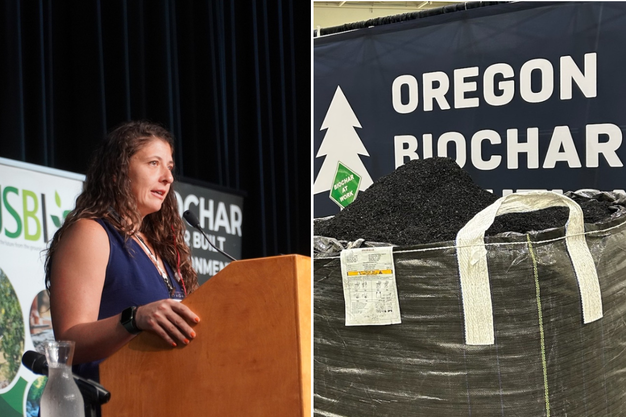 © USBI
How vertical farms fit into the picture
"Vertical farming did not come up as a specific question from California attendees, but we expect this to be a hot topic in other climate zones," said Tera Lewandowski, Director of Agricultural Markets at USBI. "The training covered several topics that align with what controlled-environment growers often want to understand. Those foundations apply across both indoor and outdoor systems.
Lewandowski noted that field-based agriculture dominated the California cohort, with discussions focused on field applications, composting, and cost-share programs. Even so, she sees strong signals of interest from controlled-environment operators.
Biochar is being tested in substrate blends
"We are aware of research groups and commercial media companies that are already experimenting with biochar in substrate blends, and those efforts have shown promising results," Lewandowski said.
She added that USBI has not yet received direct inquiries from vertical farm operators about substrate applications, but the organisation hopes to change that. "We would really like to hear from vertical farm operators to better understand their challenges and opportunities. We see significant potential for biochar to play a role in commercial growing substrates, and we would be excited to help make that possibility a reality by sharing knowledge and connecting stakeholders."
Training modules could expand to include controlled-environment needs
As the national program grows in 2026, USBI is open to developing targeted modules for indoor farms. "As we grow this training series, we are always looking for places where education and value-chain networking can help unlock adoption of biochar," Lewandowski said.
"If opportunities arise in regions or markets tied to vertical farming, we would be eager to collaborate with stakeholders to design modules that speak directly to their needs." She named input efficiency, carbon impact, and closed-loop production systems as areas where biochar could intersect with vertical farming practice.
Where biochar could fit in vertical farming systems
"Biochar can be a great fit for vertical farming because it is a lightweight substrate, ideal for racks that are not designed to hold heavier materials," she said. "It also has a high water-holding capacity and, when formulated with the right particle size, can provide plenty of airspace for healthy root growth."
She added that its high cation exchange capacity supports precise fertigation. "This works well with fertigation systems by reducing nutrient waste and improving nutrient use efficiency. In practice, that could mean fewer nutrients applied and potential cost savings for growers."
Vertical farm operators or substrate suppliers interested in exploring biochar applications are encouraged to contact Tera Lewandowski directly for guidance, resources, or potential collaboration.
For more information:
US Biochar Initiative 
Tera Lewandowski, Director of Agricultural Markets
[email protected]
www.biochar-us.org