Europe's substrate market has been tightening for months. The availability of peat and coco fiber, two pillars of intensive horticulture, keeps shrinking, and no one is expecting a quick rebound.
Francisco Frias, commercial director at Global Perlita, knows that cycle well and views the current landscape with a mix of realism and advance warning. "The worst has not arrived yet," he says. "More supply cuts are expected for Baltic peat and, even with good weather, there will be no new harvest until April or May. Those months will be under pressure, and coco fiber will be in the same position."
And although shortages push growers to look for alternatives, the challenge is not only finding another material but knowing how to use it. "Any alternative product being discussed lately can be good, but growers do not yet know how to handle it. It takes weeks, months or years to learn how a substrate works. With a sudden change, some plants would adapt well while others, more selective, would not tolerate the switch and would lead to losses. That is why perlite, a well known and proven material, is returning to the stage."
This volcanic material is appearing in increasing amounts in substrate formulations, helping keep an industry afloat at a moment when consumption continues to climb.
 © Global Perlita
A mineral shaped by geology and pulled into agriculture
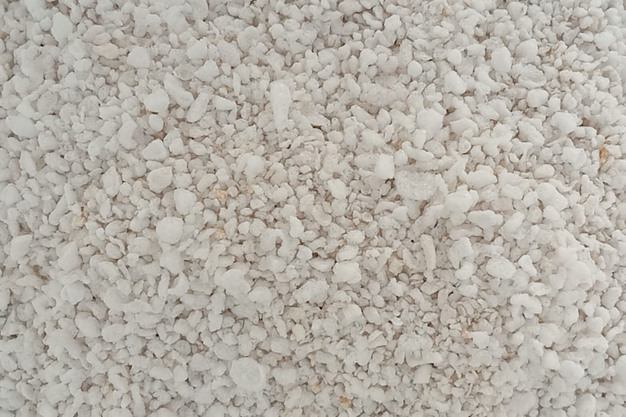
What do toothpaste, acoustic insulation panels and horticultural substrates have in common? Perlite. It is an amorphous volcanic glass rich in water that can expand more than fifteen times its volume when heated, producing a lightweight and porous material widely used in agriculture and across multiple industries.
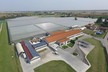
At Global Perlita's facility the company produces two materials: perlite and vermiculite, both volcanic in origin. Frias explains that their existence depends on extremely specific geological conditions, combinations of water, temperature and processes that take millions of years and do not occur in every volcano. "That is why perlite varies so much around the world. Not all of it has the same quality."
The company began operating in April 2022 and has its own factory and quarries in Turkey. Raw material is sourced there, selected by precise size ranges, and then expanded in Spain.
 © Global Perlita
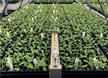
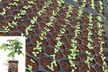
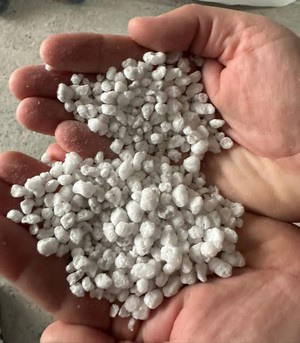
"In agriculture, perlite is mainly used by substrate manufacturers and in hydroponic systems, either alone or mixed with peat or coco. It also has applications in open field production, where its aeration and water and nutrient retention stand out. That added aeration oxygenates the roots and boosts productivity. And there is another feature few mention. Its white color reflects certain diseases, lowering the risk of root problems."
"Vermiculite, on the other hand, plays a different role. Although similar to perlite, it is more expensive due to its origin and expansion process, and its insulating capacity makes it useful for covering seedling trays and improving germination. In industry, its resistance to extremely high temperatures turns it into a key ingredient in aircraft, train and vehicle brake pads."
Global Perlita applies specific treatments to optimize perlite's functionality in each use, working hard to differentiate its quality in a market where not every producer delivers homogeneous material. "In these four years we have shown that we manufacture above the standard, and that explains our growth. A poor quality product can damage perlite's reputation, and we are showing that with excellent quality this material can reclaim the space it has lost in recent decades."
"Consumption, in fact, is growing faster than extraction. In the four years we have been active I have seen demand increase by fifty percent, and not all perlite extractors are prepared to supply such strong growth. But when the market sees that a good product used correctly delivers results, growth comes naturally."
For more information:
Global Perlita
Paraje El Bojar, S/N 04738, Vicar, Almeria
T. +34 674 86 70 60
[email protected]
globalperlita.com