A few weeks ago, HortiTech launched the trial "Blotchy Ripening: Dehumidification & Elements." The project focuses on testing new dehumidification techniques and gaining insights into climate-control parameters linked to plant physiology. Dennis Medema shared an update on Kas als Energiebron.
The greenhouse sector is working hard to reduce energy use and move toward climate-neutral production, ensuring long-term resilience. Innovations such as LED lighting play a major role in lowering energy demand in greenhouses. However, implementing these technologies often comes with start-up challenges.
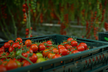
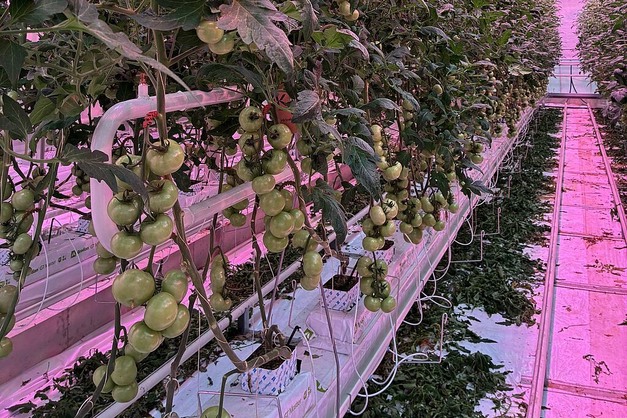
Last winter, many Dutch tomato growers struggled with blotchy ripening, with green patches on fruits that refused to colour. The issue had major economic consequences and led to significant losses in time, resources, and energy. This prompted the sector to request research into the underlying causes of blotchy ripening and the development of practical solutions.
 © Kas als Energiebron
Collaboration and trial design
This trial is a joint effort by Kas als Energiebron, the innovation programme of the Ministry of LVVN and Glastuinbouw Nederland, together with Kennis in je Kas and FVO. The experiment is being carried out at HortiTech.
The working hypothesis is that blotchy ripening is mainly triggered when plants grown under LED lighting have insufficient transpiration because of high relative humidity, limited air movement, and too little infrared heat radiation.
New techniques
The trial explores new dehumidification technologies designed to create a stable and uniform greenhouse climate. The aim is to minimise energy loss, reduce overall energy consumption, and produce a vigorous, resilient crop.
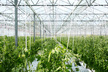
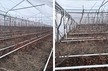
The setup consists of four greenhouse compartments: three with LED lighting and one SON-T compartment as the reference. Within the LED compartments, the team is comparing a standard LED reference (DLI), a configuration using LED fixtures with built-in fans (Climalux), and a configuration that combines DLI LED lighting with the Caeli system.
Both the Climalux system and the Caeli system have been studied earlier this year. For Climalux, the research focused on producing high-quality tomatoes under LED lighting. The key factor turned out not to be the light spectrum, typically 90-5-5, but rather the role of ventilation. The research team found enough reasons in the results to continue exploring this direction. Earlier studies with the Caeli system showed that targeted air movement can achieve a similar effect to traditional pipe heating.
Cross-crop insights
Although the trial centres on tomatoes, the underlying physiological mechanisms apply to other crops as well. Peppers and eggplants benefit from a more even distribution of heat within an active climate, which helps reduce abortion, improves fruit set, and enhances overall fruit quality. The insights are also relevant for cucumber production, as comparing SON-T heating from above with LED-based air heating provides useful information for achieving optimal fruit set and maintaining quality in lit crops.
Funding and Coordination
This project is being conducted by HortiSearch at HortiTech and is funded and coordinated by Kas als Energiebron, the innovation programme of the Ministry of LVVN and Glastuinbouw Nederland. It is supported by Kennis in je Kas (KijK) and the Federation of Fruiting Vegetable Organisations (FVO). The trial is being carried out with guidance from growers.
Source: Kas als Energiebron