Sign up for our daily Newsletter and stay up to date with all the latest news!

Subscribe I am already a subscriber

You are using software which is blocking our advertisements (adblocker).

As we provide the news for free, we are relying on revenues from our banners. So please disable your adblocker and reload the page to continue using this site.
Thanks!

Click here for a guide on disabling your adblocker.

Sign up for our daily Newsletter and stay up to date with all the latest news!

Subscribe I am already a subscriber

What happened in the strawberry industry this year?

This year's strawberry news reflected both ongoing climate-related challenges and notable advancements in production systems across key growing regions. In Spain and Greece, growers reported improved plant survival compared to recent seasons despite episodes of high temperatures and the impacts of storm Claudia.

Growers in the Netherlands installed new infrastructure, including custom Rovero polytunnels and Ultra-Clima trial greenhouses aimed at scalable, emission-free cultivation, while Belgian and Dutch facilities opened their doors to showcase modern greenhouse practices during industry events.

Developments in controlled-environment growing also advanced, with Red Sun Farms, Heritable Agriculture, and CIV reporting progress in indoor-grown strawberry breeding, and Japanese startup MD Farm promoting a fully automated, seed-based production model. Early harvests proceeded on schedule in the UK, and industry engagement extended to charitable efforts, such as Limgroup's WWF-benefiting crate sale in April.

© Fruitmasters

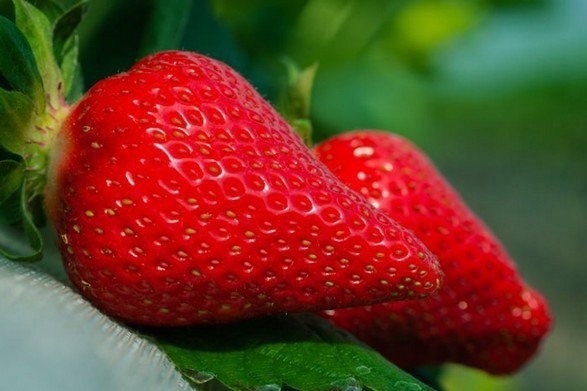
On Thursday, 17 April, Limgroup purchased a crate of Sonrosa from FruitMasters at the strawberry grower Jan van den Elzen's farm in Uden. The proceeds from this crate will be donated to the World Wildlife Fund (WWF), which, in addition to supporting pandas and rainforests, also works toward a livable planet and healthy food.

© New Forest Fruit

New Forest Fruit is one of the earliest growers to have British strawberries on the market, due the their location in Hampshire, southern England.

"We picked our first strawberries at the end of March, which is our usual starting time," said Sandy Booth, owner of New Forest Fruit. "The volumes were a bit slow to come on at the start, but the fruit size was similar to previous years."

Something is always going on at the Lokker family farm in Den Bommel, South Holland, Netherlands. It's a busy farm with a wide mix of arable crops and vegetables, a country shop, 2,300 m² of strawberry cultivation, 1,300 m² of which is under glass, and, as the latest addition, a strawberry drive-in.

© Kubo

For more than a year, KUBO has been testing in its trial greenhouse how strawberry production can be scaled up in an Ultra-Clima greenhouse, combined with our emission-free CO₂ dosing strategy. The results are already attracting international interest: we are currently implementing two large-scale projects with this system, in Canada and Saudi Arabia.

© Thijmen Tiersma | HortiDaily.com

Gestelberries, based in Hoogstraten, Belgium, was one of the companies that opened its doors as part of the International Strawberry Congress. During the visit, strawberry advisor Dirk Vermeiren from Proefcentrum Hoogstraten guided guests through the Krijnen family's greenhouses, giving them a close-up look at modern strawberry cultivation.

© Rovero

In May 2025, soft fruit grower Van As from Tricht (NL) started using a new Rovero polytunnel for strawberry cultivation. Grower Jannis van As was looking for a custom solution and found it with Rovero. "They developed an excellent all-in-one solution: a robust tunnel greenhouse with diffuse film with double continuous ridge ventilation" he says. "With this addition, we can spread out the harvest even better and grow more top-quality fruit."

© Fotis Karabetsos | HortiDaily.com

"While in the past two years, strawberry growers saw up to 20% of their plants lost due to adverse weather conditions, this year we had only half as many losses, and those occurred only in the plants that were transplanted during the last few days. The losses affected both bare-root and plug plants of all varieties, with no particular variety standing out negatively. When a plant is transplanted, it needs stable, cool temperatures for about a month. This time, at the end of October, we had warm weather, 25 degrees Celsius, with temperatures inside the greenhouses reaching up to 30 degrees, so we had to do some minor replanting," says Mr. Odysseas Kyriazis from the company Kiriazis Fruits.

© Rebekka Boekhout | HortiDaily.com

"If you want to understand why so many indoor farms fail, look at who is running them. Most of the time, there are no growers with genuine agricultural experience in the field; instead, individuals rely on borrowed knowledge from universities or tech companies. When growing strawberries, that doesn't work. Our approach is different; we combine decades of field expertise with a scalable seed-based system that eliminates viruses and makes global expansion possible," says Mr. Songtian Matsuda, CEO of MD Farm, a Japanese startup based in Niigata, developing fully automated strawberry farms.

© SAT PLUS BERRIES

The first strawberries of the 2025/2026 season are appearing in Lepe, Huelva, after overcoming weather challenges.

"The season began with high technical demands due to adverse weather, mainly high temperatures during sowing and storm Claudia," stated David Vélez, technical manager of Plus Berries, which is starting its new strawberry season with 10 more hectares.

© Red Sun Farms

Red Sun Farms, Heritable Agriculture, and Consorzio Italiano Vivaisti (CIV) have announced significant progress in their collaborative effort to develop the leading indoor-grown strawberry at the Vineland Research Station facility. This partnership combines CIV's expertise in strawberry genetics and germplasm, Heritable Agriculture's AI-driven breeding models, and Red Sun Farms' indoor growing knowledge to change how premium strawberries are bred and grown.

Related Articles → See More