"What did you think of it?"
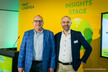
After a walk through the greenhouse at BASF | Nunhems in 's Gravenzande, we run into cultivation specialist Frans Goud. Like a few other growers visiting that Wednesday, we have just finished looking at the trial for a data driven high wire cucumber cultivation system.
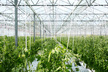
What stood out? Honestly, very little, and that is a good sign. The LED lights switched on and off from time to time. If you look closely, you can see the effect of a slightly different pruning strategy. Other than that, the crop looks clean, strong, and consistent.
While we are still in the greenhouse, Marcel Huibers, cucumber agrotechnologist at BASF | Nunhems, notices something. Once he points it out, we feel it too. A light draft of cold air is coming from along the outer wall. At that moment, the LED lights are off. Could the draft be related to that?
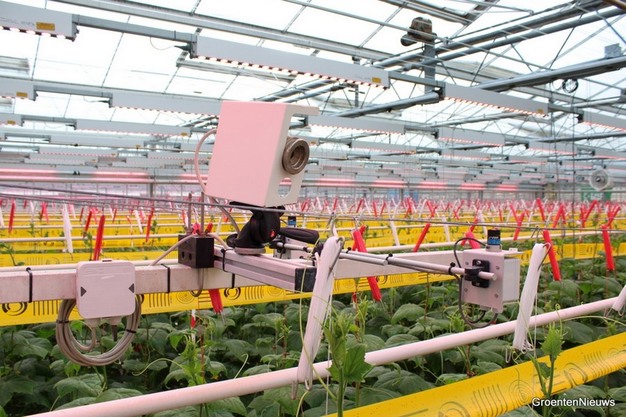 © Thijmen Tiersma | HortiDaily.comThe plant temperature meter feeds the Hoogendoorn climate computer with data
New approach to data-driven cultivation
In the BASF | Nunhems greenhouse, the first crop of the fifth project year is already growing. It is part of a long running trial focused on a data driven approach to cucumber cultivation.
Each year the team tests a different aspect so they can build a wide base of knowledge. They have tried full LED lighting ranging from 200 to 340 micromoles. In recent years they also experimented with both shorter and longer crop cycles by planting either two or three rounds per year. In 2022, during the energy crisis, they tested a much later planting date, 9 December. One factor has stayed the same across all trials, which is that the final planting density is always 2.5 plants per metre. According to the BASF | Nunhems specialists, this density is becoming more important because labour remains a challenge.
This season began on 15 October. The goal is to keep the total amount of light per day fixed. In the first crop cycle, natural sunlight plus LED light together must reach 20 mol per day. The climate computer controls this with an intelligent lighting programme. "Every fifteen minutes, the system recalculates the conditions", Marcel explains.
While doing so, the system respects certain limits, such as the maximum day length of 18 hours. Reaching 20 mol of light per day in winter creates a production potential of about eight cucumbers per square metre per week. Weekly measurements of leaf development then determine how the team prunes the plants.
In summer, the system aims for at least 26 mol of light per day. When sunlight alone already reaches that level, the LEDs dim automatically. The greenhouse also has two climate screens, which the system includes in its calculations.
Many trial varieties
Every Wednesday morning, an employee walks through the 1,000-square-metre greenhouse to check the sample plants. "Our pruning strategy is data-driven as well," Marcel explains. Because this is a high-wire cultivation system, that approach works very well. In a traditional system it would be much harder to do. "More and more Dutch growers are already pruning based on data," Marcel notes. He sees far less of this abroad. In the Netherlands the margins are tight, so growers rely even more on fine-tuning every detail.
Marcel keeps a detailed Excel file filled with data, including figures from previous trial years. In the first crop cycle of this year, the variety Hi Light is once again being used. Alongside it there are many trial varieties, each suited to different growing regions. "We have ninety small trial plots." Among these are varieties specifically bred for Finnish conditions. "Up there they run heavily lit winter crops and achieve high yields. In fact, a lit winter crop is often more efficient than a summer crop."
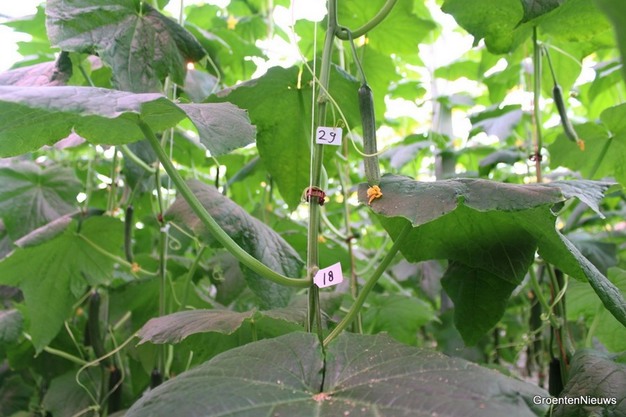 © Thijmen Tiersma | HortiDaily.comBlooming on November 18 at this sample plant. The current growth duration of the fruits is approximately 15 days. If the growth duration goes towards 17 or 18 days, the crop is too vegetative and balance can be restored, for example, with an under-tube or by faster harvesting.
Discovery from practice
From earlier trials, Marcel and his team concluded that 30 to 32 micromoles of light, combined with an 18-hour day length, is the upper limit for a cultivation crop. Now, however, he is seeing signs that even higher light levels might be possible, potentially leading to even higher production.
"In Canada, I once removed some extra leaves from the lower part of the plant at a grower's request. The common belief is that more leaf area helps the plant cool itself. But with this grower, you could actually see the plant's growing point recover just a few hours after the leaves were removed. When there is too much leaf mass low on the plant, the plant can evaporate a lot of moisture, and that apparently leaves the top of the plant short on water."
Knowing the limits and pushing boundaries
In the end, Marcel believes that data-driven cultivation offers the greatest value in countries where it is harder to find experienced growers. "Data-driven growing works well as long as you set clear limits for the system."
In 's-Gravenzande, the team is getting better at this every season, yet they continue to push the boundaries so they can keep learning, just as they are doing this year with a fresh new approach. "We trust the system more and more, but we still stay alert." That becomes clear a moment later when Marcel notices the cold draft. It is no cause for alarm, but it is a good reason to check the data again later.
Harvest forecast
For the 2025/2026 season, the first cultivation round with the variety Hi Light has been underway since 15 October. Additional plantings are scheduled for 4 February and 21 May. For the summer cycle, the team has chosen the variety Hi Score.
Based on data from light levels, in-greenhouse light measurements, and figures for grams per mol and average fruit weight, the expectation for this season is a total of 375 cucumbers, adding up to just over 148 kilos. In winter, the target fruit weight is 380 grams, and in summer around 400 grams.
BASF | Nunhems invites anyone interested to contact their local representative to schedule a visit. You can then tour the trial in 's-Gravenzande yourself, and they'll ask you the same question: "So, what did you think?"
Knowledge of the crop without a look in the greenhouse
Growers still love walking through their plants themselves, and Marcel is no different. On Wednesdays in 's-Gravenzande, that is exactly where he prefers to be. Yet with the rise of data-driven cultivation, he also sees a future in which you may not always need to physically step into the greenhouse. That is especially useful when supporting international projects, where weekly visits simply are not possible.
Marcel is involved in the AGROS project at Wageningen University & Research, where cucumber specialists are challenged to assess the condition of a crop without seeing it first. Instead, they receive a set of numbers, similar to the data Marcel shows us here in 's-Gravenzande.
With a handful of key figures, such as the Leaf Area Index or the number of leaves beneath the growing point, Marcel can already form a very accurate picture of the crop from behind his computer. Creating a production forecast before the start of a cultivation round is also becoming more precise each year. Next year, we'll learn the final results of this data-driven cucumber project and its newest approach.
For more information or to make an appointment for a visit to the data-driven cucumber greenhouse in 's-Gravenzande:
Marcel Huibers
Jaëlle Kuijpers
Rick Smulders
BASF | Nunhems © Thijmen Tiersma | HortiDaily.com[email protected]
Marcel: 06-34190605
[email protected]
Jaëlle: 06-42449393
[email protected]
Rick: 06-141175803
www.nunhems.nl