Food production near cities: The Hessian startup Pflanzentheke offers A-shaped plant shelves as a solution that can be used by everyone from hobby gardeners to large agricultural businesses. Plants grow there – requiring little space – not in soil, but in nutrient-rich water. The next step: automation and targeted control of cultivation. The Deutsche Bundesstiftung Umwelt (DBU) is funding the research project with EUR 175,000.
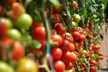
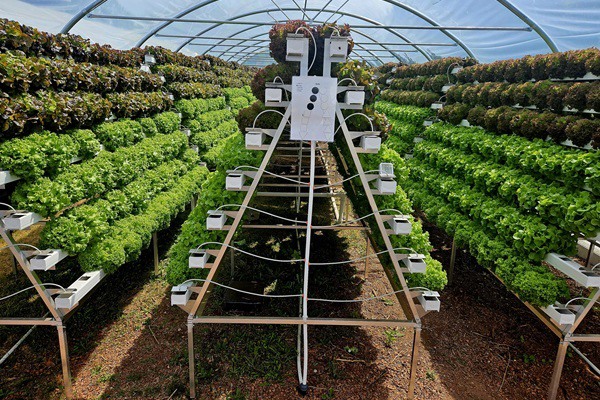 © Pflanzentheke GmbH The startup's A-shaped, vertical cultivation system enables urban agriculture on small plots of land. Advantages: lower environmental impact due to less transport and emissions. © Pflanzentheke GmbH
Efficient use of time, resources, and energy
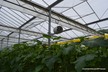
The majority of fruit and vegetables consumed in Germany are imported. According to figures from the Federal Ministry of Food, Agriculture and Home Affairs (BMLEH), the self-sufficiency rate – i.e. the proportion of goods produced in the country compared to total consumption – is 36 percent for vegetables and only 20 percent for fruit. Large cities in particular are dependent on food deliveries over long distances. DBU Secretary General Alexander Bonde: "Growing food close to urban centers with high demand saves on expensive and climate-damaging transport routes. However, this is only possible with the efficient use of scarce land." This is precisely the goal pursued by the start-up Pflanzentheke from Lorsch in Hesse with so-called vertical farming systems for protected cultivation – i.e., the vertical cultivation of food in closed facilities such as greenhouses or polytunnels. Co-founder Leon Welker: "The vegetables grow on A-shaped shelves in a so-called hydroponic system – plants thrive in nutrient-rich water instead of soil, on an average of seven levels per facility." With DBU funding of EUR 175,000, the company is now focusing on automating the system – for a more efficient use of time, resources, and energy.
Automated and data-based plant growth
According to startup co-founder Welker, the vertical systems have been stocked with young plants and harvested manually up to now. The startup is now working on fully automating the production process – with minimal energy consumption and low operating expenses. "We are focusing on practical automation steps that specifically address the areas where small and medium-sized businesses are currently reaching their limits: harvesting, replanting, and system maintenance," says Welker. The goal is to "significantly simplify daily work with a modular system that conserves resources, saves water, and reduces working hours." Welker: "This makes efficient hydroponics economically accessible even for smaller businesses." To achieve this, the existing A-shaped cultivation model is set in motion and connected to an intelligent control system. "Sensors are used to monitor the rows of plants and supply them with the appropriate nutrients for each growth phase – based entirely on data," says the startup co-founder. Each row houses a vegetable in a different stage of growth. Welker: "The movable system also allows us to optimize access to sunlight depending on the degree of ripeness." Finally, one row can be harvested and restocked while the other plants continue to grow undisturbed thanks to the repositioning.
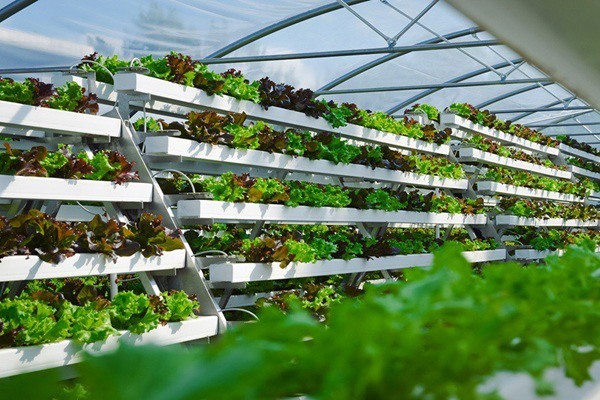 © Pflanzentheke GmbH Many vegetables in a small space: The Hessian startup Pflanzentheke enables vertical vegetable growth in nutrient-rich water instead of soil. Now, automation is to make climate-friendly cultivation more effective. © Pflanzentheke GmbH
System aims to conserve soil as well as reduce water and fertilizer consumption
According to Welker, the system developed by the startup conserves soil, reduces water and fertilizer consumption, and allows as much food as possible to be grown in small areas. "The system achieves the same yield with around 90 percent less water and 85 percent less fertilizer than conventional agriculture," says the Pflanzentheke co-founder. "We combine the advantages of indoor vertical farming – such as nutrient utilization and water efficiency – with a decisive plus: our systems use natural sunlight and therefore require only a fraction of the energy costs," says Welker. "This makes resource-saving cultivation economically viable – even without energy-intensive lighting systems." Welker continues: "Long-distance transport generates high levels of climate-damaging greenhouse gases. Growing crops close to cities using vertical farming systems reduces delivery distances and, depending on the food, energy-intensive cold chains."
For more information:
Leon Welker (Project Manager)
Pflanzentheke GmbH
Tel: +49 1575 4231095
[email protected]
https://pflanzentheke.de
www.dbu.de