"Historically, Egypt is an open-field market due to the good weather and the good availability of water through the Nile," says Farid Ellakany, Business Development Manager MENA at Svensson. "But due to climate change, very hot summers, pesticide resistance, and water scarcity, the market is moving slowly towards protected cultivation." The past decade has presented these challenges that are accelerating investment in greenhouse technologies.
This transition received a major boost when the Egyptian army launched several large-scale greenhouse development programs, including the prominent Future of Egypt initiative. According to Farid, these projects laid the first cornerstone in that direction, showing the value of controlled environments for year-round, high-quality production.
Svensson's role: Knowledge partner and technical contributor
Svensson, known for climate and screen solutions, has expanded its position in Egypt by focusing not only on product supply but on knowledge transfer and greenhouse climate expertise.
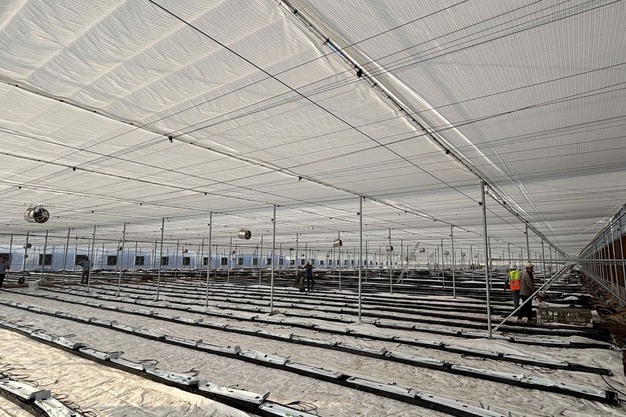 © Ludvig Svensson
"We have chosen to position ourselves as a knowledge partner and not just a supplier of products," he explains. "This is why we invest in having not only salesmen, but also a team of consultants whose main aim is to help growers with solutions for climate management inside a greenhouse."
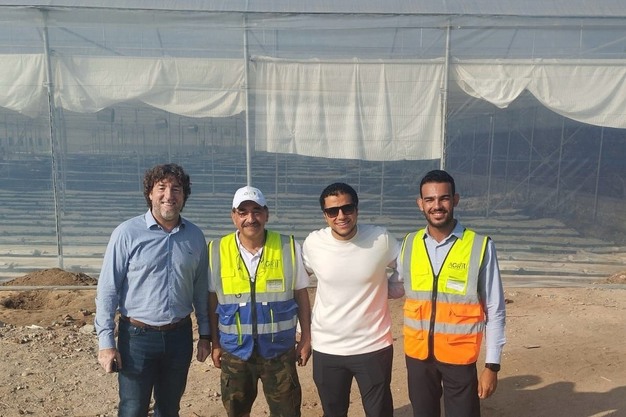
For a recent pepper-production project at Mazari3, Svensson collaborated with AgriT (a main contractor and one of the leading greenhouse builders in Egypt), as well as some other Dutch suppliers of components to improve the greenhouse climate. "AgriT brings substantial experience, having constructed more than 1,000 hectares of greenhouses for national projects," Farid shares.
The technical focus was to achieve consistent, year-round pepper quality, a crop particularly sensitive to high temperatures during flowering and fruit set.
For Mazari3, the objective was to stabilize plant conditions year-round. This was not only to avoid summer stress, but to reliably achieve EU-grade export quality during the winter export window from December to April, when Egyptian production can complement European markets.
"It reduces plant-head temperatures during high radiation periods, but just as importantly, its thermal insulation properties help minimize heat loss on cold winter nights, making our heating more efficient and ensuring uniform fruit quality throughout the season", explains Taymour Heikal of Mazari3.
"The patented Harmony screen not only offers the right shading level for the plant, but more importantly, offers high-grade light diffusion, which improves growth and yield." Diffuse light prevents the leaves from burning, penetrates deeper in the canopy to reach the lower leaves, and lowers the temperature of the plant head (up to 4°C).
 © Ludvig Svensson
Overcoming technical challenges
Although the project progressed smoothly, uneven ground conditions required modifications to the screen installation. "Such adaptations underline the importance of on-site expertise and coordination among technology partners, particularly in regions where greenhouse construction is still evolving."
Egypt benefits from an abundant and cost-effective labor force, which supports the implementation of greenhouse projects. However, operating climate-controlled structures demands new skill sets.
"Egypt has abundancy of skilled and affordable labor, but operating a more developed greenhouse requires this labor to be trained," Farid explains. "This is why knowledge transfer is crucial, and Svensson supports all initiatives done through collaboration between companies and institutions such as DGD, Delphy and the Dutch Embassy in Egypt."
Berries as a strategic crop
Beyond vegetables, berries (particularly strawberries and blueberries) are gaining momentum in Egypt. The country has already experienced a surge in strawberry volumes this season.
"Egypt is on track to be one of the main exporters of berries. We have seen an abundancy in strawberry production this year which has even driven prices down."
More notably, he sees significant growth potential in blueberries as protected cultivation expands. "We see a very interesting development in the protected cultivation of blueberries in the coming couple of years, with lots of projects in the pipeline," he adds.
Regional conditions may further favor Egypt's emergence in this sector. "Being aware of the challenges Morocco is currently facing with water scarcity, I can see that it is Egypt's chance to grab some market share of the blueberry export industry," Farid says.
For more information: Ludvig Svensson
Farid Ellakany, Business Development Manager MENA
[email protected]
[email protected]
www.ludvigsvensson.com