Nighttime hours present a persistent and costly challenge for commercial greenhouse operators. When thermal screens close and vents shut, the greenhouse becomes sealed, trapping the humidity produced by the crop. This creates a high-stakes struggle against condensation, disease, and unnecessary energy loss. Amir Kandlik, B.Sc. Plant Sciences and Genetics in Agriculture and agronom with Drygair analyzes the critical nighttime humidity problem and explains a strategic shift from traditional ventilation-based control to a system built around active internal dehumidification. "This "closed greenhouse" approach improves energy efficiency and supports stronger crop health."
 © DryGair
The nighttime challenge: A thermodynamic and pathological risk
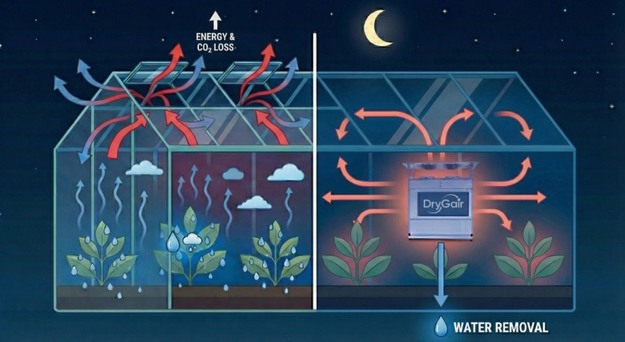
"At night, plants continue to transpire even though photosynthesis has stopped. Without the drying effect of daytime conditions, the air mass in the greenhouse quickly approaches saturation", Amir says. "Traditional methods rely on ventilation, but venting warm and CO₂-rich air replaces it with cold outside air. This raises heating demand, destabilizes temperatures, and may introduce more moisture, especially during damp weather."
A variation of this, heating the air before venting, wastes energy because the conditioned air is expelled immediately. "In cold, rainy, or snowy conditions, ventilation becomes impractical, and humidity increases unchecked. As relative humidity rises above 85 percent and temperatures fall, surface temperatures can drop below the dew point. Condensation then forms on leaves, fruit, and structural elements, creating conditions that promote Botrytis, powdery mildew, and downy mildew."
The solution: A "closed" paradigm with active dehumidification
A more advanced strategy replaces nighttime ventilation with active internal dehumidification while keeping the greenhouse sealed. Amir explains the process begins when the unit pulls in humid air, cools it below its dew point, and condenses the water vapor into liquid form. "The latent heat released during condensation is captured and recycled, warming the dried air before it is redistributed across the canopy. Instead of losing heat to achieve dryness, this method converts humidity into heat and produces a net-positive energy cycle."
 © DryGair
Core advantages of the closed nighttime strategy
This approach improves disease prevention by maintaining a stable vapor pressure deficit and preventing dew formation. Keeping surfaces above the dew point sharply reduces disease pressure. Flower trials recorded a 98 percent reduction in Botrytis when relative humidity remained below 85 percent. Energy efficiency also increases because vents remain closed and latent heat is recovered during dehumidification. Vegetable growers have reported about 50 percent energy savings.
"Climate uniformity improves as constant air circulation removes microclimates, and sealed conditions preserve CO₂ for uptake at dawn", says Amir. Crop quality and yield benefit from consistent transpiration and better nutrient and calcium movement. Basil showed a 15 percent yield increase with no mildew, and unheated tomato houses reported up to 25 percent higher yield per stem.
Practical implementations for head growers
Adopting this strategy requires a shift in operational logic, usually managed by a climate computer. "During the day, vents remain open and natural ventilation manages humidity, so dehumidifiers remain off. At night, once the outdoor temperature falls below the indoor setpoint, vents and screens close, and the dehumidifier operates on an RH setpoint of about 75 to 80 percent. The priority is maintaining a dew-point gap of at least 2 degrees Celsius. The dehumidifier becomes the main nighttime humidity tool, while heating is used only for temperature stability. In regions with nighttime temperatures below 10 degrees Celsius, a defrost coil add-on is required for continuous operation."
Looking at results from the field
Field studies show that flowers grown under this strategy maintained lower relative humidity, achieved major energy savings, and required no nighttime venting. Basil trials showed a 15 percent yield increase and zero mildew. Tomatoes and peppers demonstrated yield increases between 5 and 25 percent and a 98 percent reduction in disease. Cannabis growers recorded 30 to 40 percent higher yield with about 50 percent energy savings.
Geographic and climate specific FAQs
In very cold climates, this approach performs particularly well. Venting at minus 10 degrees Celsius creates an extreme heating load, while sealing the greenhouse and dehumidifying internally retains heat, recovers latent heat, and reduces boiler use. In hot and humid climates, nighttime ventilation becomes unreliable during warm or rainy periods. Active dehumidification maintains controlled humidity removal, and with the Air-Water Heat-Exchange add-on, the system can also heat or cool the air using an external water loop.
Supporting science and technical references
Supporting research includes Elad and Shtienberg's work on Botrytis cinerea, guidance from the University of Massachusetts Extension on reducing greenhouse humidity, Stanghellini's studies on transpiration, and work by Ho and Adams on water and nutrient uptake in tomatoes.
No venting away
"Nighttime humidity is not a problem that needs to be vented away but an imbalance that must be managed", says Amir. "The closed greenhouse strategy treats humidity as an energy resource instead of a waste product. By keeping the greenhouse sealed at night and using active internal dehumidification, growers reduce disease, improve energy efficiency, retain CO₂, stabilize the nighttime climate, and increase yield and crop quality. This represents one of the most impactful changes in modern greenhouse climate management."
For more information:
DryGair
www.drygair.com