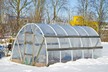
One way to fight the food crisis is through modern agricultural innovation with the smart greenhouse, developed by Slamet Widodo, an Associate Professor from the Department of Mechanical Engineering and Biosystems at IPB University. A greenhouse is a transparent, enclosed structure designed to create a more controlled growing environment for plants than in the open air. These structures are typically made of glass, special plastic, or other translucent materials that allow sunlight to penetrate.
The smart greenhouse concept is equipped with sensors, automated systems, and advanced technology. This technology is used to automatically monitor and control conditions within the greenhouse, such as temperature, humidity, light, and soil conditions.
Unlike typical greenhouses, which require manual control, smart greenhouses utilize automation to optimize plant growth conditions without requiring extensive human resources. With this technology, crop yields can be achieved year-round, ensuring a sustainable food supply.
"The concept of a smart greenhouse doesn't have to be sophisticated with highly advanced technology. However, it's about how a smart greenhouse can read its environment, including microclimates like temperature and humidity. The available data can be optimized so that decisions are made based on data," Slamet said in a webinar held by the National Research and Innovation Agency (BRIN) on Thursday (November 27, 2025).
Read more at Kompas