Assistant Professor Aleksandr Gavrin from the Department of Molecular Biology and Genetics, Aarhus University, has received a grant under the Danish Independent Research Fund's Green Research programme. The project focuses on improving the efficiency of biological nitrogen fixation in legumes - a process that allows plants to access nitrogen naturally and reduce the need for synthetic fertilisers.
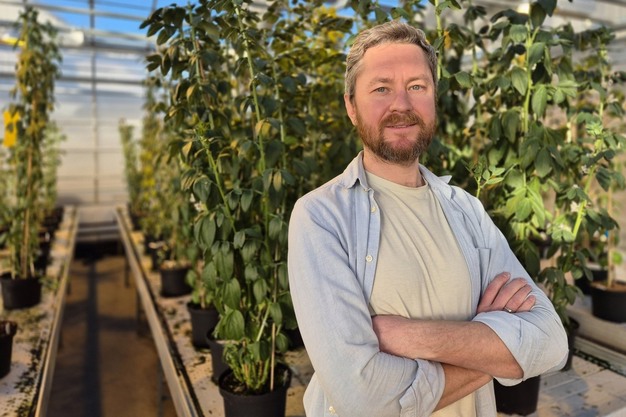 © Helene Eriksen
Nitrogen is essential for plant growth, yet most plants cannot access the vast nitrogen reserves in the atmosphere because it exists in an inert form, dinitrogen (N₂). Today's agriculture relies heavily on synthetic nitrogen fertilisers, but crops partly absorb the applied nitrogen, while the rest is lost as runoff, creating both economic and environmental challenges. Legumes, however, have evolved a unique partnership with soil bacteria called rhizobia, which convert atmospheric nitrogen into a plant-usable form through a process known as symbiotic nitrogen fixation.
"Nature has already solved the challenge of nitrogen limitation," says Aleksandr Gavrin. "Legumes form special root organs, called nodules, where bacteria live and convert nitrogen for the plant. In return, the plant provides sugars, and this is a beautifully balanced exchange that sustains both partners."
The European Commission has recently highlighted bio-based fertilisers and biological nitrogen fixation as key strategies for achieving climate neutrality by 2050 further underscoring the importance of this research area.
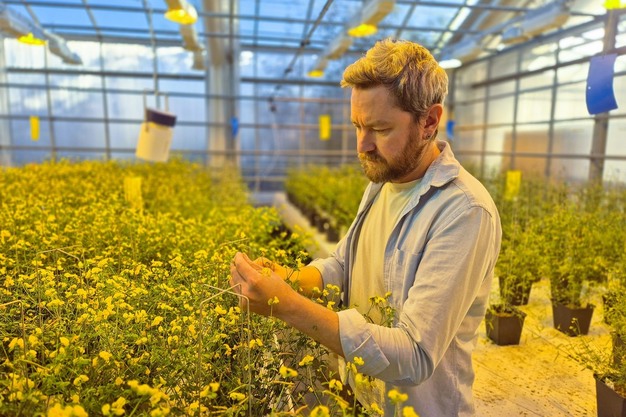 © Helene Eriksen
Fine-tuning the nitrogen fixation process
While this symbiosis is remarkably efficient, it is also tightly regulated. Plants control the rate of nitrogen fixation depending on their nutritional needs and environmental conditions. Aleksandr's new project aims to uncover the molecular mechanisms behind this regulation.
"Like any biological process, nitrogen fixation has both positive and negative regulation," he explains. "We want to understand how the plant adjusts this rate and whether we can gently modulate it to increase efficiency without harming the plant."
Using advanced molecular and biochemical approaches, Aleksandr Gavrin and his team will study how cytoplasmic signalling affects the activity of nitrogen-fixing bacteria inside plant root nodules. The project specifically focuses on cytoplasmic signalling cascades thought to act as a negative regulator of symbiotic nitrogen fixation.
By identifying and potentially disabling such negative regulatory mechanisms, the project aims to explore whether legumes can be bred, using non-transgenic methods, for enhanced nitrogen-fixing capacity. Several grain legumes, including peas, chickpeas, lentils and fava beans, already have mutagenized populations that can be used for such traditional breeding approaches.
An international collaboration
The project is a close collaboration with Professor Justin Lee and his group in Germany.
"This is my first funded collaboration," says Gavrin. "It's a true partnership in which both sides are funded, and we will work together to identify new regulatory mechanisms in symbiotic nitrogen fixation."
Lee, based at the Leibniz Institute of Plant Biochemistry in Halle, is a leading expert in kinase-mediated cytoplasmic signalling, making him a key partner for investigating new pathways in legume biology.
The collaboration will not only advance basic understanding of plant–microbe interactions but also contribute to sustainable agriculture by reducing reliance on environmentally harmful fertilisers.
Towards greener agriculture
By revealing how legumes naturally manage symbiotic nitrogen uptake, the research could pave the way for breeding or engineering crops that are more self-sufficient.
"If we learn how to fine-tune nitrogen fixation, we might one day produce legume crops that provide higher yields with less fertiliser input," says Gavrin. "It's a small but important step toward a greener, more sustainable future and maybe even a world where we all eat a bit more peas and beans, and a bit less pizza and pasta," he adds with a smile.
The project "Increasing Symbiotic Nitrogen Fixation via Cytoplasmic Signaling Modulation" is funded through the Danish Independent Research Fund's Green Research programme, which supports innovative projects contributing to environmentally sustainable solutions. In total, the Danish Independent Research Fund has awarded 6.7 million DKK to the project.
Source: Aarhus University