To clear crops quickly at the end of the season, growers first need to cut the plants before removing them from the greenhouse. To support this, DETO Mechanisatie is reintroducing a renewed mechanized system, developed together with growers.
The Dutch machinery manufacturer acquired a patent for cutting crop stems beneath the support wire, then refined and optimized the system for use in modern greenhouses. The machine was recently used to clear an aubergine crop at the operation of Paul, Marcel, and Jolanda van den Broek in Straelen-Broekhuysen, in Germany.
Patented cutting technique
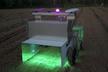
The machine is designed for high-wire V-systems, widely used in aubergines and sweet peppers. It drives between the gutter rows and cuts the stems as it moves forward. The plants then fall cleanly to the ground behind the machine, ready to be removed from the greenhouse.
The key feature is the fully automated cutting process, explains Tom van den Beuken of DETO Mechanisatie. Inventor Wiel Nies originally held the patent, which DETO has now taken over. "The cutting technology saves a great deal of time and labor. Cutting plants by hand is physically demanding, especially toward the end of the crop. The machine takes over that heavy work, greatly reducing physical strain on staff. It also frees workers to focus on other tasks."
Speed
The machine can clear two rows of 120 meters in under two minutes. "This means far more work can be done in a fraction of the time, which boosts the overall efficiency of the clearing process. It not only saves labor hours, but also brings more structure and calm to the greenhouse," says Tom. Crop changes are always a hectic period with high labor demand, making the cutting machine a welcome solution.
The machine runs on a compact diesel engine that powers several hydraulic pumps. These pumps drive both the traction system and the cutting mechanism beneath the crop wire. On the central path, hydraulic functions also drive the lifting mechanism and, when needed, reposition the unit.
Robust by design
The developers intentionally avoided unnecessary electronics, choosing instead for a robust system that avoids failures during the busy crop-change period. "We want machines that simply do their job when growers need them," Tom explains.
DETO Mechanisatie delivers each machine with on-site commissioning. Inside the rows, the machine is operated by radio control. On the paths, hydraulic valve controls are used to lift, maneuver, and position the unit properly on the pipe-rail system.
One person can operate the machine when cutting a single row. The operator walks one or two rows alongside the machine, using the remote control. "This gives them a clear view of the cutting process."
The machine was recently used during an aubergine crop change. Aubergine plants grow with their fruit stems pointing downward, which makes the crop more challenging to cut. "This is why we often see a second person walking behind the machine to reposition plants that fall at an angle," Tom notes. This worker places the plants neatly between the pipe rails, making removal easier. For best results, DETO recommends allowing aubergine plants to dry for about two days before cutting, which also reduces disposal costs.
A double machine
A double version is also available, capable of cutting two rows simultaneously. This model moves around the growing gutter rather than between two gutters. Growers at Greenbrothers in Zevenbergen have already gained experience with this machine in their aubergine production. It is also suitable for cutting pepper crops.
DETO Mechanisatie, founded in 2012 by Tom and Dennis van der Sterren, grew out of a hobby and now develops a range of machines aimed at mechanizing labor-intensive tasks in vegetable production and post-harvest handling. For low-wire cucumber production, the company offers a different clearing system. "That system also brings many benefits during crop changes compared with manual clearing."
For more information:
DETO Mechanisatie
Voltaweg 11
5993 SE Maasbree
[email protected]
www.deto-mechanisatie.nl