For strawberry propagation material, which is usually produced from runner cuttings, a well-developed root system is essential. Growers look for a good spread of white primary roots throughout the substrate, along with plenty of active feeder roots. According to Thierry Janssens, Head of R&D at Biota Nutri, this root structure greatly improves the young plants' resilience to abiotic stress from the environment, such as drought, heat and mechanical handling, and ensures optimal uptake of nutrients from the substrate. In the end, it gives the crop a much stronger start once it enters the production phase.
As part of the PPP "Resilient cultivation systems strawberry: renewable substrates and organic fertilizers", Biota Nutri is collaborating with WUR Glastuinbouw in Bleiswijk and several consortium partners to make strawberry production more sustainable and more robust, from propagation all the way to fruiting. The project focuses on sustainable innovation in propagation techniques, substrates and organic fertilization, both for raising young plants and producing fruit, with the goal of creating a sturdier crop overall. To support this work, a detailed propagation trial was carried out in Bleiswijk for six weeks. The trial examined how substrate type and fertilization strategy influence the rooting and early development of runner cuttings, using ebb-and-flow tables with tray-grown plants, as shown in Figure 1.
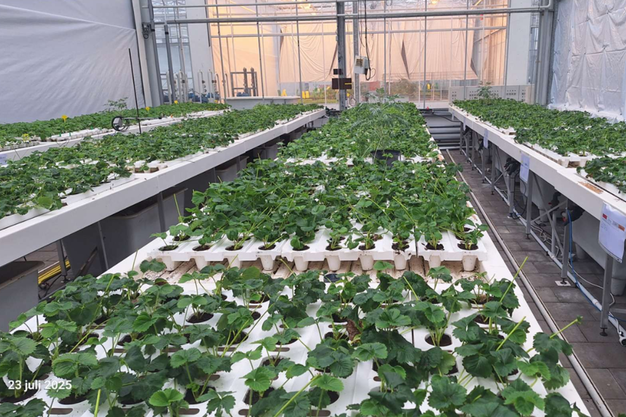 © WUR Figure 1: Overview of the cultivation trial for the propagation of strawberry plants from cuttings. WUR Glastuinbouw (Bleiswijk)
This article zooms in on the effects of Biota Nutri BV's organic fertilizers, compared with conventional mineral fertilizers. Biota Nutri's organic products contain circular nutrients that are recovered from residual streams and processed through microbial pathways, including the production of nitrate using the ONP system (Organic Nitrate Production, which generates nitrate from circular nitrogen sources). Table 1 shows the fertilization regime for the main elements.
 © WURTable 1: Composition of the main elements in the nutrient solution for mineral and organic fertilization.
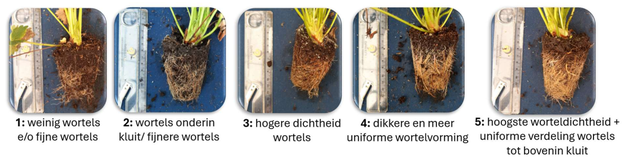
At the end of the six-week propagation trial, the root development of 288 plants was evaluated using photographs in a blind setup, meaning the assessors had no prior knowledge of the treatments. Five evaluators independently scored each plant's root system on a scale from 0 to 5, using reference images to guide the assessment, as shown in Figure 2.
 © WUR
© WUR
Figure 2: Example photos of the root index 1 to 5. In some cases, 0 was also assigned in the absence of clear root formation.
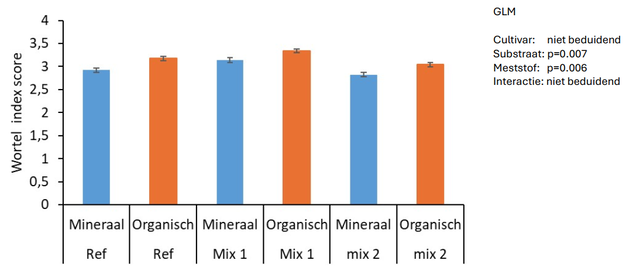
"The statistical analysis showed that, across all variables (cultivar, substrate and fertilizer), the type of fertilizer had the strongest influence on root system development, with a very significant positive effect from Biota Nutri's organic fertilizers," says Thierry. "Plants that received Biota Nutri's organic fertilizers developed a noticeably stronger root system compared with those grown on mineral fertilizers, as shown in Figure 3. This effect was even greater than the influence of the substrate type."
 © WUR
© WUR
Figure 3: Average root index (with error bars) for the different combinations of fertilizer and substrate (based on 288 plants). The effect of fertilizer (organic from Biota Nutri, mineral) is greater than the effect of the substrate (Ref, Mix1, and Mix2), with Biota Nutri's organic fertilizers yielding a higher root index. The smaller p, the more significant.
The nutrient solution based on Biota Nutri's fertilizers includes not only the effluent from the ONP system but also products such as Biota Calcium 8%, Biota Potassium 15%, a range of Biota trace elements and, most importantly, Biota Phos 8%. In an earlier in-house propagation trial at Biota Nutri, this last product was shown to strongly enhance root formation in Petunia as well, possibly because it reduces phosphate leaching from the substrate. "It is likely that the organic matrix of the applied circular phosphate allows the plant to take up phosphorus more efficiently and supports the development of a more resilient root system, giving young plants better structure and extra stability when conditions become temporarily unfavorable."
For more information:
Wageningen University & Research
https://www.wur.nl/