Sun Gro® Horticulture's R&D program has spent several years designing an engineered biochar, the Black Bear® Biochar, intended to function as a reliable, high-performance aggregate for professional greenhouse substrates. According to Kay Jeong, Corporate R&D Manager and lead developer of the material, the goal was "to engineer biochar specifically for growing media and not to repurpose a generic biochar."
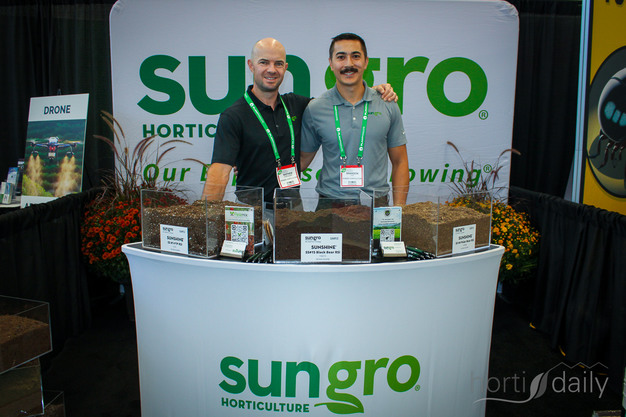 © Eelkje Pulley | HortiDaily.com
Mathew Sargeant and Brandon Yep at the Canadian Greenhouse Conference 2025
 © Sun Gro HorticultureEngineered structure and particle size
A differentiator of Black Bear® is its controlled particle size and particle size distribution, designed to match and, in some cases, exceed coarse perlite performance.
"Not all biochar can provide drainage. We engineered the particle size to deliver premium drainage and aeration just like perlite, but more consistent and coarser," she explains. Sun Gro® Horticulture refers to these coarse fractions as sustainable aggregates.
Because of their rough surface texture and structural interlock, Black Bear® particles remain evenly distributed in the pot. "Perlite tends to float or shift during overhead irrigation. Biochar stays where it should be," she adds.
Chemical benefits: pH stability and high CEC
Biochar's naturally high pH (typically 8.5–9.5) required substrate-level lime rate adjustments. Once balanced, the material contributes strong pH buffering capacity, which Kay described as especially benefitial for pH-sensitive crops such as geraniums.
Black Bear® also delivers substantially higher cation exchange capacity (CEC) than perlite. "We have clear data showing higher CEC, meaning greater nutrient retention. We're now developing even more advanced measurement methods with University research partners."
Dual-function potential: drainage + nutrient retention
Initial imaging work comparing biochar, coarse perlite, and vermiculite suggests Black Bear may act as a dual-function aggregate, supporting drainage while also holding nutrients. "With higher surface area and higher CEC, biochar could perform the roles of both perlite and vermiculite," she notes. Further scientific characterization is underway.
Crop performance and production efficiency
Greenhouse trials across ornamentals, bedding plants, vegetables, and cannabis indicate that Black Bear can increase biomass within standard production timelines. "One grower gave feedback that our product helped the plants be ready earlier. That means early harvest and more return per cycle. So this is a major win and is becoming a key area of focus for us."
Sun Gro® Horticulture is also developing finer-grade biochar for propagation and germination mixes.
 © Sun Gro Horticulture
Feedstock, production, and carbon quality
Black Bear® is produced from sawmill residues which is a renewable stream typically burned for energy or landfilled. These residues undergo high-heat (600–900°C), slow pyrolysis, which Kay identified as essential: "Slow pyrolysis at high temperature fixes more carbon into the solid phase instead of losing it as gas."
The resulting biochar contains ~80–83% carbon and is pathogen-free. A critical metric, the H/C ratio, consistently falls below 0.4, indicating that roughly 75% of the carbon will persist for more than 1,000 years. "We want high-carbon, persistent biochar to support climate-conscious growing media," she emphasizes.
Supply and industry readiness
Engineering coarse aggregates requires significant adaptation at the production level. "Many suppliers are not set up to make large particle biochar. Meeting our specifications takes major adjustments," Kay says. Sun Gro® Horticulture partners only with producers who can deliver cost-effective, high quality, and consistent supply, criteria Kay describes as "the foundation for any new growing media raw material."
A technical path forward
According to Kay, Black Bear® represents a new category of engineered aggregates: materials designed to enhance substrate performance while contributing to long-term carbon storage. With strong aeration, enhanced nutrient retention, and reliable pH stability, the material is positioned as both a functional and ecological advancement.
"We want growing media that meet horticultural needs and support climate goals. High-carbon, persistent biochar helps us move in that direction."
For more information:
Sun Gro Horticulture
Kay Jeong, Corporate R&D Manager
[email protected]
www.sungro.com