Food safety has become a defining priority in controlled environment agriculture (CEA). Substrates used for germination and early growth are now recognized as a potential upstream vulnerability.
Jiffy Growing Solutions, long involved in developing propagation media for commercial greenhouses, is highlighting this risk with Jiffy Gel, a bio-based, process-controlled substrate.
Food safety in CEA
Global supply chains now treat food safety as both a regulatory requirement and a consumer-confidence issue. Outbreaks linked to pathogens such as Salmonella, Listeria, and E. coli continue to affect leafy-green and fresh-produce sectors, showing that contamination can originate at multiple production points.
Controlled environments eliminate many field-based risks but rely heavily on soilless substrates that may carry microbes or become contaminated during shipping and handling. For growers operating under strict certifications, inconsistent substrates can complicate monitoring programs.
"Growers spend enormous time and effort on hygiene protocols, but the growing media itself is often the first thing they worry about when they think upstream risk," says Kyle Freedman, Segment Manager CEA at Jiffy. "If the substrate can't be validated, it becomes a constant question mark in an otherwise controlled system."
 © Jiffy International
Where traditional media creates vulnerability
He adds that conventional soilless media present several challenges. "Raw materials may contain opportunistic microbes unless processed or certified. Even after treatment, mixing and transport can introduce contaminants, especially when materials pass through multiple facilities."
Kyle notes that batch-to-batch sterility is difficult to confirm, leaving growers uncertain about microbial status. Disposal can also expose workers and equipment to residual microbes. In addition, irregular substrate structures can interfere with automation, requiring more manual handling.
Many growers attempt to counter these risks through sanitation, testing, and zoning, but upstream risk cannot be eliminated solely through downstream controls.
"Food-safe substrates have been a missing piece in the CEA toolbox," he adds. "Growers can optimise HVAC, fertigation, crop monitoring, but the actual plug or block that starts the plant has often lagged in terms of safety design."
Process-controlled substrates: A new framework
Reducing microbial risk requires inert materials, validated kill steps, traceability, and controlled handling. Substrates that follow this model reduce inspection uncertainty and support compliance.
According to Kyle, Jiffy has built these principles into a production system aligned with ISO 9001 and ISO 22000, supported by a global food-safety team. The framework includes risk assessments, preventative controls, environmental hygiene programs, and full traceability.
The innovation behind the gel
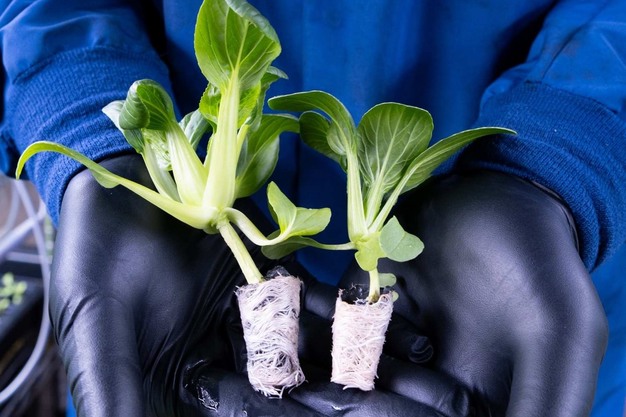
"Jiffy Gel is a sterile, gel-based, plant-derived substrate for leafy greens, herbs, microgreens, and similar crops. Its formulation reduces many risks found in fibrous or soil-derived media," he elaborates. "Pathogen-free raw materials eliminate variability, and a thermal validation step inactivates both plant and human pathogens.
The gel is dispensed in a uniform liquid state before curing, standardizing plug formation and reducing manual handling. Growers can also produce the gel on-site using input materials rather than shipping prefilled trays, cutting transport volume and opportunities for contamination. After harvest, the gel biodegrades for simpler disposal. Once cured, it forms consistent plugs that support predictable root development and uniform crop starts.
Kyle emphasised the efficiency of this system: "One pallet of gel input material can make the equivalent of up to six truckloads of prefilled plug trays. That consolidation reduces shipping exposure and gives growers more control, both of which matter when you're trying to reduce contamination vectors."
 © Jiffy International
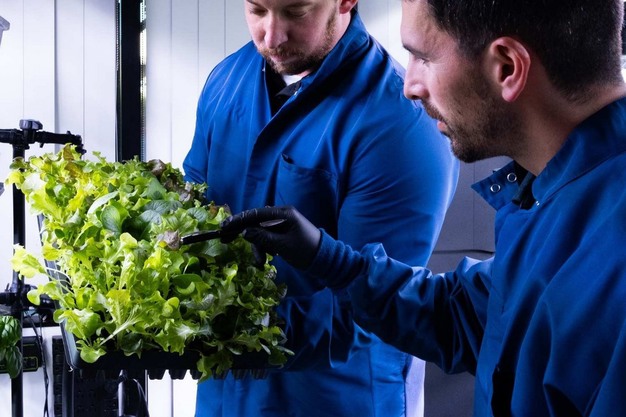
"CEA operations are increasingly automated, and a substrate that behaves the same way every time helps stabilise that workflow. But more importantly, it gives growers confidence that the first step in their production is also one of their safest."
Jiffy encourages producers to consider substrate design as part of broader food-safety expectations. The company offers resources such as its "7 Ways Food Safety Program" and detailed information on Jiffy Gel's development to help growers integrate substrate safety into facility-wide protocols.
For more information:
Jiffy Products International
Tel.: +31(0)78 2062200
[email protected]
www.jiffygroup.com