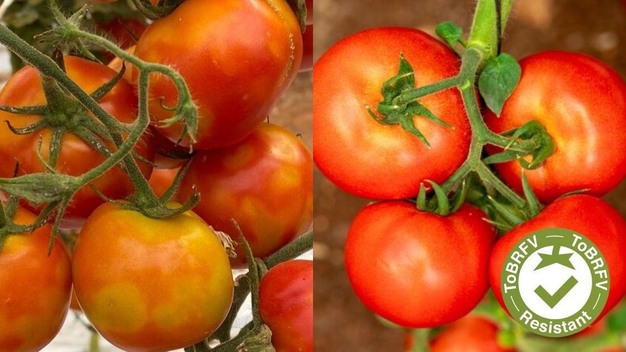
For the past decade, tomato growers have been fighting against Tomato Brown Rugose Fruit Virus (ToBRFV). In 2020, resistant varieties hit the market, starting with varieties from Syngenta Vegetable Seeds. But five years later, how do growers navigate the dozens of companies that claim various levels of resistance to find one that works and helps them achieve their goals?
First, let's break it down: what is the difference between High Resistance and Intermediate Resistance?
There's no legal standard for what level of control means high or intermediate resistance – no regulatory guidance, zero. The International Seed Federation (ISF) has issued guidelines as to the different levels of resistance. Given the lack of exact metrics for high or intermediate resistance, companies can claim high or intermediate resistance using any standard – and Syngenta's internal research proves not everyone has the same standards (or follow ISF guidelines adequately).
Why Syngenta opted for IR designation
There's no proverbial 'silver bullet,' no genetics, spray, or management method is perfect and will completely stop the infestation of ToBRFV. With pressure there's symptoms, because no one is selling total immunity.
"We took a conservative approach and consider our first trait intermediate resistance to heavy ToBRFV infestation," said Norm Sissons, Solanaceae Crops Strategy Head. "That doesn't mean it's less effective, our surveys with customers and internal performance data results show competitive and effective resistance compared to competitors that claim high resistance."
Syngenta test varieties in real-world conditions, and the real world isn't perfect, and growers all have different levels of pressure and management styles. What might be high resistance for one grower, might only show intermediate protection for another.
Syngenta is a global company with some growers who work in high-tech greenhouses with all of the latest technologies, and it works with other growers who use greenhouses that don't have all of the controls and tools – so the needs and demands for the trait are different.
"We're committed to continuing to support and develop additional traits with durable resistance to ToBRFV in current and future tomatoes," Sissons explained. "All while maintaining high yield potential, superior fruit quality and taste, and long shelf life."
 © SYNGENTA
ToBRFV HR versus IR study results
Over the past year, the research team conducted a comprehensive study comparing non resistant checks, commercial varieties carrying Syngenta's current ToBRFV resistance trait, upcoming varieties that combine two resistance sources, and competitors' varieties that claim intermediate or high resistance. The work took place in a dedicated, contained greenhouse to ensure consistency and control.
The setup involved artificial inoculation on the second true leaves through mechanical inoculation, carried out thirty five days after sowing and one day after planting. Three months after the initial inoculation, the researchers evaluated the plants on a one to nine scale to assess symptoms on fruits and canopy.
The findings show that Syngenta's initial trait provides competitive fruit protection when compared with competitors labeled as HR. They also show that both environment and genetic background strongly influence how effective resistance traits are in tomatoes. Early trials for upcoming Syngenta products, expected as soon as 2026, indicate that combining multiple resistance traits delivers stronger control than using a single trait and offers improved leaf protection. Competitors demonstrate stronger leaf protection than Syngenta's initial trait, but their performance on fruit shows no meaningful difference compared with the Syngenta varieties tested.
For more information:
Syngenta Vegetable Seeds
www.syngentavegetables.com/