In controlled environment horticulture, the physical structure of a substrate determines how water, air, and nutrients move through the root zone. This structure — its texture — directly affects irrigation behavior, crop steering, and ultimately, plant performance.
"The texture of a substrate defines how water and air interact around the roots," says Chris Vaos, Director of Product & Business Development at HortGrow. "Getting that balance right is essential for consistent crop response."
Why texture matters
Texture refers to the balance of particle sizes within the growing medium. Fine particles smaller than 0.5 mm can fill pore spaces and restrict oxygen flow, leading to compaction and slow drybacks. Conversely, large husk chips drain too quickly, creating uneven moisture distribution.
"Both extremes make irrigation unpredictable," he explains. "When pore spaces are clogged, you lose aeration. When they're too large, you lose uniformity."
A balanced texture provides a mix of macropores for drainage and micropores for water retention, maintaining stable porosity and allowing oxygen to reach the roots while holding enough water between irrigations.
 © Hortgrow Solutions LLC
The HortGrow approach
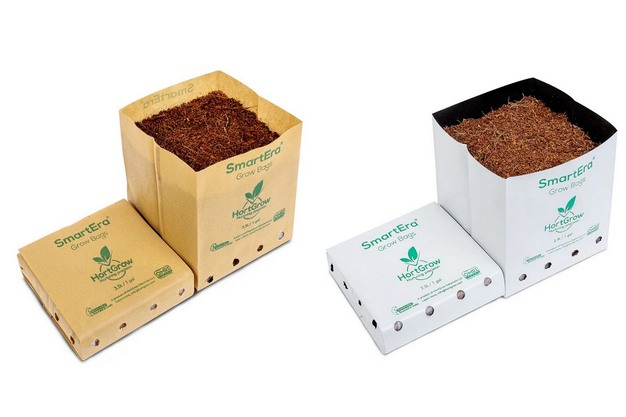
Coco coir is naturally adaptable, but its performance depends on precise processing. HortGrow's coir is refined through a controlled production method that focuses on particle size distribution and structural stability.
"Our goal was to create a coir profile that performs predictably without additives like perlite," says Chris.
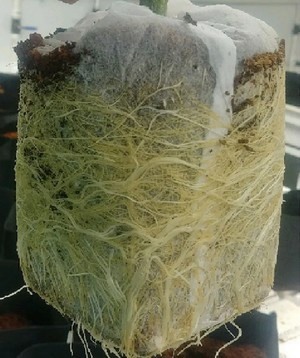
To achieve this, HortGrow removes fines smaller than 0.5 mm to prevent compaction and improve aeration. Larger husk chips are resized for consistent drainage, while around ten percent baby fibers are incorporated to enhance horizontal wicking and even water distribution. The result is a substrate with balanced porosity, strong drainage, and reliable moisture movement: characteristics that promote consistent irrigation performance and root development.
 © Hortgrow Solutions LLCMaintaining consistency
According to James Susaimuthu, CEO of HortGrow, consistency begins with meticulous husk selection and a precise pith and fiber extraction process. "The ageing duration of the coir is carefully controlled," he explains. "We emphasize sun-drying the pith and avoid excessive mechanical damage after washing."
Afterward, the materials are sieved and recombined in controlled ratios of pith, fiber, and chips to maintain uniform particle size across production batches. "This ensures every batch behaves the same way in the greenhouse," he adds.
Irrigation and crop steering benefits
For growers, texture consistency translates directly to predictable irrigation and accurate crop steering. Stable drybacks make it easier to hit steering targets, while even moisture distribution minimizes localized stress.
"When texture is uniform, the substrate responds the same way every cycle," Chris notes. "Growers can steer their crops more confidently because they know how the medium will behave."
Those switching from traditional coir–perlite mixes to HortGrow coco report more consistent irrigation and runoff pH, as well as faster vegetative cycles. "Without perlite and with good texture, plants often become more nutrient-demanding sooner," he adds.
Stable porosity also maintains oxygen availability during high-frequency irrigation, supporting healthy roots and uniform growth across the crop.
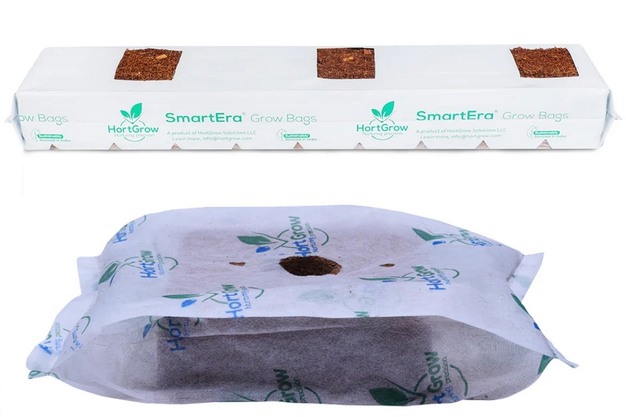 © Hortgrow Solutions LLC
Adapting texture for different crops
While crops such as tomatoes and strawberries have distinct rooting behaviors, Chris notes that in container systems, their essential needs remain similar—water, nutrients, and oxygen.
"It's less about whether a crop has thick roots or fine hairs," he says. "What matters is that the substrate doesn't get in the way. A well-textured medium gives growers full control to fine-tune irrigation, fertigation, and oxygen levels for any crop."
HortGrow's coir texture is designed to enable that level of control, allowing growers to adapt irrigation strategies confidently across crop types and varieties.
Designed for consistency
HortGrow coco coir is engineered for predictable performance from the start. By maintaining strict texture control, the company provides growers with a substrate that supports efficient irrigation and stable crop development, without the need for additives or structural amendments.
"Consistency builds confidence," he concludes. "When growers can rely on the physical behavior of their substrate, they can focus on fine-tuning the crop rather than compensating for variability."

For more information:
HortGrow Solutions
James Susaimuthu, CEO
[email protected]
www.hortgrow.com