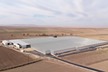
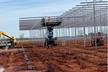
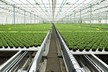
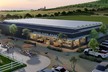
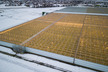
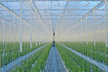
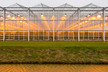
During the pandemic, Hava Arslan, a 62-year-old Paris Sorbonne University graduate who had studied and worked in France for many years, moved to the Elazig town of Karabork to focus on agriculture. Arslan is currently establishing a professional greenhouse in Tunceli by bringing her expertise and experience. As part of a project funded by the Ministry of Agriculture and Forestry, Arslan is preparing to launch greenhouse farming operations in the village of Goktepe in the Mazgirt district, aiming to significantly boost employment and agricultural output in the city.
Hava Arslan stated, "I wanted to develop some projects for Tunceli," pointing out that Tunceli has substantial job potential. "In response to European Union grant programs, I filed a proposal for a greenhouse project. I wrote a detailed proposal. I'll use land in Tunceli's Mazgirt district's Goktepe Village. My project greenhouse is strategically located and has a really efficient design. My goal is to develop greenhouse farming from Goktepe Village to the Elazig province boundary. Sadly, Adana, Antalya, and Mersin are the main sources of fruit and vegetables for Tunceli. Here, I intend to eradicate Tunceli's reliance on other cities for produce totally. I'm making excellent progress with the help of the Turkish Statistical Institute (TKDK), the Ministry of Agriculture and Forestry, and the Tunceli Provincial Directorate of Agriculture and Forestry. I hope to help other communities adopt greenhouse farming in the future, starting with Goktepe Village and working my way up to Akpazar. In this sense, Erzincan is a perfect example. They have established greenhouses spanning hundreds of hectares and carried out genuinely successful greenhouse operations. In Tunceli's Mazgirt neighborhood, I wish to follow suit. Soon, we'll sign a protocol."
Arslan, who stated that she is working to prevent migration from Tunceli, stated, "We, in Tunceli, have been benefiting from TKDK (Turkish Refugee Agency) projects for a year. I'm thinking, 'How can we stop excessive migration in Tunceli?' Tunceli could create significant employment in the agricultural sector. If, for example, a 2-hectare greenhouse can create 60 jobs, if we build 10 greenhouses on 2 hectares, we'll be able to provide employment for 600 people and feed 600 families to help stop the migration of young people. Tunceli is currently included in the support program by the World Bank and the European Union. They are going to give out large grants. For instance the World Bank has set aside up to $10 million for cow farming. Therefore, you can easily create projects with grants of 70 to 80%."
Source: Yuksekova Halkin Sesi