 © iUNU
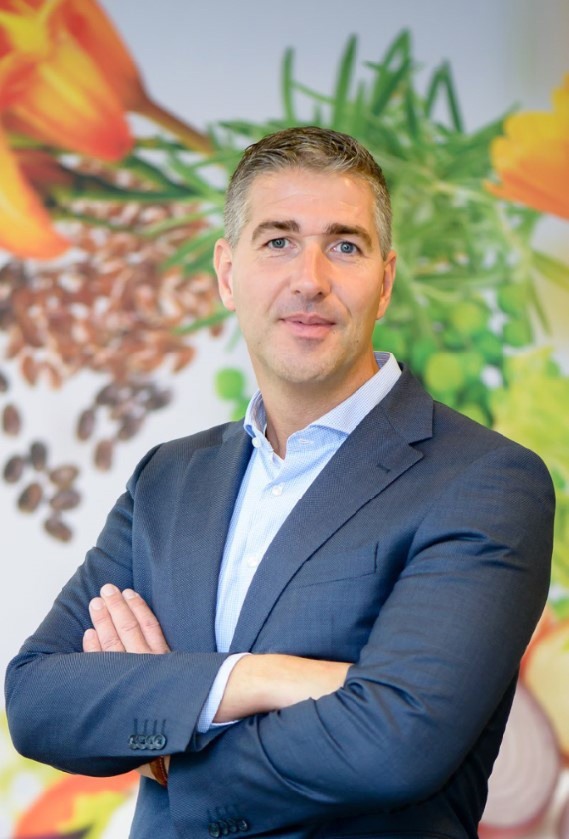
For many years, Gerard Flinterman worked in greenhouse horticulture, data, and sensor technology. He saw how growers were increasingly able to steer their crops using climate computers, dashboards, and sensors. Yet, according to him, there was always one weak spot, especially in high-wire crops: measuring the plant itself.
"That still had to be done manually in the greenhouse. How is the plant growing? What is the growth rate, head thickness, and leaf area? It's a lot of work and very prone to error," says Gerard. With IUNU's AI Platform, he sees an opportunity to change that.
"There are more solutions on the market to analyze and control data, but automating these manual measurements at this level to create truly accurate insights across your entire greenhouse is unique."
On the family farm where Gerard grew up, bell pepper cultivation began in the late 1980s. The plants were in the soil, and the conveyor cart drove through the crop. "At that time, it was enough to make a decent living as a one-man business," he recalls.
Over the years, he has seen the sector change tremendously: the scale of the average company and the consequences of that growth. "There are too many decisions that have to be made: equipment, CHP systems, lighting, energy, water, and fertilization, and so on," he lists. "The number of chessboards has increased, and the interdependence has only grown over the past twenty years. Growers make decisions based on fragile manual plant measurements and need help keeping the overview."
The family business was sold in 2007. In the years that followed, Gerard saw more and more applications of data in nurseries.
"You can see that automation in potted plants has advanced far when it comes to cameras and vision systems. Measuring buds and flowers are great applications. In vegetable cultivation, however, climate control has progressed much further," he explains.
"It's a monoculture, after all, so you can steer an entire department or greenhouse section based on specific inputs. That's harder with potted plants, where you're always looking for an average across different growth stages and varieties."
In vegetable cultivation, however, plant measurements remained manual for a long time, and thus error-prone. "After spending time measuring tomato plants, you can get quite rushed. And tomorrow you'll do it a bit differently again. The risk is that you make decisions based on those measurements, which can have major consequences." He clarifies with an example: "It's like driving from your hometown to Barcelona and only getting your position once every hour. With weekly measurements in cultivation, we see the same problem: too little data for the strategy you're using: especially with all the tools we now have as a grower to make many changes."
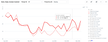
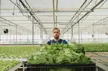
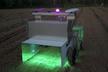
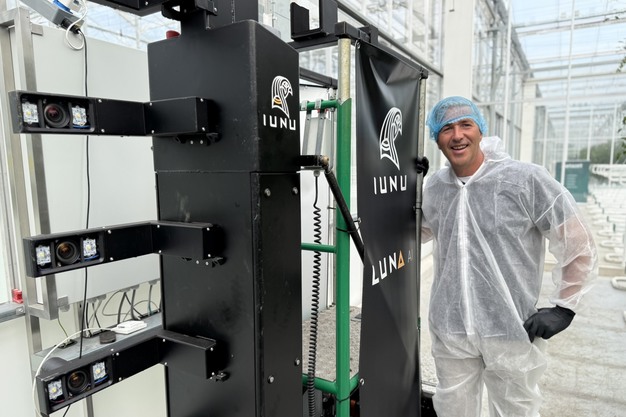
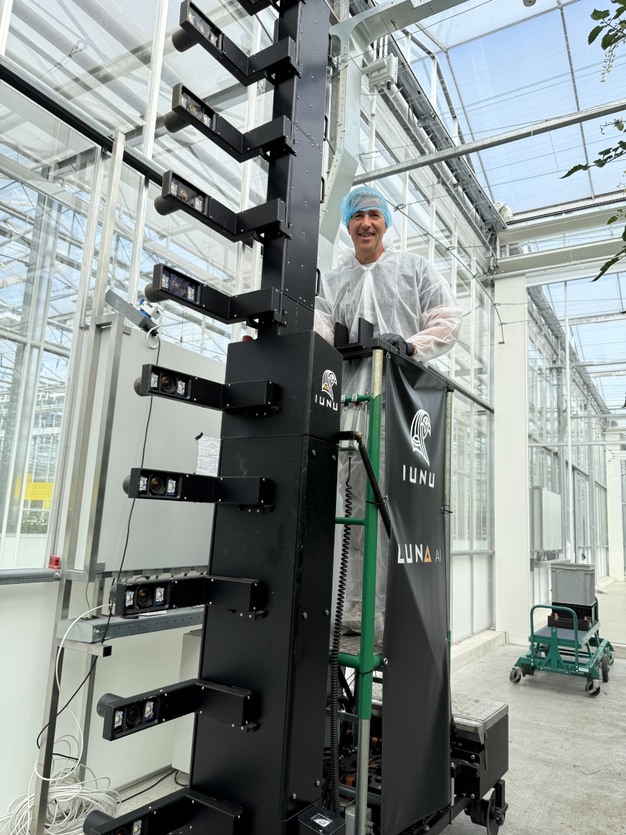 © iUNU Gerard joined IUNU because he saw the opportunity to automate these measurements with high quality and large sample sizes. The company had already developed vision technology for lettuce cultivation and created LUNA AI, a robot that drives through the crop and uniformly scans thousands of plants. They combine this with an AI-driven data platform to drive unique insights and accurate forecasting.
"I hadn't seen automation of manual measurements with vision and AI at this level before. That's what makes this solution unique: thanks to the huge number of measurements, you can speak of reliable average data. The subjective element is eliminated. Camera vision technology removes all human variation and turns it into hard data."
Moreover, cultivation is monitored more closely because measurements occur more frequently. "A grower who measures once a week only sees too late that a plant is changing or deteriorating. With automated vision data, you can intervene much earlier. That allows you to keep the plant in better balance, prevent stress, and build a strong, resilient crop."
The data collected by IUNU is also used for harvest forecasting, where the combination of data analysis and reliable measurements further improves quality. "We see that a grower sometimes gets it badly wrong a few times a year due to circumstances, resulting in lost revenue or unnecessarily high cultivation and processing costs. That makes the investment worthwhile."
 © iUNU
The next step is applying cultivation data for labor tracking and disease and pest detection. Modules for these purposes will be launched next year. "The cameras detect irregularities in the plants extremely quickly. To compare: if I hide a paperclip somewhere in a four-hectare greenhouse, AI can find it. Those capabilities can be used to recognize diseases and pests and monitor labor quality. And if an aphid or mite causes damage, that deviation is something the AI modules can detect quickly, provided you have reliable data."
Alongside Gerard, IUNU's European team has also been strengthened with Huub Fransen, based in Poland, further expanding the company's presence in Europe. Gerard notices that the market is ready for it. LUNA is already operating in the Netherlands, Belgium, France, Finland, and Greece. "Growers want more insight into their crops and to improve them as a result. That plays a role in choosing automation. Not every insight can be directly expressed in money, but knowledge often leads to improvement."
He also expects further growth in Western Europe. "Growers are increasingly aware that manual input is no longer feasible, not at the current scale of horticulture. The stakes are too high to let results depend on different people." Our goal is to make every grower's hectare more profitable - predictably, measurably, and continuously.
For more information:
IUNU
[email protected]
iunu.com