Research led by Dr Medhat Moussa, Professor in the Department of Electrical and Computer Engineering at the University of Guelph, is progressing toward practical automation solutions for greenhouse operations.
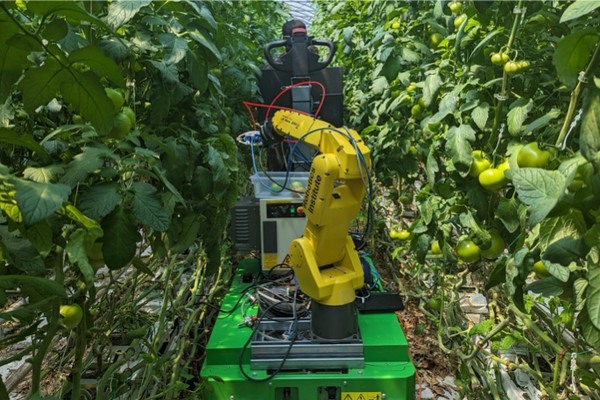
Dr. Moussa and his team are developing the Guelph Intelligent Greenhouse Automation System (GIGAS). This robotic harvester uses artificial intelligence, computer vision, and advanced gripping systems to pick crops such as tomatoes. The technology aims to reduce labour costs while improving efficiency and consistency in controlled environments.
Testing and technical progress
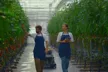
GIGAS is now being tested in a working greenhouse environment.
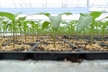
"We are currently testing at a greenhouse research centre in Leamington that grows tomatoes and other crops in a similar setting to a commercial greenhouse," says Dr. Moussa.
Testing under real-world conditions presents significant challenges. "The biggest challenge is to overcome the massive clutter and occlusion that exist in greenhouse environments while maintaining a harvesting cycle time comparable to manual labour," he explains.
The team continues to refine harvesting performance, with cycle times ranging from eight to eighteen seconds depending on the crop and cultivar. "We are working to reduce cycle time for all cultivars to ensure robustness," he notes.
A key improvement over the past year has been in grasp planning speed, which determines how quickly and accurately the robot identifies and grips fruit. "We have improved significantly the grasp planning speed and plan to test the new system in Winter 2026," he adds.
 © University of Guelph
Toward broader application
While tomatoes remain the main focus, the team is also expanding testing to other crops.
"We have trials ongoing for strawberry harvesting," Dr. Moussa reports. Although earlier work explored disease detection capabilities, that feature is not a current focus. "We are now focused on harvesting," he says. "The algorithms developed can be integrated again with a harvesting robot."
Collaboration with the greenhouse sector
Collaboration with industry partners continues to be central to GIGAS development.
"We are always communicating with growers. For the last two years, we have been working with the SEF Centre, an industry-led greenhouse research centre, as it provides us with the opportunity to test on a large number of plants without impacting the production environment."
The research team plans to hold demonstration days at the SEF Centre to share progress with growers and industry groups. "We have invited the Ontario Greenhouse Vegetable Growers (OGVG) and OMAFA specialists to visit SEF during harvesting trials to update them on the state of Technology," Dr Moussa says.
At present, there are no commercial partners bringing GIGAS to market. "Not at this stage," he notes, "but we're planning to once we are ready for this step, after we test on at least 1,000 plants per harvest."
Economic and adoption considerations
Dr. Moussa emphasises that technology adoption remains a major consideration for greenhouse automation.
"Adoption is a major issue in all agriculture automation systems," he says. "We believe a leasing model can work well to lower the barrier to adoption, but it requires significant capital investment up front from the commercialising firm."
The team tracks key performance metrics such as harvest cycle time and system downtime to demonstrate operational and economic value. Preliminary economic modeling suggests that increasing labour costs and ongoing shortages may improve the financial case for robotic systems. "As labour costs keep increasing and pressure mounts on reducing the temporary foreign workers program, coupled with reduced cost of equipment, this technology will be economically viable," he explains.
Expanding research capacity
Beyond GIGAS, the underlying technologies developed are contributing to other automation projects. "Technology developed for GIGAS can, and is, being used in other agriculture automation projects in greenhouses and open fields, as well as in the automotive manufacturing industry," says Dr. Moussa. "Essentially, GIGAS enabled us to build the capacity to tackle other hard automation problems."
As new students and collaborators join the project, Dr. Moussa sees the work contributing to broader productivity goals. "Increased productivity in all sectors of the Canadian economy is becoming a national priority," he notes. "Our research supports that direction."
For more information:
University of Guelph
Dr Medhat Moussa
[email protected]
(519) 824-4120 x53425
Room 1343, Thornbrough Building
50 Stone Road East
Guelph, Ontario, Canada N1G 2W1