The use of microorganisms as biocontrol agents continues to gain ground in modern agriculture and Trichoderma asperellum T34 has become an effective beneficial fungus strain, showing consistent results in controlling soilborne diseases and improving plant health. Experts from Biocontrol Technologies are very much aware of the fungus characteristics and how to integrate it into sustainable cultivation practices, as well as where the Trichoderma stands within the European organic agriculture regulatory framework.
 © Biocontrol
A strain with differential efficacy: the added value of T34
"Our product is based on the microorganism Trichoderma asperellum, strain T34. Microorganism-based plant protection products (PPPs) are registered at the strain level. Strains are specific genetic variations among microorganisms, which are scientifically distinguished by their phenotype (morphology, biochemical composition) and genotype (DNA sequences). As a result, each strain has different characteristics, mechanisms of action, and therefore different efficacy levels."
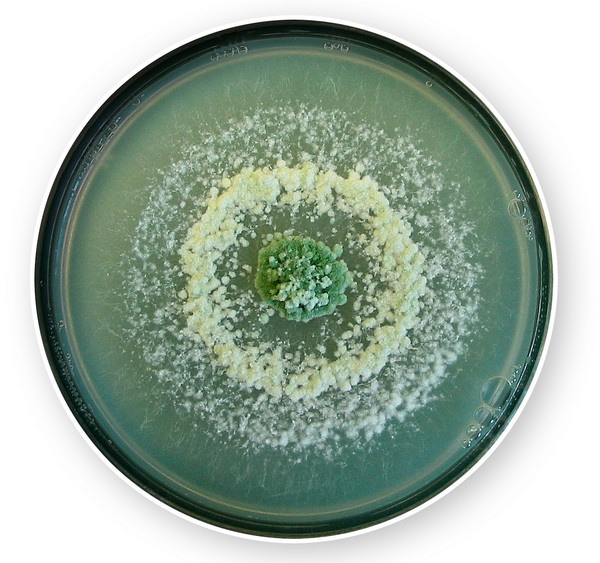
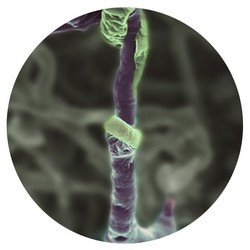
Trichoderma asperellum T34 is commercialized under different names, such as T34 Biocontrol® and Asperello® Biocontrol in Spain. "The T34 strain stands out for its persistence both in the soil and in the rhizosphere. In the soil, it parasitizes the resistant structures of pathogens, which leads to a reduction of pathogen populations in following crop cycles. In the rhizosphere (the soil zone in contact with plant roots), T34 interacts actively with the plant, activating its immune system (a 'vaccine' effect) and enhancing faster and stronger responses against pathogens and environmental stresses. This allows the plant to reach optimal growth close to its genetic potential."
 © Biocontrol
"We can say that each Trichoderma strain is different, although all share certain traits typical of the genus and species, with T34 being one of the most effective."
"Finally, we always recommend checking the product's concentration, the authorized doses, and the number of applications per crop. Only then can its efficiency be correctly evaluated in relation to its cost and the added value that T34 provides."
Integration in IPM programs and organic agriculture
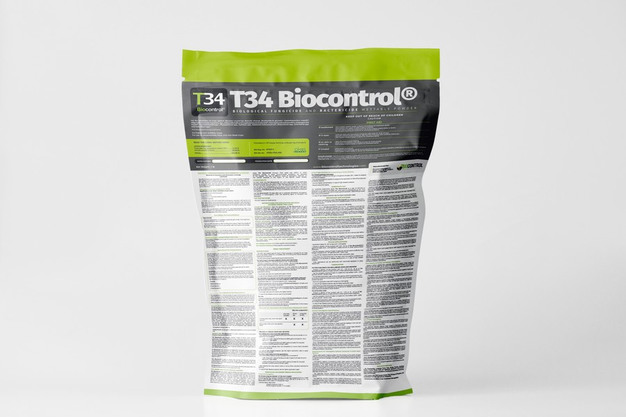
T. asperellum T34 is formulated as a wettable powder, allowing homogeneous dispersion in both irrigation and foliar applications.
Being registered as a plant protection product, it can be perfectly integrated into integrated pest management (IPM) strategies and used in organic farming. In fact, it holds several European certifications, such as Ecocert, OF&G, Skal, CAAE, and OMRI, confirming its suitability for sustainable production systems.
 © Biocontrol
"T34 is selective and safe for the environment, as it has no adverse effects on bees, beneficial fauna, earthworms, aquatic organisms, or birds. During the registration process, the necessary ecotoxicological studies were carried out, confirming this compatibility. Moreover, T34 does not affect other beneficial soil microorganisms such as mycorrhizae or nitrogen-fixing bacteria, which are classified as fertilizing products under Regulation (EU) 2019/1009 in categories PFC 6(A) biostimulants and CMC 7 microorganisms."
In integrated disease management programs, T34 can be combined with insecticides, herbicides, and other plant protection products. However, since it is a living fungus, its compatibility with chemical fungicides should be managed carefully. A safety interval between applications is generally recommended. "In particular, it is not compatible with fungicides from the benzimidazole or triazole families, as these molecules eliminate T34. With other chemical fungicides, compatibility is partial: they do not kill it but may reduce its growth and effectiveness."
 © Biocontrol
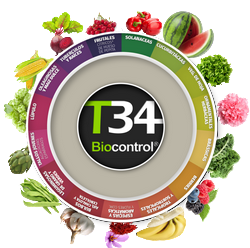
"As for other agricultural products, the use of T34 is generally compatible with natural extracts and vegetable oils, as well as mineral fertilizers, provided that pH and salinity are controlled. It can also be used with other biological control agents."
"However, when it comes to microbial biostimulants not covered by the European Fertilizer Regulation (2019), and due to the lack of defined species and strains used in those formulations, we do not recommend combining them. This could be not only counterproductive but also unnecessary."
"For updated information on compatibilities and application programs, we recommend contacting our distributors or visiting our website at www.biocontroltechnologies.com."
Authorization and safety: an ecological solution with no residue limits
"As mentioned, and based on our authorizations, T. asperellum T34 is a safe and fully approved active substance for use in organic agriculture. In addition, unlike many chemical molecules, it causes no phytotoxicity. Several studies have statistically demonstrated that T34 promotes crop growth and productivity, for example in potatoes and strawberries."
 © Biocontrol
The active substance T. asperellum T34 was officially approved under Regulation (EC) 1107/2009 with number 1238/2012 (Official Journal of the European Union, 20.12.2012, L350/59) and has been marketed in Europe as a plant protection product since June 1, 2013.
Previously, in 2011 and 2012, the same active substance was authorized in the United States and Canada, strengthening its international recognition.
Furthermore, T34 is listed in Annex IV of Regulation (EU) No 396/2005 (Official Journal of the European Union, 12.06.2015, L147/3), which includes substances exempt from establishing a Maximum Residue Limit (MRL).
"This means that T34 leaves no residues in fruits, soil, or plants. In the United States, it is likewise considered residue-exempt."
Contributors to this interview:
- Dr. Maria Isabel Trillas i Gay, founding partner of Biocontrol Technologies and discoverer of the T34 strain of T. asperellum. Professor Emeritus at the University of Barcelona, in the Plant Physiology section of the Faculty of Biology. Scientific Director of the UB - Biocontrol Technologies Chair of Microorganisms for Agriculture.
- Dr. Guillem Segarra i Braunstein, Lecturer (Serra Húnter Programme) of the Plant Physiology Section of the University of Barcelona. Deputy Director of the UB - Biocontrol Technologies Chair of Microorganisms for Agriculture.
- Mr. Jordi Fumadó i Llambrich, Sales Coordinator of Biocontrol Technologies.
- Mr. EduardFernando i Martínez, General Manager of Biocontrol Technologies.
 For further information:
Biocontrol Technologies
Av. Madrid 215-217
08014 Barcelona (Spain)
Tel.: +34 934 09 18 48
[email protected]
https://biocontroltechnologies.com/