What do the Talking Heads and Cathy Burns, CEO of the International Fresh Produce Association have in common? "Same as it ever was," was concluded by both.
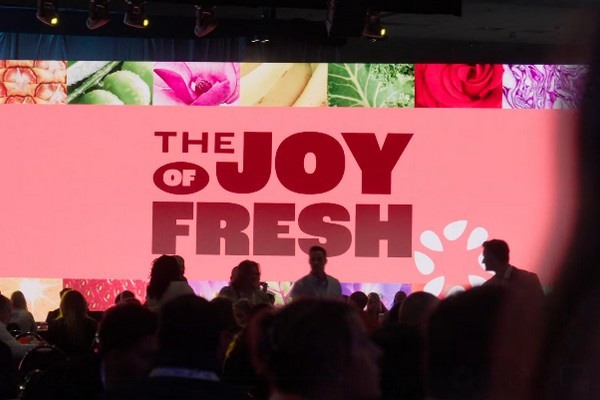
Only the latter used that sentiment as she opened her State of the Industry address at the start of this week's Global Produce & Floral Show held in Anaheim, CA.
"It's always great to come together when we've had our fair share of tailwinds and headwinds," Burns noted. She reflected on rereading remarks from two years ago when the show was last in Anaheim and key industry concerns at that time were: geopolitical risks, inflation in the economy, trade, extreme climate events, and introduction of AI. Indeed, the same as it ever was.
Burns took the audience through several key topics of interest for the industry and shared with the audience how the association continued to "Fight for fresh" in its advocacy efforts. "We're here to bring clarity to the confusion and context to the craziness," she said.
 © IFPA
Cathy Burns
Tariffs and the impact on global trade
Tariffs have been the biggest issue facing the industry this year and contending with their impact on global trade. "We believe in science-based trade policies and transparent rules-based trading systems," said Burns, adding that following this year's implementation of U.S. tariffs on products from around the world, the organization advocated for exemptions for all fresh produce and floral products, in particular, USMCA. "We encouraged the U.S. administration and trading partners to create deals to remove country-specific tariffs. We also expanded support, connections and market intelligence in other priority markets," she said.
This year the industry has seen an AI-driven Geoeconomic Monitor developed by scientists at Stanford University which illustrates business implications on the effects of tariffs, sanctions and controls–such as the fact that 40 percent of global organizations indicate that just the threat of future tariffs is already negatively impacting their operations.
At the same time, Deloitte found that reducing at-home food waste, and buying only essentials or buying smaller sizes are how consumers are contending with stronger food prices. "The good news is that fresh fruits and vegetables are the least likely item for consumers to give up, with only five percent reducing purchases," added Burns.
Supply chain pressures
"This year's crop is one, if not for many, the most expensive crop ever planted, harvested, shipped and sold," said Burns, adding that the IFPA launched the Supply Chain of the Future initiative to help deal with increasing costs by bringing together members of the supply chain to identify key challenges and co-create solutions to reduce costs and improve efficiency
Labor challenges continue
"Access to farm labor has been a contentious issue for decades. This year, the pressures have been enormous," said Burns, noting that the challenges included aggressive worksite enforcement that affected agriculture organizations across the U.S. The organization collaborated with the U.S. Department of Homeland Security and United States Immigration and Customs Enforcement (ICE) to secure clarity on enforcement–namely, not going on farms unless there's an active warrant.
 © IFPA
Other labor-related initiatives this year included the IFPA winning the lawsuit filed late last year against the Department of Labor's finalized H-2A rule, and advising the Department of Labor to create a position solely dedicated to farm labor and develop a less burdensome Adverse Effect Wage Rate (AEWR). "This resulted in the most significant financial shift for growers ever in H2A," said Burns.
Meanwhile she touched on labor and innovation and mechanization–such as the possibility of employees using wearable tech such as exoskeletons to reduce the physical impact of field work, or flower vending machines that are being used in Qatar.
Talent, trust and AI
On the topic of labor, when it comes to developing newer generations of those working in the produce industry, it's hard to avoid the topic of artificial intelligence. IFPA itself launched an AI-powered Global Intelligence Engine to provide sector specific ideas that are generated by IFPA data.
However, Burns pointed out that trust around AI varies in the workplace. As Deloitte reported, two-thirds of Gen Zs and Millennials worldwide said they will look for positions they believe are Generative AI-proof. At the same time, 60 percent also said that AI skills will be needed to move ahead in their careers.
Meanwhile, 75 percent of the next generation expect leadership to invest in developing other skills such as emotional intelligence, empathy and curiosity. "So be curious, not judgemental. We need to take the time to learn something new," encouraged Burns.
Sustainability, climate and food safety
All three topics are top of mind for the industry undoubtedly and Burns noted that inherently, fresh produce and floral are the most sustainable products on the planet. "The best thing we can do for our environment is to eat more fruits and vegetables and enjoy floral every day, full stop," she said.
Furthering sustainability initiatives in the industry also comes with the helping hand of tech. For instance, the IFPA's Foundation for Fresh Produce established a sustainable packing innovation lab which supports engineers developing or commercializing sustainable packaging.
Blending sustainability and technology is also producing some creative concepts. "Technology is also playing a critical role in sustainability and production innovation. Controlled Environment Agriculture continues to see growth as some growers introduce CEA into their production systems to build resiliency in the supply chain," said Burns, adding that some other sustainable initiatives around the world include inflatable farms, ferris wheel-like growing structures, employing AI to automate soil analysis to create a climate-resistant food system and digital twins.
Undoubtedly sustainability is tied to economics. "Studies show climate change could cost the global economy $190 trillion between 2050 and 2070 but if we use climate actions to keep global warming from exceeding 2 degrees Celsius and use innovation to feed the world more sustainably, if these two things happen, we could see a growth of the global economy of $121 trillion by 2070," said Burns.
Climate is also tied with food safety threats–researchers found that warmer temperatures and increased humidity will actually raise the risk of pathogens. "We believe that food safety is a shared responsibility across the supply chain and that regulations should be clear, scientifically rigorous and not overly burdensome to our industry," said Burns.
Produce and its role in health
"We believe bold, scalable policies are necessary to drive an increase in produce consumption and advance public health," said Burns.
While the organization has long advocated for produce as prescriptions for health, Burns also noted that with consumers continually growing interested in their own health, this leaves fresh produce well positioned. With this in mind, this past year the IFPA appointed a chief medical officer to guide worldwide outreach.
The organization has also contributed to the Make America Healthy Again (MAHA) Commission in providing policy recommendations that influenced the second commission report and more.
Finally, on the topic of health, Burns touched on another consumer trend that is providing produce an assist. "GLP1s have provided a lift in our sales," said Burns, noting that Eat Well Global found that 67 percent of GLP-1 users turn to fruits and vegetables and move away from ready-to-eat meals.
 For more information:
Ashley Sempowski
International Fresh Produce Association
[email protected]
https://www.freshproduce.com/